My Spoon Theory

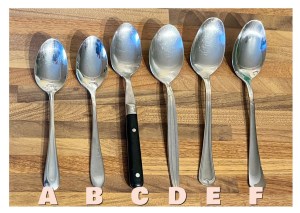
A row of six breakfast or dessert spoons, all slightly different sizes and with different handle styles, labelled A-F from left to right.

In case you missed it, there has been quite a discussion in the autistic community this week around an article Why I no longer think autism is a spectrum, in the TES, by Uta Frith. In her article, the author of the 1989 book, Autism: Explaining the Enigma, claims that the definition of autism has become too broad, there is no such thing as masking, and if you were not diagnosed as autistic by the age of five, the label does not apply to you.

This is a relatively lighthearted blog, so I will not be repeating here some of the comments I have made in response, on various posts and forums. Needless to say, I think a non-autistic person writing something like this in a publication aimed at teachers, in a time when the UK government is trying to reduce legal protections for SEND children in education, is beyond dangerous.

Deep breath.

Anyway, what I’d like to say here is that there is much more that unites us than divides us.

If you’re not entitled to the autistic label unless you’re also high-need and possibly cognitively challenged (and who doesn’t want a label that comes with so much judgement and misinformation 🙄), then why do so many of us feel such a sense of belonging to a tribe when we discover other neurodivergent people? Particularly for adult women, who according to Frith are just ‘hypersensitive’. 😬

Interestingly, my journey to diagnosis started with HSP (Highly Sensitive Person 🙄) which I personally think only came about as a label because the medical diagnosis model for autism wasn’t designed for us, but for boys.

(If you do want a great discussion on this, read Leanne Maskell’s International Women’s Day LinkedIn post here.)

Anyway. 😂 I will get to the point. It’s all about being autistic and spoon theory. Not the energy management meaning coined by Christine Miserandino, but actual spoons.

You quite often see the post go round social media, showing a picture of spoons (or forks) asking which is the only one you would use. You only have to look at the strength of the responses to know how important the right cutlery (or plate/cup/bowl) is to an autistic person with a sensory profile.

I have a hierarchy of cutlery, mugs and bowls, and I will go out of my way to select the top of that hierarchy for my first cup of tea in the morning or for my breakfast, because it sets me off for the day with a lower sensory overload.

When I make breakfast for my kids or husband, I select the right bowl and spoon, and on the rare times we manage a holiday, at least one bowl and spoon will come with us. Incidentally, I am spoon B, my daughter a C or E and son/husband are both D or E.

Okay, so allistic people probably also have a preference. But do they die on that hill? Can they eat with a different implement without distress? Does it make their mouth feel weird just looking at the wrong spoon? Would they eat toast (or nothing) rather than use poor spoon F (which I would argue is a tablespoon, despite coming in a set!)

Before anyone gets offended, I know that being autistic isn’t just about sensory reactions to metal utensils. But when I attended the Autistic Awareness four-week course run by Problem Shared, post diagnosis, I was on a webinar with 50+ newly-diagnosed adults. Often parents who only realised they might be autistic when they fought for their children to get diagnosed. Or peri and post-menopausal women, for whom the mask fell off when the hormones did a flip.

A wide array of humans who spent four sessions going, oh goodness I thought that was just me, I was just weird or wrong or broken. Who found a tribe.

(Menopause is a great parallel, actually. We all experience it differently. The advice often comes from male medical professionals with no lived experience, and it’s often fucking hard. But we’re talking about it more. That doesn’t mean women didn’t suffer before, they were just dismissed as hypersensitive).

Finding out I was autistic – that I wasn’t broken just because I could only eat with a favourite spoon – was life altering.

Life saving even.

And I won’t let anyone tell me otherwise.

Claim your favourite spoon in the comments ❤️🥄
Spoon Theory

So, it’s been a couple of months since I went back to work and, I’ll be honest, it’s a struggle. I’m definitely in the ‘not waving but drowning’ phase.

Don’t get me wrong, I love the work. It’s frustrating and bitty and annoying, but it feels so good to be using my brain again. I feel like a part of the world; I feel useful.

But, oh my days, am I out of spoons. If ever I wanted to explain spoon theory, now’s the time. So, here goes.

Spoon theory was coined by Christine Miserandino as a way to describe units of mental or physical energy. For Christine, who had lupus, it was physical energy, but I have always heard it in context of the mental energy associated with neurodivergence. And that’s what I’ll describe here. This is purely from my own experience of my neurodivergent family.

When I say that a spoon is a unit of physical or mental energy, I mean it’s what’s required to do those tasks that aren’t done automatically. You probably don’t need a spoon to go for a wee, unless of course you do. It’s hard to define because it’s different for everyone. I see it as any task that needs that extra push. Think of it like a car using fuel – you use more at 20mph than you do idling, and you use a lot more at 80mph. But it varies by car. And some cars have bigger fuel tanks. 

Each of my family members has an invisible illness – anxiety, ADHD, ASD, depression. They’re not all diagnosed, but they’re all there, especially for me. My job for the last decade or so has been to dish out spoons to keep the family functioning. When the children were little, it wasn’t so obvious that that was what I was doing. Nurturing, providing for their needs, is natural when they’re five. It isn’t until they’re ten or more and you’re still doing it that you realise there might be something more.

Let’s take a normal school day morning. My son can get up without prompting, he makes his own breakfast. But there it gets tricky. He needs reminding to get dressed on time, he needs a nudge to brush his teeth. He needs help finding the right clothes for whether it’s PE or not, or if I haven’t put the laundry away. He’ll need to be told to pack his homework – several times – and to fill his water bottle. I’ll pack his lunch and make sure his shoes are clean and where he can find them. We’ll find his coat and make sure he has his phone. Now, let’s list that:

  • Find right clothes
  • Get dressed
  • Brush teeth
  • Pack homework
  • Fill water bottle
  • Get lunch
  • Find shoes
  • Find coat
  • Find phone 
  • Track the time

These are all tasks that require a bit of extra mental energy to make sure they happen, especially to make sure they happen in time to leave the house at 8.15am. So, each one of these is a spoon. Ten spoons, and we haven’t even started the day.

Then I make sure my daughter is awake, is mentally able to go to school, has breakfast if she wants it (three spoons), I make sure my husband has eaten breakfast, because he won’t without a nudge, and then his day is harder (spoon). Then I need to make sure I’m fed, dressed, brushed my teeth, fed the dogs, fed the hamster, walked the dogs, (six spoons) maybe put the dishwasher on because none of us managed it the night before. Sign my daughter’s diary, or check school emails, maybe it’s World Book Day or my daughter needs a new notebook or can’t find a glue stick. All spoons.

Before I went back to work, that would be it for the morning, more or less. After the school run (which my husband now does, so that’s a couple of spoons gone for him), I would have until 3pm to get my mind straight. Catch up on tasks that hadn’t been done. Rest. Do something creative. Often sleep. Basically, top up my dopamine levels (ADHD), although I didn’t realise that’s what I was doing.

Then I would do the afternoon school run (also now my husband’s responsibility), which would require working out where my son wanted picking up from. Then home. To another few hours of dishing out spoons. Different meals for each neurodivergent person. Different after school activities. Mental exhaustion to soothe from the three who had been out in the world. More dog feeding and walking, more chores. Asleep by 9pm at the latest. 

And now? Now I do most of that still, but between 9am and 5pm I have a job. A complex one, with lots of stakeholders, lots of deadlines and remembering things and keeping track of things. I have three different to-do lists on my desk. And still, I carry a lot around in my head, to make sure I don’t miss anything important. So. Many. Spoons. And because I need extra support to make sure I remember all the steps in a process, I have process-mapped a lot of my tasks. I had a call from the Project team yesterday, saying my process maps were great, and could I add them as a project. It’s easy, here are a couple of forms. Another task, another stakeholder. More spoons.

There’s this view that I’m organised. It makes me laugh. I’ve heard it before, and I used to let people believe it, and then work oh so hard to keep up the pretence. I’m not organised. I have ADHD. My brain is like someone emptied out the scrabble bag and now I’m trying to read it like a book. I have process maps and to-do lists and printed out plans because I’m NOT organised. It’s scaffolding. The same scaffolding that I put around my children so that they can seem ‘fine’ in school (hint: they’re not). I’m lucky that I work somewhere that I can say ‘I have ADHD’ and their response is ‘how can I help?’ Unfortunately, I don’t have an answer to that question.

The scary part? I’m only doing about half of the work I will need to be doing in a few months. If I’m still there in a few months. I am so tired. I’m asleep by 7pm. But it’s not restful sleep, because my brain is still trying to create order out of the chaos. I’m eating non-stop, constantly searching for dopamine because I’m too tired to exercise. And exercise takes spoons to start, even if it replenishes once it’s done.

This is not a whinge. I am so lucky. My husband and children have really stepped up to fill the gaps in what I used to be able to do. But I’m tired of eating takeaway. I’m tired of an even more chaotic house. I’m tired of once more having a constantly full laundry basket and a constantly messy kitchen. 

I used to wonder if there was something wrong with me, that I couldn’t work and run a house. I didn’t have the skills, maybe, or I was lazy, or I just needed to try harder, or make my family do more, or hire a cleaner. (We’ve been through three cleaners. Too many spoons.)

It turns out there is something, not wrong, but different about me. And now I must decide what’s more important – having a job, an identity, a chance to use my skills, feeling alive and part of the world, but having my home life a stressful chaotic mess. Or having enough spoons to have a happy home, but not use my brain. It appears I may not be able to do both.