Tree Therapy

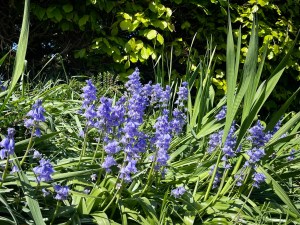
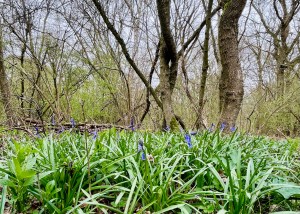
Woodland with bluebells in the foreground

It’s been quite an eventful couple of weeks.

A fortnight ago I was readying myself to start a new job, with an air ambulance charity. Then, at midday three days before my start date, I got a call to say the role was no longer available. Apparently internal reprioritisation, but I suspect an illegal war and rising oil prices creates financial issues for a charity running a helicopter four times a day.

Such is life.

I wasn’t heartbroken about losing that particular role, which is interesting, but it was a kicker to be job hunting again. Two weeks later and I’ve had a couple of interviews and am prepping for a third.

It’s exhausting.

But this isn’t another post about the extra energy it takes AuDHDers to get through an interview, due to second guessing social cues, overcoming imposter syndrome and the need to be accurate rather than selling themselves, trying to maintain eye contact, and feeling like competency questions are a trap for the unwary.

It’s actually a post about finding inspiration away from the laptop.

Earlier this week I was researching for an interview I really wanted to go well, for a conservation charity I’ve applied to many times. (I interviewed with them last year and made a complete hash of it.)

Stressed isn’t a strong enough word.

Anyway, as I started to unravel, I took myself off to a nearby nature reserve, braving the mud and 25mph winds to walk the dogs. To remind myself what all the effort was for.

It was perfect.

Yes muddy, yes blowing a hoolie, and yes I got lost. Again. In a 25 hectare wood. Hush.

It’s a small but mighty Wildlife Trust reserve, ancient woodland, a tiny remnant of Rockingham Forest, filled with bird song and the promise of spring.

And it inspired a poem.

Now I haven’t written poetry in over a decade. So it’s probably not great. But it felt good to be inspired (with a little assistance from the Merlin app to identify the bird calls)

Anyway, here it is.

The ocean wood

A-tin a-tin a-tin calls the great tit to the wheaking nuthatch.

Deep in the shadows, coal tits chatter in dolphin as, around and above, the wind is a roaring crashing sea.

Blue tits flit from leaf to new leaf, caught on the current.

A pod of clouds races past, cut through by the fin of a kite. Red gives a sailor’s whistle, and swirls higher than the crow’s nest.

Living wood creaks as wind fills her unfurling green sails.

Beneath the waves, shoals of purple sweet violet and yellow celandine dance in the darkness.

Chu-cha, chu-cha; the chiffchaff sounds out the steady turn of a windlass.

Anchor aweigh and hang on. 

Ride the swell of sound, wind rushing, roaring, surfing the crests of the trees and out across the sandy swathes of elephant grass undulating sand dunes to the shore.

My Spoon Theory

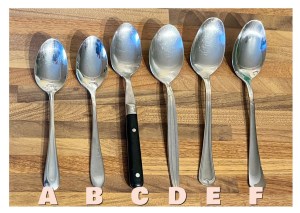
A row of six breakfast or dessert spoons, all slightly different sizes and with different handle styles, labelled A-F from left to right.

In case you missed it, there has been quite a discussion in the autistic community this week around an article Why I no longer think autism is a spectrum, in the TES, by Uta Frith. In her article, the author of the 1989 book, Autism: Explaining the Enigma, claims that the definition of autism has become too broad, there is no such thing as masking, and if you were not diagnosed as autistic by the age of five, the label does not apply to you.

This is a relatively lighthearted blog, so I will not be repeating here some of the comments I have made in response, on various posts and forums. Needless to say, I think a non-autistic person writing something like this in a publication aimed at teachers, in a time when the UK government is trying to reduce legal protections for SEND children in education, is beyond dangerous.

Deep breath.

Anyway, what I’d like to say here is that there is much more that unites us than divides us.

If you’re not entitled to the autistic label unless you’re also high-need and possibly cognitively challenged (and who doesn’t want a label that comes with so much judgement and misinformation 🙄), then why do so many of us feel such a sense of belonging to a tribe when we discover other neurodivergent people? Particularly for adult women, who according to Frith are just ‘hypersensitive’. 😬

Interestingly, my journey to diagnosis started with HSP (Highly Sensitive Person 🙄) which I personally think only came about as a label because the medical diagnosis model for autism wasn’t designed for us, but for boys.

(If you do want a great discussion on this, read Leanne Maskell’s International Women’s Day LinkedIn post here.)

Anyway. 😂 I will get to the point. It’s all about being autistic and spoon theory. Not the energy management meaning coined by Christine Miserandino, but actual spoons.

You quite often see the post go round social media, showing a picture of spoons (or forks) asking which is the only one you would use. You only have to look at the strength of the responses to know how important the right cutlery (or plate/cup/bowl) is to an autistic person with a sensory profile.

I have a hierarchy of cutlery, mugs and bowls, and I will go out of my way to select the top of that hierarchy for my first cup of tea in the morning or for my breakfast, because it sets me off for the day with a lower sensory overload.

When I make breakfast for my kids or husband, I select the right bowl and spoon, and on the rare times we manage a holiday, at least one bowl and spoon will come with us. Incidentally, I am spoon B, my daughter a C or E and son/husband are both D or E.

Okay, so allistic people probably also have a preference. But do they die on that hill? Can they eat with a different implement without distress? Does it make their mouth feel weird just looking at the wrong spoon? Would they eat toast (or nothing) rather than use poor spoon F (which I would argue is a tablespoon, despite coming in a set!)

Before anyone gets offended, I know that being autistic isn’t just about sensory reactions to metal utensils. But when I attended the Autistic Awareness four-week course run by Problem Shared, post diagnosis, I was on a webinar with 50+ newly-diagnosed adults. Often parents who only realised they might be autistic when they fought for their children to get diagnosed. Or peri and post-menopausal women, for whom the mask fell off when the hormones did a flip.

A wide array of humans who spent four sessions going, oh goodness I thought that was just me, I was just weird or wrong or broken. Who found a tribe.

(Menopause is a great parallel, actually. We all experience it differently. The advice often comes from male medical professionals with no lived experience, and it’s often fucking hard. But we’re talking about it more. That doesn’t mean women didn’t suffer before, they were just dismissed as hypersensitive).

Finding out I was autistic – that I wasn’t broken just because I could only eat with a favourite spoon – was life altering.

Life saving even.

And I won’t let anyone tell me otherwise.

Claim your favourite spoon in the comments ❤️🥄

Island of Helpers

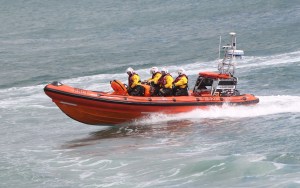
RNLI boat at sea. Image by PBarlowArt Pixabay

So, I have another job interview next week. Another organisation to deep dive in a few days, so I don’t go to pieces in the moment.

(Spoiler: I will go to pieces, I hate interviews. They are an ND nightmare.)

The difference is, I understand this organisation, this role. And, amazingly, they have a robust marketing department already (Unlike most roles advertised at present, that want you to be twenty people for a smidge above minimum wage.)

(Ooh I could write posts upon posts just from these parentheses.)

Anyway, dragging it back to the point…

As I have been researching the charity, and learning where medical emergency response sits on a donor’s emotional spectrum, my AI threw up this line:

Humans are wired to value help given with no expectation of return.

This made me pause. Are we? Are we? Then it said humans are driven by the idea that:

Someone I will never meet helped someone they didn’t know.

And then it made sense. In times of trouble, when it all feels overwhelming, the advice is to look for the helpers.

We love reels of ordinary people rescuing dogs from frozen lakes, catching babies from balconies, talking down a suicidal stranger. We honour the person who challenges the knife-wielder or who shields someone they don’t know, at risk to themselves.

We want to be that person, or to know that – when it matters most – someone like that will come to our aid. And the chances are they will.

We allow our politicians to talk of an island of strangers, to worry us about immigration or people on benefits or just people who are different. We allow our journalists to foster hate because it sells newspapers.

But when faced with immediate need, I believe the majority of us would help. And if we were in need, we would hope that someone would come. And I doubt we’d care too much if the person who saved our dog, our child, ourselves looked like us or not.

And if we really are becoming an island of strangers, I believe it’s because the infrastructure of society is being eroded: high streets lost to supermarkets, schools breaking trust with parents, doctor visits becoming sought-after transactional moments, till staff replaced by machines. We can’t value our neighbours if we never actually speak to them.

We learned to isolate during Covid, now we need to be taught how to mingle again. To form connections, to talk to strangers and realise they’re just like us.

Incidentally, if you want to see this most eloquently presented by Ian McKellen, in the words of Shakespeare, Watch this Video

In a world being damaged by exploitation and excessive profit and divisive language, I truly hope we still value ‘help given with no expectation of return.’

More Than My CV

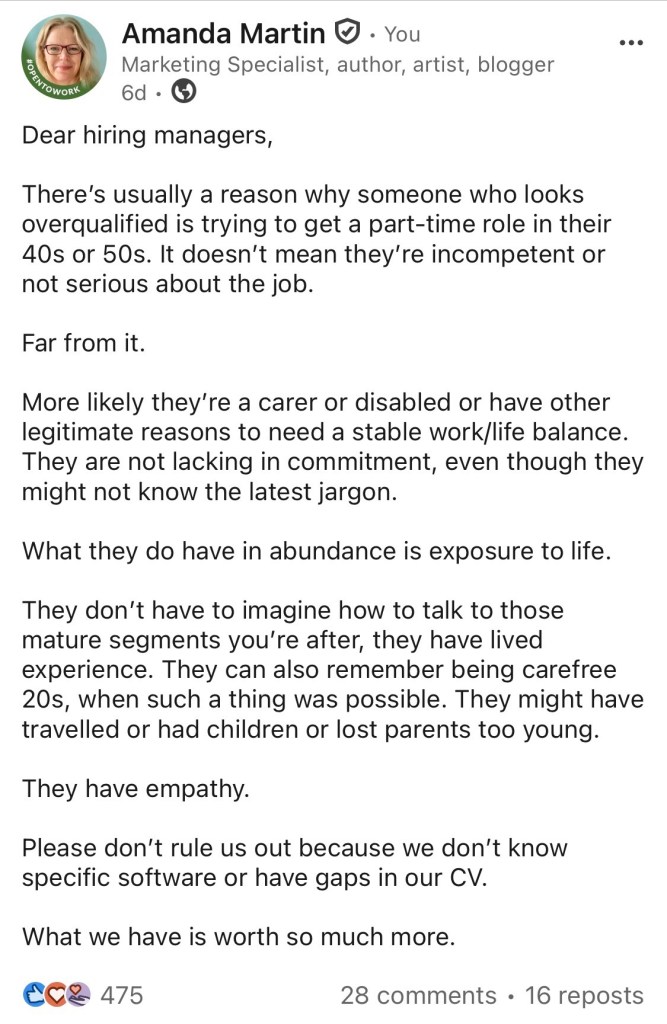
This week marks 6 months of job hunting:

  • 50+ tailored applications and probably the same again in Easy Apply
  • 8-10 HR screen calls & interviews
  • Half a dozen presentations and interview tasks
  • 1 explanation of rejection

I’m in discussions with the job centre about getting IDM qualifications to fill gaps I might have, since marketing roles seem to be increasingly about specific experience rather than transferable skills (one job ad required 2+ years experience in a niche industry). But when my liaison asks ‘will this training get you a job’ how do I answer?

Without an explanation of rejection how do I know what needs addressing?

I had a 3-hour on-site second interview last week and the email (not phone call) I got two says later said “After careful consideration, we regret to inform you that on this occasion your application has been unsuccessful.”

I actually know why. Three hours is plenty long enough to know you’re not the right fit, but still, a bit of constructive feedback wouldn’t hurt.

I wrote the above on LinkedIn this week, in a fit of despondency that I’m no longer qualified to do my job because the requirements have shifted. Then, as I was folding laundry, I got to thinking about all the things I can do and have done. And posted the following…

Things I have done in previous jobs/life that I wish I could add to my CV:

  • I got a distinction for the final-year dissertation I wrote in ten weeks (of 10-hour days) on Russian History
  • While running an event during my first job out of uni, the CEO of GUS, Lord Wolfson, said ‘Ah, there’s always an Amanda behind the scenes’
  • I helped design, build, and train contact centre staff on how to use a phone-based gift finding service. In 1999
  • While helping run a hostel in NZ, I learned how to fold fitted sheets into neat squares
  • In the first month of a new marketing planning exec role, I presented plans to the South African Board
  • I ran a solo exhibition for my abstract art, finding out I secured it while still in hospital after the birth of my child
  • While raising my ND kids, I wrote and self published 12 novels, getting two long-listed for awards, and illustrating two of the ones written for children
  • I audio-typed interviews for the Compassion in World Farming CEO’s book 60 Harvests Left, learning so much about conservation and soil
  • I edited, and designed the cover for the autobiography My Life in Colour: From Bali to Brighton and Back by entrepreneur Paula Harward
  • As an invigilator, I walked the hall listening for sniffers, rocking desks, and pen tappers and fixed accordingly, to help those around them
  • I learned how to make and edit social media videos in Photoshop because a supplier wanted one and there was no resource
  • In two roles, I compiled a 30+ page Campaign Manager’s handbook, so future recruits wouldn’t have to figure it all out from scratch
  • In two years, with the support I could offer after leaving a job I loved, my AuDHD, MADD, ARFID, self-harming teenager secured 5 GCSEs, including two 7s, and is now a full-time hairdressing apprentice

Do I know how to use Hootsuite or Google Ads? Not yet. Do I have the experience to relate to all your customers and tell their stories? Absolutely.

And then, as you do at 3am, I realised I’d missed off the biggest achievement that’s really kinda relevant to marketing.

This blog.

Particularly in 2013, when I not only blogged daily for a year, but also wrote and self published Two Hundred Steps Home. All 285,000 words of it. Maybe when my ADHD assessor snidely remarked on my ‘excessive, rapid, and tangential speech’ we both forgot that that is a Strength.

I’m not really sure of the reason for this post, except to say, if you think the world is moving on without you, focus on the can not can’t.

AI stealing your job? Your words trained AI, learn how to use it as a tool. Everything now automated and programmatic? Software still needs intelligent input. And Hootsuite can’t talk round a Brand manager who doesn’t like your ‘Cheep Cheep’ pun, or get a print manager to fast-track a job because you’ve built up a rapport.

If computers are stealing your job, be something they can’t be: be human.

Mild Aventure

Sometimes finding an adventure just means finding a new walk for the dogs.

Finding a little bit of extra energy in a day when you don’t feel like there’s anything left in the tank.

Sometimes the only way you can feel like you are having an adventure is to get lost in a place they call Short Wood, knowing that you have a satellite map in your pocket, and that despite having a terrible sense of direction, you have a pretty good chance of making it back to the car before dark.

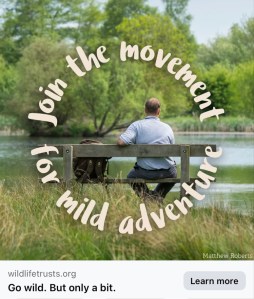
There’s a new advertising campaign for the Wildlife Trusts called Have a Mild Adventure, and it’s one of those campaigns I wish I had come up with. (“Go Wild. But only a bit.” Bravo 🤩)

I’m in a Wildlife Trusts wood right now, and I feel like I’m the only person here, although I did possibly just hear the rustle of a crisp packet, which might slightly spoil that illusion. As an aside, reading too many murder mystery books is not conducive to a relaxing walk!

I can hear Chiff Chaffs, which I’ve identified thanks to the Merlin app, and I can hear the usual suspects of pigeons and the occasional Red Kite, ubiquitous in our skies.

I can hear the wind through the trees, which is as close to the sound of the ocean I’m going to get here in the Midlands, about as far from the sea as it’s possible to live on this island.

And there is a sense of mindfulness, of calm, that I can only get while I’m physically moving.

And yes, I won’t really ever be lost, unless my phone battery dies, which is possible as I’m using it to audio-transcribe this post. And it wouldn’t be the first time I got lost in a wood that only covers a dozen hectares. (The last time being when I was supposed to be getting on a plane later that day, which was a little bit hairy.)

But I’ve been on this planet nearly 50 years, and it does feel a little bit like the last 20 have been lacking in wild adventure.

Certainly not the white water rapids (transcribed as rabbits, which is brilliant!) and climbing mountains sort.

But maybe Mild Adventure is enough.

Maybe sometimes it’s just taking that little bit of extra effort to walk the dogs somewhere new, to risk getting tired and lost and uncomfortable.

Maybe it’s okay to know that I’m only half an hour away from a cup of tea and a comfy chair.

Maybe that’s enough just now.

There may be more mountains ahead. My knees kinda hope there aren’t, but my brain is certain there will be.

There’ll certainly be more oceans, even if I have to drive there on weekends.

But for now, I’ll do a bit of tree bathing among the stinging nettles and the brambles and throw a stick for the dog.

And hope I don’t get too badly lost.

Etsy and Excuses

Picture shows a hotrod car parked on a gravel driveway
Daughter’s prom carriage

So, it’s been a while.

Yesterday’s post doesn’t count, it’s actually about a year old. I needed to add my blog to a job application, and realised half the photos were missing. Seems about right.

How to sum up the last 9 months? What’s the phrase, ‘There appears to have been a struggle’.

Menty Bs aplenty, not all of them mine. Lots I can’t discuss, lots I can’t remember.

Burnout. Brain fog. Bumpy roads.

Sounds like the title of a self help book, not that the world needs any more of those.

Things I can share:

I am Officially Autistic. As if we were in any doubt. 😂 But it’s affirming to know I’m not a crap horse, I’m a zebra.

Daughter sat some GCSEs and made it to prom. There was plenty of doubt that would happen, when we weren’t sure she had a school place for Year 11. I am indescribably proud, but also exhausted like I’ve been in labour for two years. We’re now at the start of a new – equally exhausting but also exciting and positive – chapter, as she starts her hairdresseing apprenticeship. Assuming we can find a college that doesn’t cancel its course and not tell us.

Just a wee bump in the road. 😂

I’ve started an Etsy shop. All those friends who told me to do it have finally won. I haven’t sold anything, so I’m running at a loss, but it looks pretty, and I have an excuse to paint and make videos for my Instagram page.

Expect to see posts of art and not many words for a month or two. All my words are going on cover letters and job applications at present.

Um. More positive news? My kids are mostly happy, we’re keeping pets and houseplants alive just about. I’ve taken up tame swimming (like wild swimming, but I pay to use a little lake, rather than risk E. coli in the local river!) I’ve read some great books. I’ll share a few.

That’s about it for now. Just checking in really. Waving not drowning.

How are you all?

Fancy a coffee?

Show Yourself

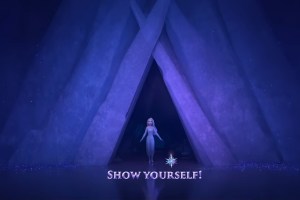
The image is a shot from the movie Frozen II, where Elsa enters the cave following the sound of the siren. It has the words 'Show Yourself!' and a snowflake beneath Elsa.

It’s no secret to anyone who knows me that I love a Disney movie. The stories are clear but still complex, the language accessible but not dumbed down. Relatable characters with flaws, and of course awesome belting songs. Not to mention a happy ending full of justice and redemption.

One of my favourite movies of more recent times is Frozen, particularly because the happy ending isn’t reliant on the girl being saved by a man. Even better, it cleverly turns the traditional story on its head with a twist that blew me away the first time I watched it.

Rather unusually, however, I preferred the sequel. If I relate to Let it Go, and really who doesn’t? (I even wrote a parent version), the song that hits me hard these days is Show Yourself. 

If you’re unfamiliar with the Frozen story, the main protagonist, Elsa, was born with a unique and frightening power, and ends up hurting her sister because her family don’t understand it and so can’t teach her how to control it. She is told to “conceal, don’t feel, don’t let it show”. When that mask slips, she becomes an outcast, and only her sister doesn’t give up on her.

In the second movie, Elsa is content surrounded by the few people who love and accept her, but she still feels different. She still feels she could be more. She is pulled by a voice, a sense of yearning, but is scared she’ll lose what she already has.

In the end, she has no choice but to follow the voice. And in the song Show Yourself, Elsa finds the source of the secret siren she has sought for answers.

I can sense you there, like a friend I’ve always known.

During the song, the spirit of her mother shows Elsa that she herself is the voice.

Show yourself, step into your power,

Grow yourself into something new.

You are the one you’ve been waiting for.

I’ll be honest, I get goosebumps every time I reach this part, although I only recently realised why. I feel like it’s my song, and the song for anyone who grew up feeling like they didn’t fit. Like they had more to give, if only they were given permission, if only it wasn’t so terrifying.

And the discovery that I am (probably) neurodivergent is that moment where I feel, “I am found”.

The more I learn about autism and ADHD, the more I understand these “cold secrets deep inside” me that are different and powerful and frightening, that make me different and often friendless, but that can be harnessed to create amazing things.

The message in the Frozen movies is that love is what is needed to control and harness the power.

However, friendships are hard for NDs to make and keep. Self confidence, self love, is even harder, when “Research has shown that children with ADHD have often received 20,000 more negative messages about their behaviour than a neurotypical child by age 12.” [Source]

It might take a lifetime, but I am going to follow the voice I hear now inside me that tells me that, while I might be different, I am not broken. I am ready to learn.

I am ready to grow myself into something new.

Just a cold

The picture shows an apricot coloured curly labradoodle dog asleep on a brown sofa

It’s just a cold, why are you making so much fuss? 

I think this every time anyone in my family is ill. And then I’m ill, and I remember this is a neurotypical view of the world.

When you’re ruled by sensory difficulties, executive dysfunction, rejection sensitivity dysphoria (RSD), it’s never just a cold.

Your body stops bodying properly. It feels wrong. There’s new pain to process and you’re hyper aware of it. You can’t control it or make it stop. You’re aware of the discomfort of dry lips, weird papery skin, pressure of blocked sinuses, achy fidgety limbs, torture headaches, hot then cold then hot (which actually you’re used to because your temperature regulation wasn’t all that great to start with). Your brain loops on a single lyric or you have lurid dreams until you don’t know if you’re more miserable awake or asleep. You’re maybe thirsty but your body cues have never been obvious and then you chug a litre in one go and feel sick but too tired to pee.

But it’s just a cold. And why are you always ill, you had a cold just last month?

You’re more prone to colds because ARFID means your diet is poor and vitamins only do so much. And you forgot to drink any water yesterday, and caffeine helps you control your ADHD.

Anxiety makes it harder to leave the house and get fresh air, and you’re on the edge of burnout so often that exercise can use the last bit of resilience and actually let the germs take over.

I’ve lost count of the times a new determination to exercise more has ended with a temperature and days in bed.

It’s just a cold, why are you so grumpy, get over it.

You’re all out of spoons and sensitive to your triggers. That’s noise for me, so things like husband snoring or dogs licking become physically painful until I have my fingers in my ears and I’m screaming at the dogs for grooming themselves (not proud of that). So I try to control the noise, but I can’t, so that increases my anxiety until I’m almost hysterical. Which funnily enough doesn’t do much for the headache.

Guilt is rife because if I’m finally taking to my bed it’s because I have nothing. But chances are I’m not the only one ill, so everything falls apart and certainly no one has spoons to check I have water or am taking my meds. Which makes me sad. Then guilty. Then mum mode kicks in and I have to go take care of them, which adds another day to me shifting the darn cold.

For my son, on top of the sensory horror is the loss of routine. His day is controlled by alarms, when to shower, eat, work out etc. A day of ill disrupts all of that. 

My daughter’s is food. Eating is hard, drinking water harder. Feeling poorly makes it harder to do both, so hangry turns up followed by guilt and self blame.

It’s just a cold, you’ll feel better tomorrow, quit moaning.

When you live in a world of now and not-now, it’s hard to think past the headache and inability to breathe and imagine a time you ever didn’t feel this way. It becomes easy to catastrophise, to want to end the misery. Your brain, part of it, tells you to get a grip, but your whole nervous system is fighting you telling you it’s too much to deal with right now.

Then you’re missing commitments, school, work, life, so the RSD pops up and tells you you’re letting everyone down and they all hate you and you’re a pathetic human being because everyone says it’s just a cold. You should just get up and get on. So you do, and the cold lingers, and comes back, and so it all begins again.

Are you ill again? I never get colds, what’s wrong with you?

But it’s just a cold. Right?

Call of the Nightbirde

The picture is in sepia and shows Nightbirde, a young woman with short hair, standing at a microphone as if about to sing, with the words "You can't wait until life isn't hard anymore before you decide to be happy."

I’m often late to the party when it comes to seeing things on social media. My children laugh that by the time it’s reached Facebook it’s about two years out of date.

I don’t mind.

I get to love the thing without the hype and know it for what it is. I get to quietly search out the story and be moved by it, changed by it.

And so I found Nightbirde.

This video appeared in a post on LinkedIn, which is surely last to the party. A video of a girl winning a golden buzzer on America’s Got Talent. A girl with a beautiful smile, a heartbreaking story, a powerful message.

You can’t wait until life isn’t hard anymore before you decide to be happy.

The emotion in her singing and her story and her smile healed my heart. Life is so hard at the moment but still filled with glimmers of joy if I just search for them.

We’re all a little lost and it’s alright.

From the video I found her instagram and then her website. I found her beautiful songs and profound words. I found her on Spotify.

I found the lyrics to Brave

And I swear that I’ll never make you small
I’ll never make you say you’re sorry for nothing at all.

I found profound lyrical heart wrenching posts on Facebook

It was early spring and the flowers were opening one eye to see if the winter was over. We stopped at a lookout hundreds of feet above the water. The sun was waist-deep in the ocean, and all the chalk had been wiped off the sky.

I found she died in February 2022 but was more alive than most and lives on still.

The dirt intended to bury me is now the mountain I stand on.

In her words I found peace.

I will decide to be happy.

Caution: Builder at Work

The picture shows the side of a house with scaffolding around the chimney

I’m on week four of my new job and just about hanging in there, juggling parenting and working.

Thankfully having teenagers in the summer holidays is mostly about making sure there is lots and lots and lots of food and driving them places. Throw in a bit of laundry, cleaning, and some body-doubling for my daughter, and that’s it. It will be more challenging when they go back to school, as they will need a lot more scaffolding.

If you haven’t come across the term scaffolding in a neurodivergent sense, it’s simplifying tasks other people find very easy, to free up spoons for the essential or more difficult tasks.

When I went to see my son’s head of year to talk about reducing his timetable, I was given a long list of all the reasons why he was thriving at school and didn’t need any accommodations: He turned up to class on time, he had all of the things he needed to learn, he remembered all the ingredients for his food tech, he was always smartly dressed. These are all things that I put scaffolding in place for, to allow him the spoons to get through the day.

He still comes home exhausted.

For an average teenager, I would be encouraging them to weigh out and label their own food tech ingredients, make sure they have ironed shirts or that their laundry has been done. I would tell them to find and polish their own shoes or put together their own PE kit. This would be ‘preparing them for adulthood’. 

But the thing is, my son already knows how to do it all, but each tiny task takes spoons.

He also has his own scaffolding: multiple alarms to remind him to get up, shower, brush his teeth, and other things an allistic person might not even have to think about never mind be reminded to do. By the time he leaves for school, he’s used up so much of his capacity already, the least I can do is help. 

Unlike the scaffolding on a building, this scaffolding may never come down. He may end up with an understanding partner, or he may need a housekeeper, or like me he might rely on AI (Alexa, Siri, and ChatGPT are my team.) These are accommodations for an autistic person in an allistic world. 

The same is true in my new job. I have a reputation for being very organised, which always makes me laugh as someone with ADHD. What people don’t realise, but I’ve become much more open in discussing, is that the organisation is essential for me to have any idea of what I’m supposed to be doing on an hourly or daily basis. 

I have links from spreadsheet to spreadsheet, I have bookmarks in sub-folders in folders. I have to-do lists and checklists and calendar reminders and even with all these things I still have to go through my notes every day to remember what I should be doing.

It is exhausting.

Like my son at the end of a school day, I have been crawling into bed early and sleeping late.

The analogy of the swan, calm on the surface and furiously paddling underneath, is a flippant image I use often. But imagine the swan is on an apparently slow-moving river with a very fast undertow: you would have no idea how exhausted the swan was just trying to stay in one place. Now imagine someone built a dam or a jetty to break the undertow. 

In case it helps, here are my favourite tech/AI scaffolding tips:

  • Alexa shopping list
  • Alexa devices in every room
  • Calendar reminder to check Echo app shopping list
  • Alexa timers and reminders (particularly cooking pasta!)
  • Talking work problems through with ChatGPT
  • Smart watch linked to phone so I hear calls
  • Airpods to hear messages
  • Tile to find my phone when watch tells me it’s ringing
  • Alexa to find my keys to activate my tile

It’s so much easier for my husband, he just has Wife™. 😂

What scaffolding do you use?