Blogging: The Art of Listening

A potentially life-changing book

A potentially life-changing book

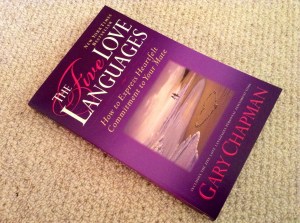
I started reading a (for me) life-changing book, yesterday, which I wish I’d read years ago, called The Five Love Languages by Gary Chapman. I haven’t finished reading it, so I won’t write too much about it here, but the basic premise is that we all speak one of five love languages and for us to maintain healthy relationships (be it parenting or marriage) we have to understand the other person’s language and learn to speak it.

The languages are Words of Affirmation, Quality Time, Receiving Gifts, Acts of Service and Physical Touch. (If you want to learn more before I finish reading the book, visit www.fivelovelanguages.com).

Rather like Valerie Alexander’s Happiness as a Second Language, it teaches hope, as it reassures that we can all learn these unknown languages, whatever our upbringing. I grew up in a house where happiness wasn’t really spoken and, equally, love wasn’t an open dialogue either. I’m slowly learning to speak these foreign tongues, and having phrasebooks is essential.

The part of the book that sparked today’s blog post came during the discussion of the love language Quality Time. The author speaks of each language having different dialects. For example, Words of Affirmation can include ‘verbal compliments’ or ‘encouraging words’ or ‘kind words’. Quality Time is about giving full attention to another person but this can include ‘quality conversation’ or ‘quality activities’.

On p.67 Chapman explains how hard it is for people to listen, particularly when a loved one wants to rant about a problem at work or similar. He says, “[w]e are trained to analyze problems and create solutions. We forget that marriage is a relationship, not a project to be completed or a problem to solve.”

This was particularly relevant for me yesterday as hubbie came home from work frustrated after having had to work on his personal development plan all day. Admitting there were things he wasn’t good as was hard. Instead of listening sympathetically, “with a view to understanding the other person’s thoughts, feelings, and desires,” I tried to fix the issue. And when he wouldn’t accept my brilliant advice I got angry. Crazy.

Chapman has some great (well worn) advice on listening attentively, but it was point five (p68) that grabbed me.

“Refuse to Interrupt. Recent research has indicated that the average individual listens for only seventeen seconds before interrupting and interjecting his own ideas.”

Oh my goodness, yes, guilty as charged. Interrupting is one of my greatest flaws and I hate myself every time I realise I’ve done it. Even when I’m interrupting to agree, to share an anecdote to say ‘me too!’ or to offer words of sympathy, I am still interrupting. I’m even worse with the children, because for the past five years I’ve had to interpret what they’re trying to say. Now, when they’re capable of explaining it themselves, I still do it and it drives them bonkers, especially the youngest one.

My head fills with words and it’s like I can’t actually carry on listening because my need to speak fills my mind and my words are too precious to waste. How arrogant. When the children interrupt me and I stop them, they often cry and say “I’ve forgotten what I wanted to say now”. My response is usually, “if it was important it will come back to you” but I know from experience that isn’t true. For me, words not said or written down are lost forever (especially the blog posts or character scenes I write in my head at 2am and don’t capture because I don’t want to wake everyone up by getting out of bed.)

I’ve been known to lose track of whole conversations with other people because of the nagging sensation that I was about to say something brilliant. Maybe it’s time to let that go and trust that the words, if important enough, will come back eventually.

Thinking about all this at 5am this morning I realised that is why people love blogging so much and why I love reading posts that other people write. You cannot interrupt. I can write all the way to the end of a thought, or read all the way through to the end of someone else’s explanation, discussion or revelation, without interruption. In a world where we are all so eager to speak, blogging teaches us to listen and allows us to be heard. I hit the like button (where there is one, and I hate it when there isn’t) when I get all the way to the end of a blog post, as if to say “I have listened”.

I also realised that, by reading all the way to the end of a post without interrupting, I often don’t have anything to say. There is nothing to fix, no need for shared anecdotes. The writer has often answered their own question or revealed that actually their situation isn’t exactly like that time when I … at all.

So, my mission is to learn to listen, to learn to let my words go so that I can hear the words of others. How can I write stories if I won’t ever listen to them?

And I’m also going to try really really hard not to beat myself up about past failures. My favourite quote so far in Chapman’s book is “I am amazed how many individuals mess up every new day with yesterday. They insist on bringing into today the failures of yesterday and in so doing, they pollute a potentially wonderful day.” (p47) The sun is shining outside, the children are happy and the husband is smiling. Who would want to pollute this day?

Happy listening.

Watching The Winter Olympics: Reason to Celebrate or Racist Tribalism?

Vicarious Happiness

Vicarious Happiness

I spent today watching the Winter Olympics while doing armchair parenting (spinning the Twister wheel and supervising filling the trampoline with teddies).

It’s the first chance I’ve had to get engrossed in watching it – I’m not as big a fan as I am of the Summer Olympics because there are so few Brits competing (comparatively speaking) and it makes it easier to be a bystander rather than a participant. But, as I watched Elizabeth Yarnold win gold in the women’s skeleton – after throwing herself headfirst at 85mph down a hill on a tray – and listened to her interview afterwards, I finally got excited.

But I also remembered a Facebook post I’d read earlier in the week from the author Matt Haig. Now, I think Haig is brilliant – I love his books and his social media commentary is usually spot on, particularly his commentary on depression, which I find comforting. However, on Tuesday he said he didn’t understand supporting a sports person just because they “happened to be born on the same landmass.” He goes on to say “It seems tribal, to me, and tribalism is next to racism isn’t it?”

His comment made me uncomfortable because I suddenly worried that my flag-waving support of Andy Murray or the English Cricket Team (although not so much recently!) or the British Lions is somehow racist and bad. It’s hard for me to disagree with someone I respect and admire but I think in this instance I do.

For me, supporting sporting people, particularly at the Olympics, is no different to watching documentaries or reading biographies, devouring a book or following an author on social media: It’s a way of vicariously experiencing someone else’s life; a life that I will never live myself. It doesn’t matter who you follow or why. I supported USA in the hockey today, because I knew my American brother-in-law was doing the same, and it became exciting to watch, instead of background noise. It gave me a reason to care about my fellow man, rather than a reason to hate.

Thought-provoking Post

Thought-provoking Post

In terms of the tribalism aspect of nationalistic pride, I think it’s easier to follow someone from my own country because I can more easily understand their background, lifestyle and upbringing. Listening to Lizzy Yarnold speaking of growing up admiring Denise Lewis (and wanting muscles like hers!) – I could relate to that. I could picture her juggling studies with training, I could visualise her in Bath, or imagine her family smallholding in Kent. Listening to her was like listening to a friend.

The joy of watching sport, for me, mostly comes from buying into the stories and caring enough to will someone on to be the best they can be. Cheering for them, experiencing their highs and lows, pains and achievements, and – yes – crying a little as the national flag rises, the anthem plays and I feel connected to a wider world than my messy lounge in the Midlands.

It’s disingenuous to believe we live in a completely nihilistic society. Life does have meaning; being human has meaning. Forming connections with fellow humans, however we can, is intrinsic to being human. We ARE tribal, we’re a social breed. We replace neighbourhood community with nationalistic sport and social media. As our real world narrows to four walls, remote working, and 2.4 children, we reach out to experience life through other ways. To celebrate people’s successes and commiserate their failures. It’s the rise in reality TV and programs like X Factor. Give me the Olympics any day: I’d rather form an illusionary connection with an athlete who has worked tirelessly to be at the peak of physical fitness than someone looking for fame for fame’s sake.

When you break it down you could as easily support the underdog in every competition, or the one with the fanciest costume or best name (how I choose horses in the grand national.) Maybe national pride is a dangerous illusion, a foolish whim. Maybe it is racist, although I like to think I can support Lizzie Yarnold without suggesting all the other competitors are somehow inferior beings. Maybe there’s a difference between racist and racial discrimination. Or maybe it’s human nature to categorise ourselves and sport is a harmless, positive, enjoyable way to channel our basic instincts.

All I know is I would love my daughter to be inspired to work hard and achieve great things because a member of “our team” did well.

The Parent I Am and the One I Aspire to be (reblog)

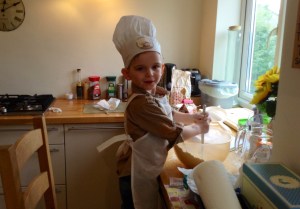
Forgiving son as we finally did baking

Forgiving son as we finally did baking

Today has been a pig of a day, from a half-five start with my up-with-the-lark daughter, through yelling at my son because he wanted my attention when I was trying to restore order in a filthy house, to losing it entirely and sobbing for a whole evening after the dentist told me my three-year-old has two cavities (does parenting fail get any lower than knowing you didn’t control sweets/juice/teeth brushing enough in two short years to stop him having bad teeth like you?)  finishing with an evening staring blankly at a su doku trying to numb my brain because I just don’t want to be me anymore.

Hubbie has watched me like a hawk to make sure I don’t do anything stupid and all I can think is I don’t want such love because I don’t deserve it.

Was this worth yelling for ten minutes because I'm sick of being the only one who cleans anything?

Was this worth yelling for ten minutes because I’m sick of being the only one who cleans anything?

So, as I often do, when happy words for the blog won’t come, I hit ‘random post’ to reread an old blog entry for inspiration. And I found this one, from 7th April last year. Seems appropriate (If slightly worrying that I have these days so often).

I don’t have many words today.

Lack of sleep and residual illness has turned me into at least four of the seven dwarfs. I’ll let you figure out which.

Instead of waffling on as usual, I’d like instead to share two thoughtful and beautiful posts about being a parent: both written as letters to a child.

One describes the parent I’d like to be, the other the parent I am far too often. Again, I’ll let you decide which.

It won’t be hard.

An Open Letter to My Son:

Like some poor, naïve fairytale mother, I’m trying to help you navigate your way through a forest that’s by turns enchanted and haunted. The path is familiar, as if I walked it once years ago, but different, too; overgrown and seemingly impassable in some parts, and unexpectedly clear in others. And as we pick our way through the undergrowth, as we do our best not to trip on twisted roots and sharp stones, I try to remember the lessons I’ve learned from all folktales I used to know.

For example, I won’t make the mistake that Sleeping Beauty’s parents did when sending out invitations to her christening. Unlike them, I’ll be sure to invite the dark fairy godmothers as well as the good ones, because I know that they’ll come anyway, slipping in through back doors and lurking in corners where you least expect them. I’ll let them give you their murky gifts in broad daylight, so that I can look them in the eye while they do so. Then I’ll smile and thank them, recognizing that I have to let life give you the bad as well as the good.

And when I send you out into the world alone, as I know that I will someday have to, I’ll give you something more substantial than bread crumbs with which to find your way back home.

And I won’t make you go to your grandmother’s house alone until I can be sure that you can tell the difference between an old woman and a wolf in a nightgown.

I Wasn’t a Good Mom:

Dear Daughter,

Today, I wasn’t a good mom. The morning came too soon after a long and exhausting night. I rolled out of bed and put pants on an hour before you normally woke up. When I came into your room you were ready for me, your hair tousled and your smile crooked. “I up!” You said reaching your arms out to me. “I pay wif toys!”

I didn’t smile, not because I don’t love you, but because I just needed more sleep. And then the day came and you stuck stickers to the couch and I grumbled under my breath. You tried to play tag and kicked me in the chest and I yelled, “BE NICE TO MOM!” I realize now, I wasn’t yelling that at you. I was just yelling at the world. But how could you know that? You couldn’t, and I’m sorry.

And when I went upstairs to go to the bathroom and you said, “NO MAM GO PODDY!” And I said, “Shut up!” It wasn’t my finest hour of parenthood.

I’m sorry I cried when you ate my lunch. The lunch I bought for both of us to feed my feelings. Because my feelings needed chicken nuggets, but apparently so did you. And I’m sorry I put you in time out when you made your plate do a little dance on the table. I’m sorry I didn’t kiss you when I put you down for nap, choosing instead to run away and lay in the guest room bed and just dwell in some silence.

These are only extracts of the posts. I encourage you to read the full version, and to follow these inspiring blogs. They get me through many hard days as a mother and a writer.

Descriptions That Breathe – Bringing Writing to Life

The Dream Thieves

The Dream Thieves

When I write, both in my blog and my novels, I know that my language is straightforward – no deviation between signifier and signified. No real stretch of the imagination necessary to obtain meaning. I gently lead the reader by the hand as they wander through my stories without minimal effort required on their part.

Thinking about it this morning, I’ve decided this is due to three things: My inexperience as a writer of fiction, my background as an analyst and academic, and my constant lack of sleep. Taking those in order, this is how I see it:

1. My inexperience as a writer means I lack confidence and bravery. I over-explain to make sure the reader understands my story, knows what my characters are thinking and feeling. I dread “I don’t get it” and as a result probably get “I don’t feel it.”  Any tendency towards being different is slashed so that I can find acceptance. Any flowery description is deleted as ‘purple prose.’ (The person who edited Baby Blues crossed-out half the similes, saying, for example, “Or just ‘he slept'”)

2. Similarly, my business and academic background have kept my language uncomplex. Actually, that isn’t true of the academic writing: what that did for me was ingrain the passive tense as an acceptable form of language usage. “One could argue that …” is a historian’s stock phrase.

But marketing was all about saying what you meant in easy words. There’s a phrase in marketing, summarised as the acronym KISS – Keep It Simple Stupid. One of my jobs working in Internal Comms was to take complex business documents and ‘translate’ them into briefings for the staff. I was good at seeing through difficult ideas and getting to the essence of the message.

It’s a useful skill as a parent of young children. I am constantly trying to break abstract ideas down into basic language. Unfortunately, nothing kills vocabulary quicker than not using it. Oh, apart from lack of sleep.

3. I can barely remember the colours of the rainbow on fewer than six hours’ continuous sleep and I hardly ever get anything near that these days. I remember at university, when I would pull all-nighters to complete essays: I’d stumble into the communal kitchen at 7 a.m., bleary eyed, and ask my housemates, “What’s another way to say Stalin was pissed off?”

Bereft that I've finished it!

Bereft that I’ve finished it!

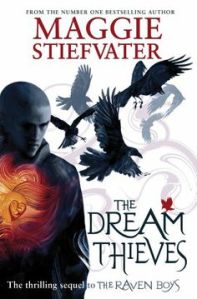
Why am I writing this defence of my unsophisticated prose? I finished The Dream Thieves by Maggie Stiefvater last night, and was as blown away as I was by The Raven Boys (and slightly less put out at the ending, having braced myself with the knowledge that it’s a quartet of books.)

Maggie Stiefvater’s writing is beautifully rich. Meanings have to be wrestled from the often dense and opaque prose. Motivations, character’s feelings, and even the basic plot, are often hard to fathom, despite the novel being written in omnipotent third person. It is not a passive read.

What I love most is the way the language is mixed up. I’m struggling to describe it (for all the reasons listed above!) but the closest I can come is to say the descriptions are alive. Just as Death is anthropomorphised in the Terry Pratchett novels, so is everything in The Dream Thieves. It seems appropriate, in a novel where the trees speak Latin and half the characters are psychics, that you can have an “ardently yellow” polo shirt or a “desolate” washing line (pp 7 and 57 respectively. All references taken from the paperback version, UK, 2013.)

Some of the language reminds me of my favourite poet, Gerard Manley Hopkins, who was known for stringing words together, like “dapple-dawn-drawn Falcon, in his riding | Of the rolling level underneath him steady air” (from The Windhover.”). Compare Maggie’s description of one of the characters visiting the family house:

“When Ronan opened the door, the car was immediately filled with the damp-earth, green-walled, mould-stone scent of home.” (p147)

All the senses invoked in one description, without apparent effort. You don’t have to analyse what the character feels, smells, sees, because it’s all there.

For the first time I wish I’d read the book in e-form, as I’m struggling to locate some of my favourite phrases. But here are a few (none of which, I hope, give any story away):

“Adam’s hand glided over her bare elbow. The touch was a whisper in a language she didn’t speak very well.” (p9)

“Gansey’s furiously orange-red ancient Camaro.” (p21)

“Blue Sargent was pretty in a way that was physically painful to him. He was attracted to her like a heart attack.” (p60)

“Then the engine expired … The engine ticked like a dying man’s foot.” (p122)

“Declan looked shocked and poisonous. He was always so alarmed by the truth.” (p411)

“The past was something that had happened to another version of himself, a version that could be lit and hurled away.” (p221)

“Cicadas sang madly from the trees. It was so impossibly summer.” (p340)

“She smiled at him. It was a tiny, secretive thing, like a bird peering from branches.” (p360)

“The crowd, drunk and high and gullible and desirous of wonders, screamed their support.” (p432)

“It was deadly like a cancer. Like radiation.” (p434)

It would be disingenuous to write in Maggie Stiefvater’s style. It is so clearly and unequivocally hers. But reading books like this stretch my vocabulary muscles and build up their strength. They encourage me to be braver and self-censor slightly less. Above all, they transport me to a place where words are everything, reminding me of their power. A place where emotions aren’t described as “her heart thumped like a hammer” (there are a lot of thumping hearts in my prose!)

To read is to learn and to learn is to grow. Bring it on.

Revisions and The Raven Boys

My new workstation - the kids' homework desk!

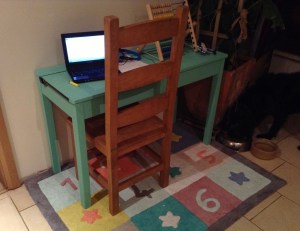
My new workstation – the kids’ homework desk!

I finally managed to get back to some work today, having packed my almost-better children off to school and nursery. I felt guilty about it, because they probably should have been at home, but I needed the space and silence and absence of sick to start feeling human again.

It felt good to work on my manuscript for the first time in ten days, even though I failed at the numbers game. That’s the thing with revision: you write and write and cut and edit and, at the end of several hours, you have 200 words fewer than you started with.

It’s disheartening.

I’m editing and expanding with this novel, so there are still thousands of words to write to fill the gaps. It’s not uncommon for me. When I write my first drafts I tend to write the highlights; something like an extended synopsis. I write for the romantic ending, the big scenes, the turning points. Then, fifty thousand words later, I look through what I have written and think what?! How did I get from there to there? How did she go from hating to loving him? Why have I given all the secrets away in the first chapter? How much backstory? Then I have to go through and unpick the mess. Fill in the motivations, flesh out the hundred-word paragraphs that really should be two-thousand word chapters. It’s tiresome work, because I write to discover the ending. Once I’ve reached the end, I’m not that interested in filling in the spaces.

I read that way, too. I usually have to read a book twice because, the first time through, (if the book’s any good at story pace or suspense) I skim-read whole chapters to get to the essence, the plot point, the drama. I miss all the great language, the unfolding of characters and personalities, the subplots, the themes. I devour the book, barely tasting it, and then have to go back through and vacuum up the crumbs.

Revision leaves me feeling like this

Revision leaves me feeling like this

I’m reading the sequel to The Raven Boys – The Dream Thieves – at the moment (despite my rant about the abrupt and unsatisfying ending of the first one) and I’m utterly hooked. Now that I know it’s a four-parter, I’m not worrying too much about story resolution (although I’m still skimming ahead for the drama, of which there is plenty). I feel that I’m reading the book in a language other than my native tongue, as if it’s in Old English or something, because the writing is dense and complex and poetically beautiful, but for some reason that’s okay.

But it hasn’t helped my revision. Because, when I put the book down and reluctantly get back to work, I read through my oh-so-obvious story line, with my two-dimensional, unintriguing characters, and I want to chuck the lot in the bin. My Alex and Rebecca are pale imitations (not imitations, because I wrote them before I read Maggie Stiefvater, but you know what I mean), pale shadows of Gansey and Ronan, Adam and Blue. And I want them to shine and live, like Maggie’s characters do. It’s exhausting.

No one says writing a novel is easy. Actually, writing it is the easy part. Making it make sense, making it shine: that’s the impossible task. Reading the words of a master is at once both inspiring and crushing. Never mind. I shall slog on, ignoring the expert sprinting past to the finish, and climb my own climb, one step at a time. It’s worked before. I have faith. I’ll see you at the summit!

Reblog: “All Retch and No Vomit”

Freedom: From the Alan Watts video

Freedom: From the Alan Watts video

Things are still hanging on by a feverish thread here in the Martin household, with little man peeling away my last layers of patience with his fractious, “Mummy, but..” “Mummy, can we just…” “Mummy, I’m bored / tired / miss Daddy” and “Mummy, I’m hungry…” followed by a refusal to eat anything, on eternal loop.

I  decided to look back twelve months to see if this is normal January/February stuff. It is. We need to holiday somewhere hot in the winter to avoid this annual decimation of the family health and happiness and to preserve my ongoing sanity.

In the meantime, as I have no words, I’ve decided to steal a post from back then, 9th February 2013 to be exact, to keep the blog alive in my absence. The title seemed very fitting, as it describes the coughing noise that’s become the soundtrack to my life! (Sorry, too much info!). Joking aside, the Alan Watts speech resonated with me back then and, listening to it again, now my daughter has started school, it has even more meaning now. This is the original post:

________

The Alan Watts video, What if Money Didn’t Matter?, came my way today via Facebook. It’s been around a while so I’m sure most people have seen it. If you haven’t, check it out on YouTube.

My favourite line (describing schooling and how we raise our kids to want the things we want) is

“it’s all retch and no vomit.”

You can’t beat that for an image with impact.

Actually the line that truly resonated was this:

“Better to have a short life that is full of what you like doing than a long life spent in a miserable way.”

What if Money Didn't Matter?

What if Money Didn’t Matter?

Now I know if you have kids, responsibilities, mortgages and so forth, this is a difficult thing to fit into your life. Many of the less positive comments beneath the video are along the lines of “that’s all well and good but I’m a single mum / I have a mortgage / I have bills to pay, I can’t afford to do what I want.” Or my favourite, “what; do I tell my kids not to bother with their homework?”.

To me that has missed the point. It doesn’t have to be so black and white. We can knuckle down to hard work and try to direct that towards something we will love doing in the future. And if in some ways we are already caught in the trap, stuck in a career that’s more about money than happiness, it doesn’t mean we can’t try and pass a different ethos onto our children.

Yes kids still need to do their homework.

Having aspirations doesn’t mean it won’t take hard work to realise them. I think the message is to find something you love and put it nearer the centre of your career than the need to get rich.

When my husband first watched the video he realised he didn’t know what he would do if he didn’t have to earn money. That’s a sad realisation at forty. He’s given it some thought and come up with some answers but I think it’s important to know what you love doing even if it isn’t possible to do it.

I’m probably rambling making no sense: it’s been a long day on little sleep and too much coughing. I might revisit this topic when I’m feeling more lucid. In the meantime I love the first screenshot I captured, I think it encapsulates the journey Claire is on as she realises life is about more than earning enough money to buy the next must-have designer shoes.

P.S. Why did I never have Claire parascend into a cave? That would have been amazing! One for the sequel maybe…

Not Running on Empty, Running On Sober: A Blogger Profile

A very inspirational profile on someone who seems a very inspirational blogger. I like the idea of collecting words like butterflies: I too used to collect lyrics when I was younger and pour over them for meaning.

Krista Stevens's avatarWordPress.com News

We first met Christy after reading her post,My Grace is Gone (A Climb Out of Alcoholism). The sheer honesty and emotional intensity of the piece resonated with us — so much so — we not only bumped it to Freshly Pressed, we included it in our year-endEditors’ Picks — a collection of our favorite, most powerful posts from 2013. Christy sat down with us to tell us how she got started atRunning on Sober, what blogging has meant to her in recovery, and a little about some new blogging projects she recently started.

rosmasthead

Tell us the story of how you started your blog, runningonsober.com.

One of my best friends actually pissed me off, that’s how. It’s actually kind of funny. See, I had my last alcoholic drink in May 2011, just two months after my mom died. (No, that’s not the funny part.) But…

View original post 2,510 more words

Advice For Writing and Life

This is what I want to do today

This is what I want to do today

Okay, I finally admit it. I’m ill. I went to bed at 8pm last night and slept until hubbie came to bed at midnight. Then I popped a pill to make sure I’d get back to sleep. And didn’t. There’s nothing worse than your body being asleep when your mind is wide awake and all around you the house is coughing like every occupant smokes 40 a day. (We don’t. We’re all ill.)

I would have written a post then, but I was drugged so could only lie awake and worry about life and fume that I’d had a fourth failed delivery from the crap company I had the utter misfortune to choose to deliver my daughter’s new bed.

So this morning I’m taking time to be ill. After the school run I’m heading back to bed. So I am utilising the blog network for today’s post. Here are five great articles to help with writing and life:

1. 10 Foundational Writing Practices – Charlotte Rains Dixon: the importance of getting the basics right. My favourite three are Move your Body; Calm your Mind; Stay Positive

2. The Simple Joy of Slogging Through to the End – Speak Happiness: an old post on the satisfaction of finishing a difficult task. I’m hoping I’ll feel like that when (if) my daughter’s bed finally arrives and I’ve managed not to break anything or anyone in my anger at the company’s sheer incompetence.

3. “Days are Lost Lamenting over Lost Days” – another from Speak Happiness: this explores a quote attributed to Goethe. A very interesting read. The full quote is:

Then indecision brings its own delays,
And days are lost lamenting over lost days.
Are you in earnest? Seize this very minute;
What you can do, or dream you can do, begin it;
Boldness has genius, power and magic in it.

4. Why Doing a Jigsaw Puzzle is a Bit Like Writing A Book – Debbie Young: looking at the ways assembling a jigsaw puzzle is like writing a book. As I’m in the difficult stage of redrafting Class Act, trying to make sure all the pieces fit together and the whole picture looks right, this struck a chord. Especially these points:

  • No matter how carefully you prepare the component parts – the corners, the edges, all the pieces with blue sky or Persian carpet or Delft tiles or pink flowers – the assembly of the puzzle never goes entirely according to plan.
  • When daunted by what seems like an insurmountably difficult section, you realise that if you only apply yourself, one piece at a time, you really can conquer the challenge.
  • Sometimes it works best if you switch your conscious mind off for a bit and let the subconscious take over.

5. In Defense of Pantsing – Jami Gold: because Pantsers can write novels too, as long as we remember to apply structure and story beats during redrafting. Enough said!

Right. Back to bed.

A Curious Novel

My latest read

My latest read

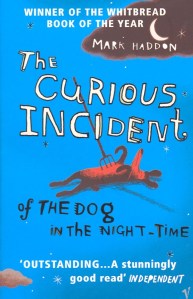
I finished reading The curious incident of the dog in the night-time by Mark Haddon last night and I really want to capture my thoughts on this interesting novel. I began reading it with no expectations. I’d heard of it, that’s all, when I saw it in the library. I had no notion of what it was about, or the author, or anything (including the fact that the title comes from a Sherlock Holmes quotation.) I merely selected it as part of my aim, this year, to read more and select a wider range of books.

I’m glad I did. It is a strange novel, about a fifteen-year-old boy with Aspergers Syndrome. I feel privileged to have read it. Yes, that’s my overwhelming impression. It wasn’t a rip-roaring read, a heart-warming romance, or an unputdownable thriller, but still it dragged me through to the end with little effort (which is a big ask of a book these days because I’m very quick to give up on something that doesn’t keep me awake!)

It is funny, quirky and endearing, but mostly it’s a clever book. Written in the first person, from inside the mind of an autistic teenager, it presents the world in a new way. It also gave me a new respect and understanding for autistic children and their parents. But not in a way that demanded sympathy or forced ideas on me.

Instead, through an evolving set of anecdotes and an unravelling mystery story, it revealed immense detail about the character, his family, his life and his interpretation of the world. Some of the apparently peripheral discussions, for example about God, or time, or the universe, were both enlightening and profound.

As a writer, the book is a master class in RUE (resist the urge to explain). The reader is left to put the pieces of the jigsaw together in a way that the main character often isn’t able to. And, despite it being written in the first person, an entire world is unveiled surrounding the main character. I can’t begin to explain how so much was revealed with so little being said (certainly not without giving away spoliers.)

I think the enjoyment came from this, though. The reason the novel kept me awake was because I was actively involved in constructing the text, fleshing out the story, connecting the dots. The same was true of The Raven Boys, now I come to think about it. I’m starting to think of it as the art of secrets. Not glaringly obvious secrets, of the kind I might clumsily put in a novel – like Josh’s big secret in Two-Hundred Steps Home, or why Claire broke up with Michael. But more a subtle revelation of the bigger picture, like panning out in a movie and seeing the full context.

It is a goal I intend to aim for in my own novels, although I know I’ve got years of practice ahead of me before I get there. I don’t think it’s something that can be taught, but something that has to be learned through hard effort. I suspect it will also require me to become more a planner than a pantser. My natural writing style is to reveal everything as soon as it occurs to me (I’d make a rotten poker player). Instead I need to play it more like chess. Think fifteen moves ahead, prepared to change my plans if necessary, but keeping the moves secret for the reader to discover at the best moment.

I feel like my daughter; only just learning to read but wanting to be able to read adult books. I’m only just learning to write and I want to be able to write like that. Now! Now! Now! *Pouts*. Time to read a few craft books, consume a stack of fantastic novels, dip into a load more blogs and, more importantly, practice, practice, practice. I can feel (another) rewrite of Class Act coming. Bring it on.