In Response to Coffee and Conversation

Culture Monk Blog

Culture Monk Blog

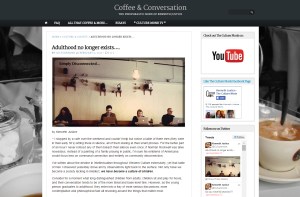
One of my favourite blogs, Culture Monk now called Coffee and Conversation, is written by Kenneth Justice. He discusses many big themes, such as community, culture and religion, and I often find myself nodding in agreement (although as an agnostic I don’t necessarily agree with everything he writes).

Today he published a post called Adulthood no longer exists…. I had to read it, because it has occurred to me many times since becoming a grownup that there aren’t really any grownups and we’re all winging it. In fact there’s a quote to that effect going around Facebook at the moment (I’ll link when I find it).

I think you become most aware of it when you have children and you realise you have to start being the adult. I often look at my parents and my father-in-law and think they seem so grown-up, but I know that they don’t feel any different inside than they did when they were in their teens or twenties, just the same as me.

I also read the article because recently I’ve felt that my husband and I need to grow up a bit more, take a bit more responsibility, spend a bit less time playing computer games and more time cleaning the house and taking the children swimming. But then I read Kenneth’s article and, instead of confirming my view, it made me reconsider. Mostly it made me reconsider what we mean by Adulthood. Does there have to be a demarcation between child and adult? I look at my children and they’re amazing. They see the world with such fresh eyes, they are open to endless possibilities, they live in the now and rarely dwell on the past or grievances or things they don’t have. Why would we want to be different to that?

Also, as I read more of the article, which focussed on people playing games on their phones instead of interacting in coffee shops, I realised that such behaviour might be that of a teenager but it certainly isn’t that of a child. A child would be in there, introducing themselves to everyone and discussing what they had for breakfast. We train that out of them when we tell them to grow up and behave, to be wary of strangers, to stay out of other people’s business.

This was my comment on Kenneth’s blog: It focusses mainly on the gaming aspect (and by gaming I mean computer games, not gambling. I have a whole different view on that!) I’d like to discuss this further but I have a dog to walk and children to collect, so I’ve just pasted the comment here. I would love to know what you think!

For once I’m not sure I agree with you. I have had many similar discussions with my husband recently because a) he and I would rather be gaming in the evening than reading (and I’m a writer of fiction, there’s nothing wrong with my intellect and I love to read, whether it’s YA or Hemingway) and b) our six year old daughter would rather play computer games and watch youtube videos than read. Again, she’s a very bright child and I don’t see the games as diminishing her intellect. If anything, they are stretching her far more than the drivel her school send her home to read. She is discussing strategy and learning about the world.

Obviously I monitor closely the games she plays, and make sure they aren’t sapping the life out of her. But I despair of getting her to read through choice. I did nothing but read at her age and I explained that to her the other day (in a mother-guild panic because not reading is equated with going to hell in the middle-class world I live in), and she said, “but, Mummy, do I have to grow up to be like you?”

Those were her exact words and they floored me. No, of course she doesn’t. I hope she doesn’t, because she lives in a completely different world to the one I grew up in. I read to escape at her age. Enid Blyton and Sweet Valley High books, even Lord of the Rings and other weightier tomes (for an eight year old) were my friends and family. But do I look back and think that was healthy? Not really. I was escaping life. My daughter doesn’t read I believe because she doesn’t need to escape life. She loves life. She doesn’t need to be entertained – she is entertained, by her drawing, her brother, her toys, and by the ipad.

My children discuss their games together, they strategise and plan and compete and learn and help each other. Even on a ‘mindless’ game like Minion Rush I see them getting so much from it. And me, too. I’ve never felt so alive – since becoming a work from home mum – as when I started playing strategy games. I am using my brain like never before. I have something to discuss with my husband: we talk far more than we used to when I was buried in my books all the time. We have few points of contact in our choices of books and films but we found a common point in games.

I don’t disagree that culture is becoming fragmented, that people are spending more time in their virtual worlds and less time making human contact. I worry that empathy is disappearing (and then I read some posts on Humans of New York and my faith is restored.) I quite often only speak to people at the school gate, and not even then if I’m tired.

But I certainly wasn’t having deeply intellectual conversations before becoming a SAHM or before playing games on my ipad. My friends and I talked about clothes and handbags and restaurants and movies and a bunch of other things I couldn’t always relate to. Even my husband and I don’t talk politics because we don’t have the same beliefs. I’ve found my own tribe online. Facebook is my coffee shop where I hang out with friends and discuss the political views I subscribe to. My blog is where I chat and swap parenting stories and work things out.

Maybe culture isn’t failing, maybe it’s just shifting. Maybe we’re no longer restricted by trying to find common ground with the people we happen to exist alongside geographically, maybe we can reach out to a whole world and find people who are like us, wherever they exist (or even whether they are real, I guess).

Anyway, something for me to think on when I have my coffee! 🙂 Great and thought-provoking article.

Learning Characterisation from Humans Of New York

HONY Facebook Page

HONY Facebook Page

I’ve talked about the Humans of New York Facebook page many times before, mostly in passing. Today I wanted to discuss what an amazing resource the page is for writers.

For me, one of the hardest parts of being a writer is coming up with three-dimensional characters. When I start a first draft my characters are usually pretty vague. I know their motivation or I know the key story problem (Helen getting pregnant, Rebecca’s dislike of the upper class, Lucy’s need for a family and to fit in), but the character starts out as a hazy version of me at some earlier point in my life. They move on from that, and by the end of the first draft they become living, breathing, talkative people in my head. But I think one of the reasons I like my male characters better is because the starting point for them is more often men I know and admire or love, rather than versions of me. (There’s a lot of hubbie in Marcio!)

The problem now is that my novels are starting to have mirror scenes. I’m stuck with Finding Lucy because it starts with a death and a funeral – as does Class Act (although Finding Lucy came first.) Now, it’s unlikely many people will read both, as Class Act bombed, but I can see the reviews now. “Amanda Martin’s latest novel is dull and repetitive, with chunks lifted directly from her previous release.” Oh joy.

Similarly, the protagonists often have similar upbringings and backgrounds because I write more authentically when I can really live it (or have lived it!)

Brandon's Latest Post

Brandon’s Latest Post

So where does HONY come in? I’ve been editing Dragon Wraiths this week for one final time before entering it in the Chicken House/Times competition, after having had the lovely lady who proofread Class Act run through it. She pointed out the bits where I lose the sense of Leah being a teen (my editor has teenage kids, which is fantastic). But she also pointed to the bits where I evoke Leah’s backstory well, when she was in foster care.

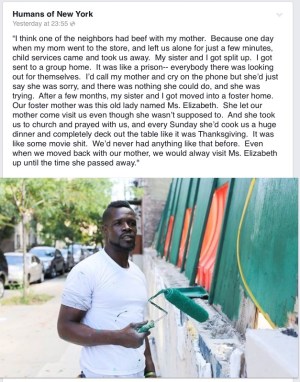
I did a lot of research online for the care scenes, and the snippet of Leah’s time on the streets. I wanted it to be realistic but not sensationalist, genuine but not too gritty. A fine line. But then I read a HONY post yesterday which gave an insight into care in one paragraph. In fact it created a whole story and three-dimensional character in a couple of hundred words. Each HONY post does.

When Brandon Stanton (the amazing man behind Humans Of New York) was on his UN tour, the stories were beyond my ability to visualise, but now he’s back in New York the wealth of material is incredible. Not just for main characters. I think one of the reasons Baby Blues resonates with people is because all the characters have stories of their own. I chose not to develop the bit-characters in Class Act, because some reviews of Baby Blues said it was crowded with people, but I’m learning you can’t please everyone!

What Brandon shows is that a person’s whole life and character can be depicted in half a page. He has a way of getting under people’s skin to their very essence. He gets them to tell the core of their life story succinctly but with feeling. I read his posts to keep me grounded in the stories of the world, but also I read them to learn from a master.

Help Keep an Inspirational Message Alive

TraceyLynnTobin's avatarNo Page Left Blank

Three days ago I wrote a post about my cousin, Ryan Gillis, a drug-addict-turned-inspiration who recently passed away in a car accident, and you all responded in a huge way. Not only did my usual blog followers drop by to give their condolences, but over 14,000 people showed up in total on that one day, coming from all over in search of information on Ryan. I also watched the visitor stats for Ryan’s “Love Life” video skyrocket, and I have to say that I couldn’t have been more thankful to see that Ryan’s message is being spread even in the wake of his death.

Today, because you’ve all been so wonderful and supportive, I want to share a couple of plans that are going on in Ryan’s name that some of you may wish to support.

First, Ryan’s family has opened a fund to raise money to help…

View original post 285 more words

A Ramble About Life

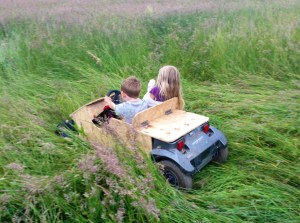
Kids and their new go-kart

Kids and their new go-kart

I’m sorry about my recent silence; I’ve been in a strange world where I’m actually enjoying editing. What’s more amazing is that I’m editing Dragon Wraiths. You’d think that finding anything wrong with a book that’s been published for eighteen months would send me into a spiral of despair. Especially finding grammar mistakes and typos, rather than just poorly worded sentences. But surprisingly it hasn’t. I knew there would be some errors, especially as it’s the only book that I haven’t paid someone to edit, relying instead on family and friends.

(That said, my mum found a few glaring typos in Class Act and that was edited, so you can’t catch everything.)

I think I’m enjoying it because I know the book has received great reviews (and awful ones!) so I can read it knowing at least some people like it. But the main reason I’m enjoying it is because I can see how much I’ve learned about writing in the past year or two. I’m not changing the story but I am tightening the prose and it’s surprisingly empowering.

My original intention was to try and cut 35,000 words (30%) from the story so I could enter it in the Chicken House children’s novel competition. So far I’m only cutting 8-10% from each chapter. Unless I find half a dozen chapters that are redundant it isn’t going to happen. But I’ve decided that’s okay. Instead I’m going to try and get the book below 100,000 words and resubmit to agents. Who knows, I might have more success this time.

The nice thing about editing is that it structures my day. Aside from the two hours of school run mayhem in the morning, and the four hours of whining, crying, shouting and chaos from pick up to bed time, my days are calm and focussed. I carry my manuscript round and edit at the school gate and waiting for my coffee. Having a deadline of the end of term really helps keep me working. My only distraction is constantly checking for Class Act reviews!

On the trampoline

On the trampoline

This morning I wrote a response to a post on Helen Yendall’s blog about having too much to do and how much harder it can be to manage your time when you don’t go into an office to work. This was my (edited) response:

This is how my boss used to tell me to do to prioritise work: categorise things into ‘what will get me fired if I don’t do’, ‘what will get me promoted if I do it,’ ‘what do I enjoy?’ and everything else. It’s tough to do that when you’re self-employed, but for me I’ve roughly translated it as, ‘what has an immoveable deadline that will either make or cost guaranteed money’, ‘what will clear the biggest headspace most easily (usually niggly admin),’ ‘what will make me happy and therefore make everything easier’ and everything else.

Of course stuff like school run, cooking, dog walking, kids’ homework have to happen. But non-essential ironing, cleaning, Facebook, even the blog, go by the wayside in peak times. I’ve also found the routine of the school run and walking the dog can help. I constantly feel overwhelmed by stuff, too. Getting diagnosed with depression taught me to take better care of myself for everyone’s sake.

Writing it made me realise that it’s all true. Life has been tough recently, for me and for hubbie, and the routine hell of the school run that tops and tails my day makes me yearn for twelve-hour office shifts and getting paid. But I’m learning not to compare myself to others, or even to who I was before kids, and get on with it. My struggles are mine, no one else’s, and I’m certainly not the only person fighting to survive (as hubbie pointed out this week). Life is what it is and you have to make the most of it. If that means watching Queens tennis or drinking too much Waitrose coffee (it’s free! I come four days a week to work…) then why not?

As Lauren wrote recently on her blog BetweenFearAndLove, feeling guilty that you haven’t got it as hard as others is a useless emotion. I haven’t learnt that lesson yet but I’m working on it.

Please Help A Fellow Blogger

Donation page

Donation page

It’s no secret that I love the blog Miss Fanny P, as I often share bits here on Writermummy. Miss Fanny P is one of a handful of people that I’ve ‘met’ since I started this blog that has come to feel like a close friend. She is a talented writer and photographer and her children are adorable (and say the funniest things.)

A few days ago MissFannyP was burgled, with her son waking up to find a man in his room. Everything of value was taken, including baby photos and other irreplaceable things. The worst part is that – due to a paperwork error – they aren’t insured. I have set up a crowdfunding page to raise money for her to replace the things that can be replaced – camera, laptop etc. The lost photographs can’t be, but we can help her take more.

Please, every pound will help (and if you’re from a country that can’t donate through GoFundMe please contact me and we can sort something). This is link: www.gofundme.com/MissFannyP


Poem About Grief

I just have to share this powerful piece of writing

rmbenson's avatarUbiquitous. Quotidian.

Note: I want to share this thing with you. Not because it is finished but because it needs to be outside of me. It came to me very quickly. A few words a few days ago. A sentence last night. A phrase when I woke up this morning.

I ate my breakfast. I drank my coffee. I took my daughter to school.

It was waiting for me when I found my chair. It is better, I think, for it to be on the outside of me. What I mean to say is this: I wrote this, then went for a run with a friend and, when I came back to it, it seemed more beautiful than scary.

***

Grief is the subterranean monster that has been waiting with inexorable hunger since your childhood. She is the unseen creature lurking just beneath the surface, reaching up for you with her impossibly…

View original post 550 more words

Help me help Ria

Please read this post about an inspirational woman seeking to make a difference in the world.

Ken Powell's avatarkenthinksaloud

There are two versions of this post today. You can read one or the other or both. They are complementary though cover the same ground. This one looks at this project from the Bangladesh side of things. The other, on my writing blog WriteOutLoud looks at the project from the angle of the e-book I’m about to bring out. You can read that post here

I have about four books on the go, all very close to being ready to publish. These have been set aside, temporarily, to put together a book which I hope will raise money for a special lady in my life.

Let me introduce you to Ria.

Ria 1

Ria Mollick is a young woman I’ve had the pleasure of knowing for more than seven years. I taught her while living in Bangladesh and her family and mine are very close friends. Ria has worked hard through…

View original post 1,018 more words

4000 Gifts: A Story of Arrival

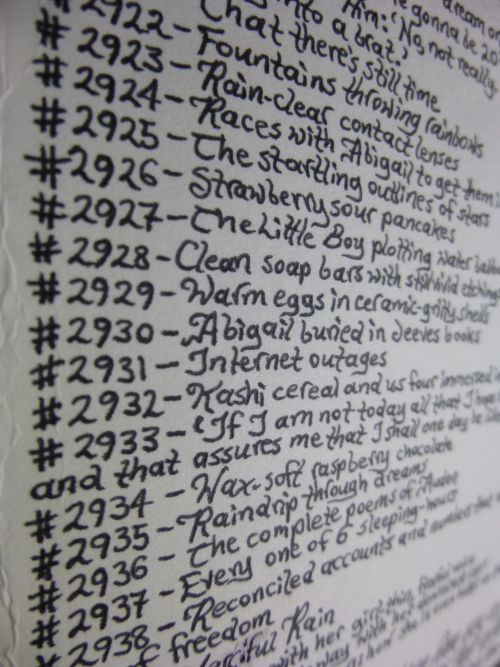
I was looking for a post to reblog for International Women’s Day (having failed to write anything inspirational myself) and I discovered this gem in my reader. Such an inspiring post from an inspiring lady. I want to start my own book of gifts. Beautiful.

Bryana Joy's avatarHAVING DECIDED TO STAY

P1040686 Some years ago, I was seventeen, and life made almost no sense. What a surprise.

That is, I had my bearings on a great many matters, and I had a veritable collection of high ideals, but they were just that: ideals. And when you are young and living in your parents’ house, it is probable that everything worth having will seem to be far in the distance. If you are not careful, that will never change.

The story of the seventeen year old whose life makes no sense is hardly a novel one. But neither is the story of the college graduate whose life still makes no sense. Or the mid-career professional. Or the young housewife. Or the wealthy, retired couple that vacations in Europe. Or the worn old man, full of days, who finally holds up the white flag and gives his surrender to cancer, and whose life makes…

View original post 606 more words

The Perfect School?

Sudbury Valley School

Sudbury Valley School

Almost as soon as my nephew was born, my sister began to speak about sending him to a particular school in America. A free school, a democratic school – run by the children for the children. A place where a child could ride their bike or play video games all day, everyday, if they chose.

I scoffed. My parents rolled their eyes. I’m an academic at heart, with straights As and a first class degree and a Masters (we won’t mention the B in A Level General Studies – after all it wasn’t a ‘real’ qualification – it was only about life and that’s not important to a student who wants to succeed.)

Over the years, my brave, courageous, determined sister never let go of her American dream. Her husband’s sister’s children went to the school and her desire grew. I never got it. Three years ago, after untold hours of effort, my sister and her family emigrated to America to live near my brother-in-law’s family, with a view to my nephew and now niece going to the school.

The school run for my sister

The school run for my sister

I still didn’t get it. School is about learning and classes and exams and school uniform and all that, and my children were going to love it. There were going to be reading and counting to a hundred by the time they were five, they were going to be top of the class. After all, I was, and that made me happy, didn’t it?

My daughter started school six months ago, and my confidence began to waver. School seemed so regimented, especially for these tiny four-year-olds looking so serious and adorable in their smart uniform. The school run was chaotic and emotional and full of stressed parents snapping and snarling (particularly me).

To begin with, my daughter loved it. As suspected, she thrived on learning and was reading and counting to a hundred by her fifth birthday. She loves the community of school, idolises her teacher, and adores singing, reading and PE. But, here’s the thing: after spending a whole year desperate to go to school, my bright, academic, sponge-like learning child doesn’t want to go anymore.

“Mummy why do we only do PE once a week, I love PE.”

“Mummy, I love singing, is it singing assembly today? Is it?”

“Mummy, we didn’t get to do reading today.”

Drumming with his sister (click for video)

Drumming with his sister (click for video)

Then, yesterday, I watched this video on the Sudbury Valley school my sister has set her heart on. And I cried. Oh my. I want that for my children. I want them to be able to play piano for three hours straight if they choose. I want the calm, majestic, green surroundings, the rocks and the lakes and the books and the teachers there to facilitate enthusiastic learning. I want my children, my artistic children who often spend hours playing in their band, to have that.

Who cares if they meet some government-decided tick box of success. I want them to know what makes them passionate by the time they’re fifteen, not fifty.

Already, in six months, I’ve seen my daughter lose her edge. Become less able to find things to do without direction, become more concerned about breaking rules than having fun. She gets some of that from me, but where did I get it from?

I read a post yesterday written by the talented and successful writer, Kim Bongiorno, who wondered if the fact that she didn’t finish college would affect her own children’s desire and ability to go to college. She wondered whether she was a good enough role model for them. This was my reply (before watching the Sudbury Valley video!)

“I think you are being a better role model by not having finished your college degree. I don’t think university is for everyone. I went to university because I didn’t know what I wanted to do with my life. For people with vocations, like doctors or teachers, of course university is essential. However, if you’re not academic then it’s a way to run up huge debt and be no nearer to a job at the end. Certainly that’s true in the UK.

Fifteen years ago I graduated with a first class degree and it marginally improved my chances of getting a good job. Which I did. But I hated it and had a breakdown after three years. The next job was no better except I lasted five years before realising I don’t handle office stress well and I need to be creative.

And I AM academic, I loved studying. What about the people who don’t learn through lectures and essays? My sister struggled for four years to get a 2:2 in a language she hated, and graduated with massive debt, great pool playing skills and a love of Jack Daniels. Since then she’s started from scratch, building up her own businesses and finding what she loves and is good at.

In fifteen years time, when my daughter would graduate, I suspect a degree won’t be enough to compete. She’ll need a Masters, maybe a PhD. Years more of study and debt, for what? She wants to be a writer like her mummy, my son wants to be a racing driver (he’s three). I truly hope I’ll be strong enough to encourage them in those desires because happy is as important as well paid.

There is a great lecture I watched http://new.ted.com/talks/ken_robinson_says_schools_kill_creativity all about academic inflation and how university is really only good if you want to be a professor. I have long debates and worries about education and making sure it’s right for my children and this lecture consolidated some of them.

If your children want to go to college, the fact that circumstances outside your control prevented you completing your course shouldn’t stop them. And if they don’t want to go, you’ll be the best person to show them that – with hard work and determination – they can be a success without it.”

Daughter drumming - stuff she can't do at school

Daughter drumming – stuff she can’t do at school

This all sounds like I’m upping sticks and moving my family to Boston, doesn’t it? Oh I wish. But I don’t want to live in America, not even for an amazing school. For all my angst and depression, I’ve travelled the world and found myself home. But it does mean I can now say,

“Sister, you are the bravest, smartest, strongest, kick-ass person I know, and well done. Sorry I didn’t always understand.”

And I can keep looking for a better school for my children, and give them space at home to be children. To be themselves and to be happy with that. It’s taken me nearly four decades to achieve it, and I’m only partly there. In the meantime, I hope more schools look to the Sudbury Valley model and at least take some parts of it away. Watch the video and tell me you aren’t just a teeny bit impressed.

What’s Your Love Language?

My daughter loves quality time

My daughter loves quality time

I had a revelation at 6am this morning – when I have most of my epiphanies – to do with the book I’m reading: The Five Love Languages. As I mentioned before, the Five Love Languages – as defined by Gary Chapman – are Words of Affirmation, Quality Time, Receiving Gifts, Acts of Service and Physical Touch.

Chapman argues that, for a relationship to thrive, we must first identify and then learn to speak our partner’s love language. I’ve always assumed my language is Acts of Service. I do the laundry out of love, I cook and clean and make coffee out of love. It has frustrated me beyond measure that my husband doesn’t understand. Not just that he doesn’t do those things himself, but that he doesn’t recognise them as acts of love from me.

Hubbie’s love language is Physical Touch. Not (just) in the obvious male way – Chapman distinguishes between sexual desire and touch as the primary love language. If you have sexual desire, but can take or leave the hugs, hand-holding and incidental moments of day-to-day physical contact, then chances are you have a different primary language.

My son is either touch or quality time

My son is either touch or quality time

Thinking it through this morning, using the techniques Chapman suggests, I suddenly realised that the Acts of Service may well be learned behaviour from my parents. Chapman recommends thinking back to the time when you and your partner were first dating, to understand the thing about your partner that made you think ‘he’s the one’. Hubbie and I lived apart for the whole of the two years between meeting and getting married. Picking up dirty underpants and cooking rarely figured in our equation. Oh yes, I liked that he cooked, that was a bonus. Who doesn’t love a domesticated man?

But the thing that first snared me, on day one as we chatted online before even meeting, was that he listened. My favourite times in our courtship were the long phone conversations, lying in the dark with just the two of us speaking. No interruptions, no distractions, just voices, sharing, listening. (Well, I assumed he was listening. I did have an ex who confessed years after we broke up that he used to mute the phone and watch TV while I rambled, but at least – even at the tender age of 16 – he realised my need to speak and indulged it.)

All my life I’ve felt that no one really listened to me. As discussed that’s not uncommon. But as I thought it through this morning, I realised that I blossom when I am listened to. I have a good friend who is a listener and I come away from our coffee catch-ups fizzing and smiling and alive (and feeling guilty for being what Chapman calls a ‘Babbling Brook’). Growing up, and even now at least once a month, my family tease me remorselessly for being a chatterbox. I hated it; still do. The endless words were driven inwards, to diaries and inner thoughts (not helping the depression) and now to my blog and my novels. And always I feel guilty for speaking, for hogging the attention, for asking to be heard.

Chapman lists a dialect of Quality Time as ‘Quality Conversation’ which includes quality listening. I was so quick to accuse myself of being a rubbish listener that I missed the point. Being listened to is my primary love language.

Joanne Harris

Joanne Harris

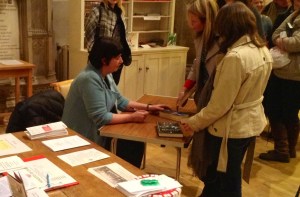
I went to an author lecture by Joanne Harris last night and came home bubbling with excitement and a need to discuss it. Hubbie paused his TV program but I still felt I was interrupting. I realise now that an act of love – to me – would have been for him to turn off the TV and give me his full attention.

And again, earlier in the evening, I was getting angry and frustrated with my son because he kept interrupting me, endlessly, as only a three-year-old can. And it dawned on me that the yelling I often resort to, that has become increasingly prevalent in recent years, possibly stems from an insatiable need to be heard.

I know my daughter’s language is quality time and I suspect my son’s is too, (although – like his Dad – physical touch is also super important.) Certainly both children talk as much as me and get just as frustrated if they aren’t attended to. That’s tough on hubbie – being in a house with three chatterboxes all vying for airtime. No wonder he switches off and stops listening; it’s probably a self-defence mechanism. However, if we can become a family that hugs and hears, that loves and listens attentively, we might just cut back on the shouting and increase the joy. It’s worth a go.

I told the doctor yesterday, when talking about my depression, that I didn’t need any more therapy; that words didn’t help and the last psychotherapist I saw made it worse. Turns out I just needed to hear (read) the right words. I can’t recommend the book enough and I will always be grateful to the lovely lady who leant it to me.