A Pantser Plans

Using Beat Sheets to plan my revisions

Using Beat Sheets to plan my revisions

The unthinkable happened today. I did planning. With beat sheets and notecards and everything. I’m a Pantser to the core: analysing a scene down to the tiny details paralyses me. Especially if I do it before I write, as I have done for the extra third of a novel I’m putting at the front of Class Act. But actually, do you know what, it wasn’t so bad.

I’m still working on some of the terminology, for example pinch points and black moments, although instinctively I have a shrewd idea what they are. I have done it before, actually, for all my seat-of-the-pants writing preference, and I’m always relieved at how much of the necessary detail I already have. Sometimes it just needs writing down to reassure myself I do know something (although a VERY VERY long way from everything) about this novel writing lark.

I had gathered much of the required information during my last craft session (the sporadic times when I read through a load of blogs and books to refresh or learn elements of writing craft.). My favourite resource is Jami Gold: as a Pantser and a romance writer, I feel she understands my pain. In fact her Beat Sheet for Romance Writers formed a large part of my morning’s work. She explains that if, like me, you can’t pkan in detail for fear of frightening off the Muse, you can use beats – points in the story – to make sure things are developing as they should.

I also used her posts based on a Michael Hauge workshop she attended to put more thought into my characters’ development, flaws and ultimate romance. The key ones I used were Are These Characters the Perfect Match and An Antidote to “Love at First Sight”. Both of these look at two elements of characterisation – a character’s Mask (the role they play, based on their longings, fears, wounds and beliefs: their emotional armour) and a character’s Essence (who they are inside, behind the masks, or who they have the potential to be). In a good romance, attraction will be based on Essence rather than Mask.

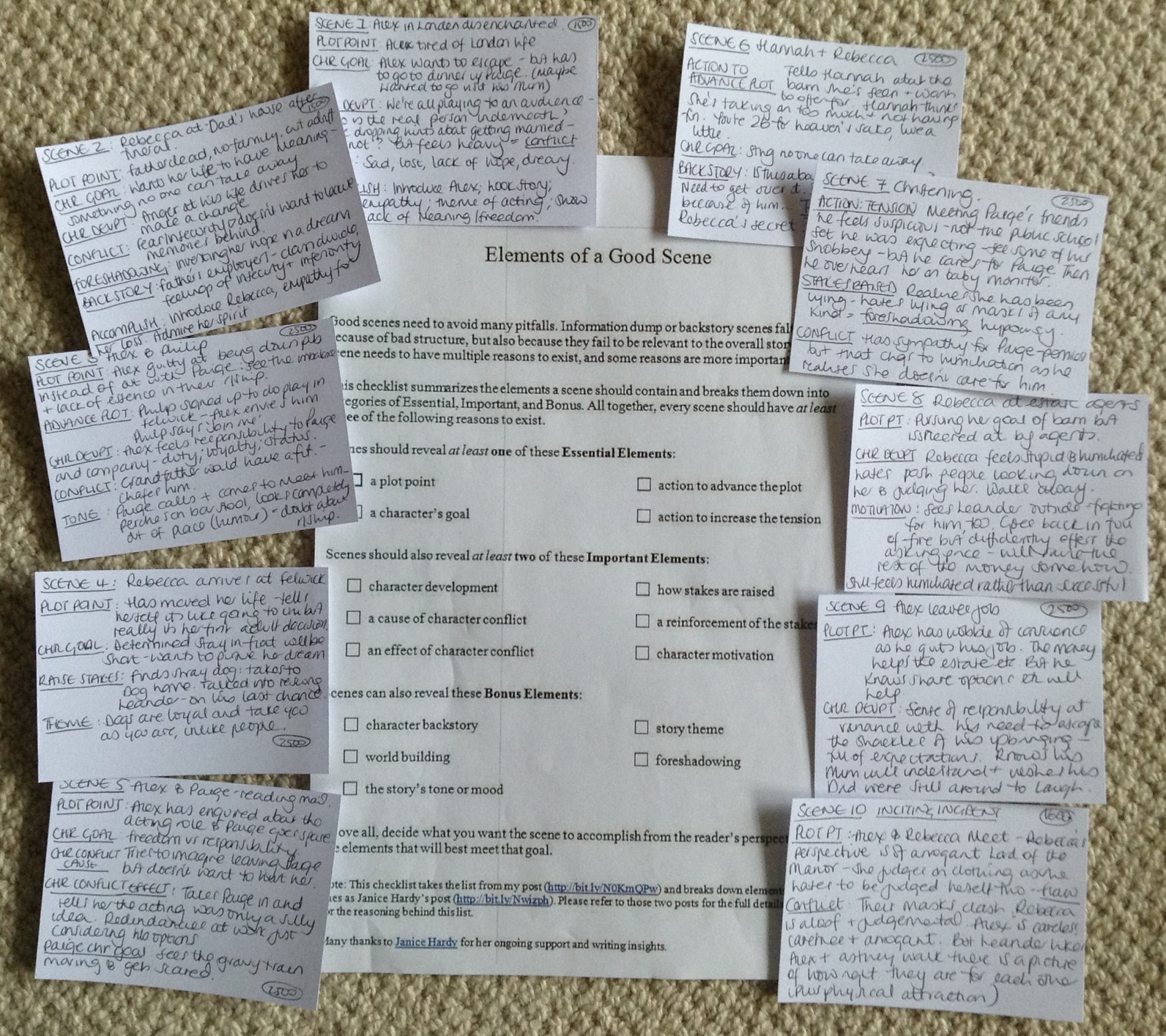
Planning Elements of a Scene

Planning Elements of a Scene

So, in Baby Blues, Helen was attracted to Daniel because his businessman forceful character Mask played to her career orientated Mask. But Marcio was her right love interest, because they both had the same essence underneath: a love of creativity and interpreting the world through their art, and a desire for home and family.

The concept really helps when a character moves from one relationship to another (as mine often do.) You don’t want the protagonist to look like an idiot because the previous relationship was flawed, and also you don’t want the previous partner to be a stereotype or a villain (although Daniel, in Baby Blues, is a bit of both!)

The other thing I’ve been trying to use is an Elements of a Good Scene checklist, which I also found on Jami’s Blog, the idea for which came from Janice Hardy’s blog. I feel exposed, using something like this, as I feel I don’t know the difference between “Plot point” and “action to advance the plot” or “how the stakes are raised” versus “reinforcement of the stakes”. I suspect that might be why I find it hard to write tense page turners! In my head, though, I’ve summarised it as “plot development”, “character development”, “conflict” and “backstory/theme/tone/foreshadowing”. As long as the scene has some of those that’s good. Well, it’s a start!

Of course, I was right – at the beginning when I said planning paralyses me. I need to start writing, before I spend so long on planning I’m fed up with the story or too scared to start. But it was a useful day’s work and hopefully, when I sit at my desk on Monday, I’ll be able to write some of the additional 45,000 words the story needs to get to a full length novel!

Anyway, hopefully now I have a plan this will be the last of the ‘I’ve forgotten how to do manuscript revision’ posts and I’ll get on to writing something more interesting for the non-writers who follow my blog! Thank you for your patience.

The Tricky Question of Backstory

Challenging my views of writing!

Challenging my views of writing!

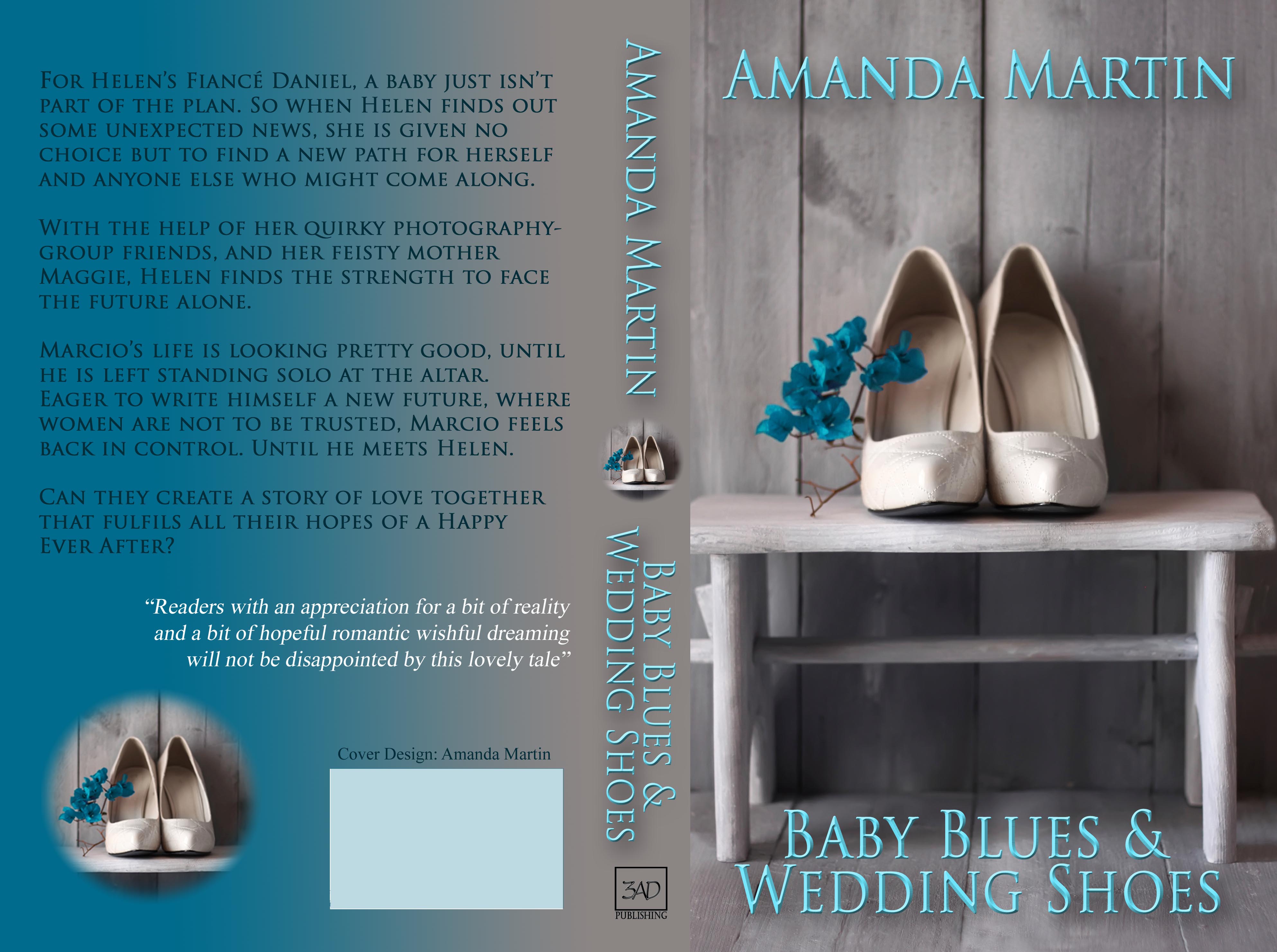
Following on from yesterday’s request for advice and opinion, I need to ask about back-story. It’s the bane of my life, and Class Act is littered with it. Baby Blues & Wedding Shoes was, too, in the early drafts, and I solved the problem by starting the novel six months earlier.

That will work to some extent for Class Act, (lovely – another massive re-write! 🙂 ) but there are two incidents in the female protagonist Rebecca’s early life that impact on her current personality, and I don’t know how to integrate them. At present they’re written as flashbacks. Shudder. Unfortunately I actually like how they’re written so it’s easy to become attached to the scenes rather than put them in the bin where they should be.

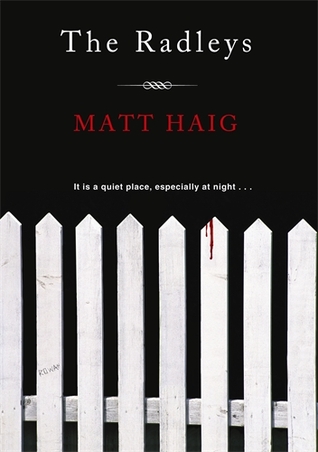
The problem is I get defensive of my characters and want to explain why they have the flaws they do. But how much detail is necessary or desirable, and when should it be revealed? In The Radleys, by Matt Haig, the back story is cleverly integrated and is also overlaid with the character’s perception, so you start out with a half truth that colours your view of a character’s actions, and that view evolves and changes towards the climax of the novel. Masterful stuff. I’m pretty certain I’m not skilled enough just yet to pull it off without getting in a muddle.

The other problem is defining the novel’s inciting incident. Really, both bits of backstory are. Or the moment where the lead protagonists meet, which is where the novel currently opens. Baby Blues originally started with when the love interests meet, too, and after the rewrite that scene ended up a third of the way through the book. I like it, because you get to know the characters first, but then it blows wide open what the first turning point should be. We make decisions every day which, with hindsight, turn out to be inciting incidents. The job we take,   or the bus we catch that breaks down or gets blown up.

Incidentally, Jami Gold has a great post on the importance of getting these elements or ‘beats’ right in a novel and how defining them isn’t always straightforward! See Why Story Structure Matters. Unfortunately, even with her helpful Beat Sheets, getting the right elements into a story at the right time is (for me) the hardest part of writing.

So, right now my options are revelation through phone conversations with a friend (tricky), adding a prologue (generally advised against), or vague hints that might be missed or misunderstood. It was much easier with Claire in Two-Hundred Steps Home, as she didn’t really have a back story that mattered!

What are your views? Any great examples of how inciting incidents in childhood or early adulthood have been successfully integrated into a story? How much do you need/like to relive past experiences that have influenced a character? When do you need to know the details? Do you need to already care about a character, or do they help you care? Sometimes it feels like I’ve forgotten how to write a novel!

How Many Heads?

How many viewpoints in a novel?

How many viewpoints in a novel?

When you’re reading a modern third-person limited perspective novel (he said, she said from inside a single character’s head – see this great post for an explanation on narrative modes in literature) how many heads are acceptable?

When I first wrote Baby Blues & Wedding Shoes, which is written from two key protagonists’ perspectives, I switched from head to head without thinking about it, and would quite often jump into the head of minor characters. Strictly speaking that’s nearer third person omniscient, without that irritating ‘know-it-all-ness’ of an Eighteenth Century narrator.

I didn’t give it much thought, until a Beta Reader pointed out that head-hopping within a scene can be confusing and is generally avoided, and that it wasn’t a good idea to see inside the head of minor as well as major characters. It came as a surprise, because I didn’t really think about it as I wrote – the almost-omniscient style seems to be my default.

That probably reflects the literature I read: authors like Georgette Heyer, who write in what I suppose to be omniscient third person. Even though Heyer spends most of the time following one person’s viewpoint, she’s happy to hop into the thoughts of anyone relevant to explain the scene. Even though I’ve studied the theory and know the principles I still struggle when I write (and even when I read) to always know the difference. I read this great article today that helps to explain it.

That’s why Dragon Wraiths was refreshing – in first-person-present you only know what the main character sees, hears and feels. It adds other challenges to do with character development and so on, but you don’t have to worry about head-hopping.

Class Act Cover

Class Act Cover

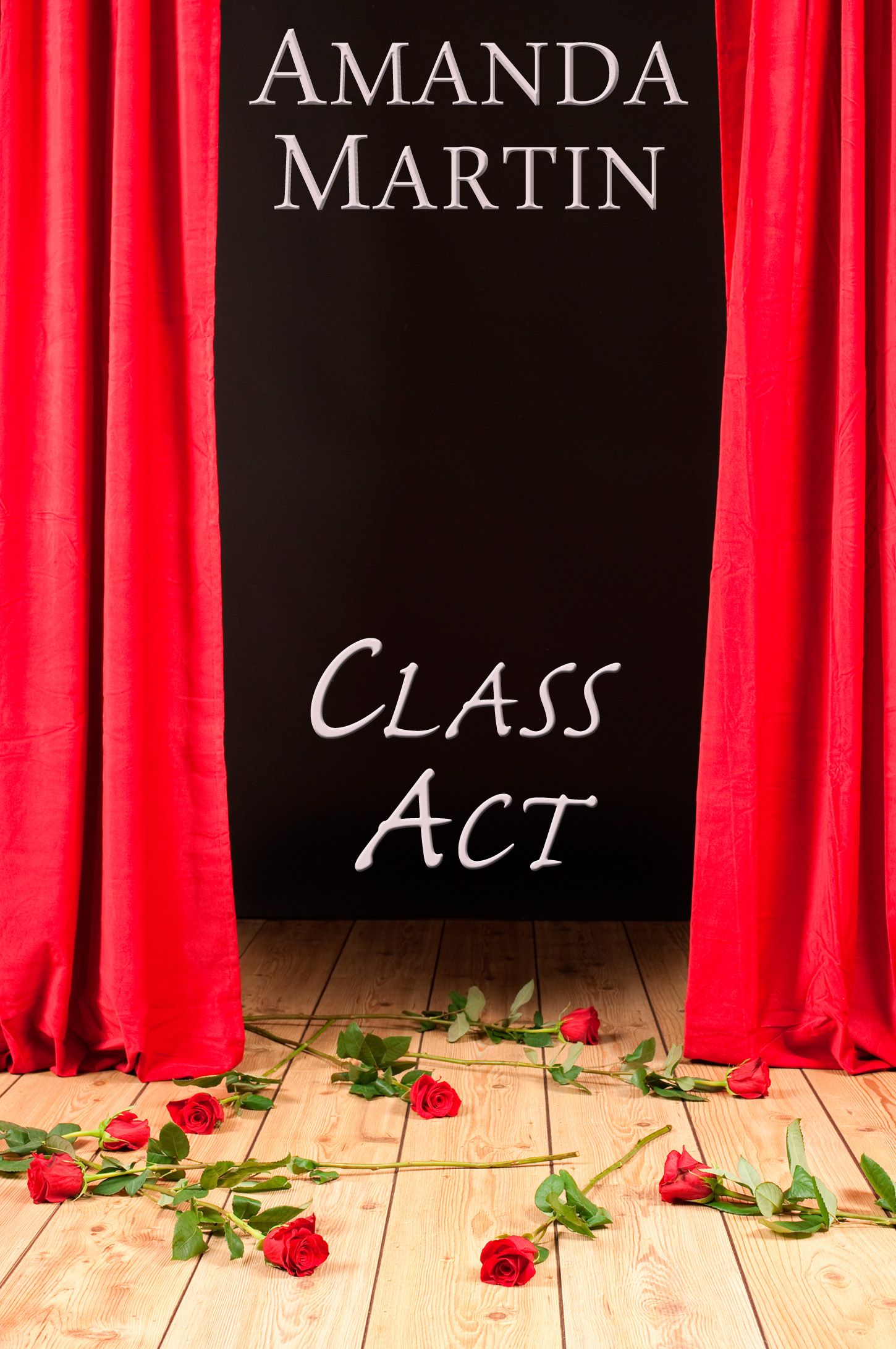
I’ve just been through my first draft of Class Act and, like Baby Blues, it’s littered with head-hopping. That’s fine, I can fix that. But, also like Baby Blues, some of my favourite writing is inside the heads of secondary characters. I cut it all out in Baby Blues but now I’m wondering if that was entirely necessary. Maybe it’s just my voice, my style. Maybe I tend more towards multi-voice perspective or omniscient than tight third person (sticking to one head). Maybe I should embrace it rather than fix it.

I say this only because I’ve just finished The Radleys by Matt Haig and it reads like a soap opera script, seen from everyone’s perspective. I have to admit it added to my enjoyment of the novel rather than detracting from it. (Possibly because I love omniscient authors like Heyer.)

Now Haig is a much more experienced and talented writer than I am, and my execution is bound to fall a long way short, but that’s no reason not to try.

So, my question is, if you were reading a novel that took you on a brief trip inside the mind of the mum or the best friend, would that confuse or irritate you? I guess until I finish my revisions and send it out to Beta readers I won’t know. Here’s an example scene to show what I mean.

Daphne looked up, and her smile was like the sun rising over the horizon. She put the tapestry aside and rose to her feet, holding both hands out in greeting. Alex took two paces forwards and enveloped her in a bear hug, her scent infusing the space between them, bringing with it all the comfort and memories of childhood. He hadn’t been home for weeks, not since he’d started rehearsing the play, even though it wasn’t that far away. He felt terrible, but his mother of all people understood his need to carve his own way in the world, away from Sidderton.

“Alex, darling, how lovely to see you,” she said as she finally released him from the embrace. “Sit down. Does your grandfather know you’re here yet?”

“No, I came to see you first, of course.”

“You mean you crept around the side like a naughty school boy?”

His smile made him look every inch as she’d described him. “Maybe. I need to ask for something and I thought I’d ask your advice about the best approach.”

“You need money? I thought you’d got a handsome settlement when you left your last place of employment? Didn’t you talk of share options?”

“I don’t need money, and as if I’d ask Grandfather if I did! He’d roast me alive. No, it’s more complicated than that.”

“Then it’s about a girl. Have you got someone in trouble?”

“Mother!” Alex was genuinely shocked. “What do you think of me? Firstly, no, I haven’t got some poor girl pregnant. Secondly, this is the twenty-first century, not Downton Abbey. We don’t buy the servants and wenches off with money these days you know.” His tone was ironic and gently chiding. Sometimes he thought living here at the hall had confused his mother into believing they lived in the eighteenth century.

“You are partly right though,” he continued, “it is about a girl.”

“I thought you had decided girls were all fortune hunters out to ensnare you? Has one managed to catch you?” She looked worried, and he laid a hand on hers to reassure her.

“Well, I suppose I have been snared, but not for my fortune. She doesn’t know anything about it.”

“What do you mean? Does she think we are one of those impoverished families who spend every penny on their crumbling manor?”

Alex thought about the immaculate interior of Sidderton Hall – Mother had been an interior designer before she married – and laughed. The laughter lit his handsome face from within, like the sun breaking suddenly from behind storm clouds. Then the clouds drew across the light again, as he realised his charade was no laughing matter. He had to think of a way to make Rebecca love him despite his background. He had to get to the bottom of her dislike of the landed gentry – there had to be more to it than a few idiots being rude to their gardener. That was for another day. He was here to help her build her future, whether that included him or not. Acts of altruism were not part of his general make up, and he found he quite liked the sensation.

Daphne sat patiently whilst these thoughts played out across her son’s even features. She was used to her son’s internal dialogue and knew he would present his conclusions when he was ready. He shifted his position on the ancient and battered leather sofa that dominated the family room and she knew he was ready to speak.

“I need to get grandfather to agree to sell the old hay barn down in the south east corner.”

Whatever Daphne was expecting, it wasn’t that. She spoke aloud her first thought.

“No Sidderton has ever sold one inch of the estate, not even when they faced bankruptcy”.

Alex laughed suddenly as she said it. She gave him a bewildered look and he clarified: “That’s what the estate manager said to me, and I thought the same recently when I was talking with Rebecca about buying property. It must be a mantra that we’ve all been brainwashed with.”

“What makes you think you’ll convince grandfather otherwise, when you know it is so much against the family way?”

“Because I have to,” his voice was urgent, “Because it’s important. Just because that’s the way something has always been doesn’t mean that’s the way it always has to be. Because I want to help the woman I love, and – if I’m really lucky and dig myself out of the huge hole I’m in – it won’t be out of the family for long.” His words came out in a rush, as if to explain it all to his mother suddenly seemed both difficult and vital.

In limited third person the entire scene should be either from Alex’s or Daphne’s perspective, or there should be a scene break when it hops from Alex’s to Daphne’s head. But, to me, the scene works fine as it is. Maybe it’s the subject matter: there is an air of Heyer, or of nineteenth-century romance, about the novel. Should I have the same consistent voice across all my novels or is it permissible to shift it according to the needs of the novel. Answers on a postcard, please… 🙂

Terry Pratchett: Fact and Fantasy

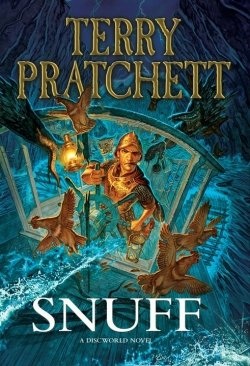
Snuff - About Dickensian London

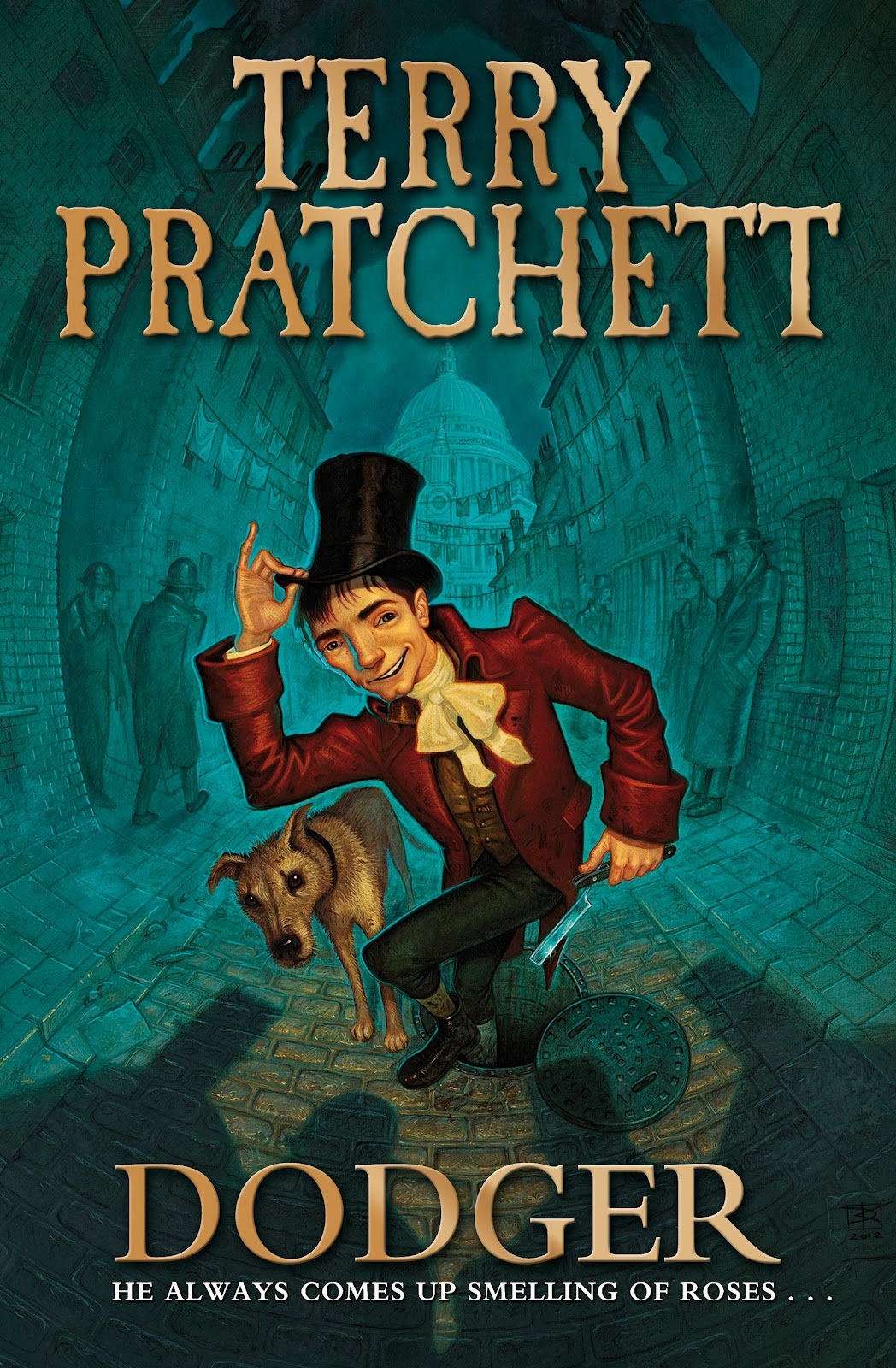
Dodger – About Dickensian London

Those of you who regularly follow this blog will know that I don’t generally write book reviews. In fact I subscribe to the view that it’s very difficult for a writer to review a book as a reader might.

However, partly because I want to carry on with the daily blogging, and partly through self-interest (as one of my most visited posts this year is a book review) I’m going to try and write a few on the blog in 2014. I want to concentrate on books where I have no connection to the author – those people I have met through the blog or who I have beta-read for – because I read those books differently. I don’t enjoy them less (probably more, actually) but I’m usually too close to be objective.

But books I’ve picked up at the library, or authors I’ve read for years, well I’ll happily pass on any observations that occur to me and we’ll see how it goes. I suspect it will be more a ramble than a review, such is my style! As a happy coincidence I’ve just finished two books by my favourite author of all time, Terry Pratchett, so that’s a good place to start.

Of the two books – Snuff, A Discworld novel, and Dodger – Snuff was by far the most enjoyable for me. I’ll admit I may not even have read Dodger if I’d bothered to check the blurb and seen that it wasn’t a Discworld novel. I’m glad I did read it, even though it was a struggle to finish, because it made me appreciate Snuff all the more. I also discovered that it isn’t just Terry Pratchett I love, but Fantasy as a genre; particularly his form of Fantasy.

Dodger is set in 19th Century London and includes characters such as Charles Dickens, Disraeli (former UK Prime Minister) and Henry Mayhew (a nineteenth-century English social researcher), based on their real life counterparts. One can then easily imagine that the lead protagonist is meant to be the model for the Artful Dodger and the story feels more about showing the inspiration for Dickens as a writer (at one point Dodger finishes his soup and asks for more), than exploring Dodger as a character, or what it really meant to live in Nineteenth-Century London.

For me, the novel lacked Pratchett’s usual flair for appealing characters, suspense-driven plot or great humour and dialogue. I struggled to finish it even though, as a super fan, I really wanted to like it. The novel felt like a vehicle for some ideas that had been bubbling in the author’s brain, that were then shoe-horned into a story. Or *shudder* like an Eighteenth-Century Bildungsroman novel, like Tom Jones by Henry Fielding. The book seemed to try too hard to be clever, with the references to historical figures and real places. But I may be biased in this view because, when it comes to blending fact and fiction in a novel, I hate it.

I consider myself something of a reluctant historian, as a result of doing both A Level and Degree History, despite discovering a real love for English Literature that resulted in me switching camps in my third year and then for my Masters. As a result I find historical fiction to be too much stuck in both camps. Do I suspend disbelief, as a reader and student of fiction, or do I concentrate on the factual representation, as a Historian? When I read books like this, I find the urge to check details and constantly ask “Is that true?” Or I feel ignorant for not knowing what is and isn’t historical fact.

Snuff - A Discworld Novel

Snuff – A Discworld Novel

Give me allegorical fantasy any day. Because the beauty of the Discworld novels is that they are also based on our society, albeit one that is viewed through some twisted prism (as a former Insurance Manager, the introduction of Inn-sewer-ants in Colour of Magic remains one of my favourites). Quirm for example is based on France, with it’s avec food and it’s rue de Wakening (read it out loud). Some of the best laugh out loud moments are due to recognising the parody, but the stories work without it and therefore don’t make you feel stupid.

That said, I found Snuff harder going than previous Discworld novels, and a bit darker and more heavy handed in the social commentary, focussing as it does on the race of Goblins, and whether they are considered sapient beings or vermin. This might be evidence of an author who despairs of the world, but it’s the social commentary in all the books that makes them so brilliant and poignant.

Samuel Vimes – the lead protagonist in Snuff – is a wonderfully complicated protagonist. Having read all the Discworld novels, I feel I have tracked his progress from a mere Captain of the Watch in Guards! Guards! to Commander Vimes, Sir Samuel, Duke of Ankh, married to Lady Sybil (also a brilliant character) in this book. Alongside my other favourite Discworld character, Granny Weatherwax, Vimes is fascinating for his level of self-awareness and his inner turmoil. Both are characters who battle with personal demons constantly and defeat the bad guys because they know (or at least fear) they’re no different underneath.

Although it took longer to get going, once I was immersed in the story I was swept along to the finish. Some of it was a little predictable (when you’ve read eight or nine books featuring the same character you do learn how they work) but being allowed inside Vimes’ head as he battled his past and his instincts resonated with me. Powerful, brave stuff.

Terry Pratchett has a writing style that doesn’t spell anything out. The nuances are there for the alert, and sometimes that can be frustrating (when you’re not alert, running on a few hours’ sleep!) As a writer, though, I feel it’s an important lesson in treating the reader as someone smart or, as one of my writing books puts it, Resisting the Urge to Explain (RUE). It also means you can interpret the characters and their actions, and be left wondering if you really know them all that well (particularly a character like Vetinari, the tyrant of Ankh-Morpork).

I find the Discworld novels always stay with me after I’ve finished them, with questions and challenges and difficult subjects (something I didn’t feel at all with Dodger). Snuff may not have been up there with the best, but it was still a rollicking good read. Bring on Raising Steam!

Nearly There: 2013 365 Challenge #364

My sister bought me this for Christmas!

My sister bought me this for Christmas!

Oh my goodness, here we are, my penultimate post of 2013. When I started the 365 Challenge back in early January, I wasn’t sure I’d make it to the end of the month, never mind the end of the year. By Day 4 I was just beginning to realise what was involved.

It wasn’t merely committing to writing 1,000 words a day (on average: some days a post can be nearer 2,000 when both parts are combined) but also finding time to edit and proofread those words; to make sure each post entry and each novel installment made sense; then adding photographs, tags, categories and getting it live.

I feel like I’ve come a long way.

When I began a year ago, I thought the daily novel would be the main part. I hoped to get blog followers from people who wanted to carry on reading what I was writing. That didn’t happen on the blog, but rather over on Smashwords, where the downloads across all volumes number in the thousands. Here on the blog, while the increase in followers hasn’t been massive, I feel more like I have made some really great friends. I’ve met fellow writers, artists and parents, I’ve discovered one or two amazing Beta Readers, I’ve felt – like Claire – that I’ve found my way home.

I’ve also grown as a writer. My confidence in my ability to write is significantly greater now, after the countless hours I’ve invested in Two-Hundred Steps Home. I know, now, that I can write and polish a 500-word blog post, or a 750-word scene in a novel, in under an hour.

Thank you to my amazing kids!

Thank you to my amazing kids!

I can research anything I feel the need to discuss, from a remote pub in New Zealand to what it really means to survive suicide. I can format and self-publish a novella in a few hours and get it through Smashwords’ Autovetter first time (although I haven’t resolved my issue with their Premium Catalogue!)

Best of all, I’ve learned how to edit my own stuff and Beta-read for others. When I began my journey I was trying to proofread Baby Blues & Wedding Shoes (or Pictures of Love, as it was back then). I couldn’t do it. Line-editing left me cold. Now I know that I have to do it in chunks, and then there is a delight in crafting the words and making the sentences flow.

Let’s not leave out that I’ve written 285,000 words of fiction this year, and will have published it as 12 separate volumes, each with a cover designed by me. On top of that, I estimate that I’ve written a further 200,000 words in blog posts. That’s nearly half a million words. In one year. If they were novels, I would have drafted out five. Five! During 2 or 3 days of childcare and lots of late night sessions.

I couldn’t have done it without my family. My husband has been amazing. He’s my best critic and my biggest fan. He’s taken the children when I’ve needed to write (I couldn’t have done the challenge if he hadn’t been had home for most of the year), he’s put up with me sleeping on the sofa then prising my eyes open at 10pm to tap out five hundred words. He’s put up with a dirty house and takeaway pizza.

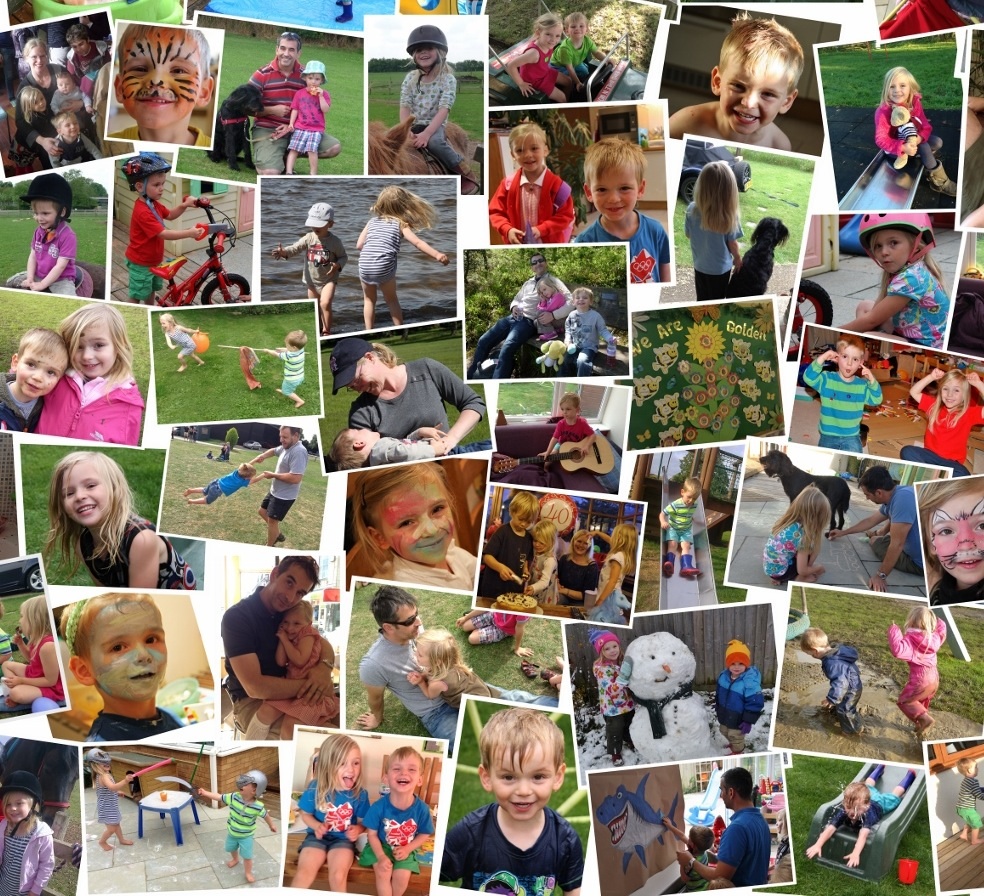
My poor children have dealt marvellously with a tired and grumpy Mummy who constantly has her laptop open or is always taking pictures “for the blog”.

My amazing family

My amazing family

Their recompense is that they have this unique diary of a year of their lives. Reading back through my posts is to read through some of the highs and lows of being a parent (and a human being).

None of my posts are likely to see me Freshly Pressed: I may have learnt to write fast, but I haven’t learned to write profoundly. Still, it’s all been written truthfully and from the heart.

And so I thank you all for listening. Without readers, followers, this would all be me shouting into the wind. Knowing people cared about me, about Claire, about the story, has kept me going.

The support of people on this blog has also led to me releasing two of my novels this year also; something I still find incredible.

To anyone thinking about undertaking a writing challenge in 2014 I say, “Do it!” And, so you don’t quit, get out there and tell people. Get support. Face humiliation for failing. Because some days the only thing that got my tired body up and at the laptop was the fear of failure. Not that failing is bad. I love the Samuel Beckett Quote “Ever tried. Ever failed. No matter. Try Again. Fail again. Fail better.”

Don’t be afraid to fail. As I said to my daughter, when she threw a tantrum for losing at her second-only ever game of checkers this evening, “It’s not winning or losing that counts, it’s having fun along the way.”

And it’s been fun. Mostly. 😉 See you tomorrow for the final installment!

_______________________________________________________________________________

Below is the next installment in my novel Two-Hundred Steps Home: written in daily posts since 1st January as part of my 2013 365 Challenge. Read about the challenge here.You can catch up by downloading the free ebook volumes on the right hand side of the blog:

_______________________________________________________________________________

Claire could barely swallow the food. Her throat felt as if it was lined with grit. She put down her fork and sipped at her water. Across the table, Conor’s plate was equally full. They’d exchanged only pleasantries since arriving at the restaurant. The longer they sat, the harder it was to speak the words that hovered between them like a flock of hungry seagulls.

“Walk with me.” Conor’s eyes pleaded with her and she nodded. While she retrieved her cardigan and bag he went to pay the bill. They left the restaurant in silence and she followed him down through the high street towards the shore.

The sun had sunk below the horizon and streetlights cast shadows across the empty beach. Out on the water a few boats bobbed like ghosts, but it was a far cry from the crowds of the Carnival only weeks before. With the children back at school there was an air of ending about the town; a sadness that tugged at Claire like a riptide and pulled her under.

What must it be like to live in a seaside town, where the passing of the seasons takes a back seat to ebb and flow of the tourist trade?

She wondered if she would feel the same at the activity centre, but knew that she wouldn’t. Timothy planned to take children all year round, with summer camps in the long vacation and school trips for the rest of the year. While the nearest town was a tourist resort, it also had a harbour and a university. Different blends of life intertwining to provide a tapestry of endless change.

And where will I fit in, in that tapestry? She didn’t know the answer, but knew it didn’t matter.

They walked along the shore, to the mournful sound of the tide sucking at the stones only to fall away. Conor took her hand loosely in his and the touch of his skin sent sparks across her body. She yearned to turn and yield to his embrace.

“When do you start?”

Claire jumped as his voice came loudly out of the dark. She didn’t need to ask what he meant.

“Monday.”

“So soon?”

She heard the pain and hardened herself against it. “The first school group arrived this week. They need me.”

“And what about me? What if I need you?” Before she could respond, he spoke again. “Sorry, that’s unfair. God knows you’ve done enough for other people this year. I don’t want to be another duty.”

He dropped her hand and ran his fingers through his hair as if trying to stop himself flying apart. She could just make out his face in the gloom and saw him give a wry smile.

“I tried. Really I did. I wanted to support you in whatever decision you made. But then it was so perfect, spending time with you, and I couldn’t imagine letting you go. I still can’t.”

He reached up to stroke her face, before letting his arm fall again. “Why?” The word hung in the dark and she didn’t know how to respond. “Why is it so important to you to go?”

She searched her thoughts for answers. “Honestly? I don’t know. All I know is that I have to do this. If it means losing you, being lonely forever, then that’s the price I have to pay.”

Once she started speaking, the words wouldn’t stop. They rushed on relentless, like the incoming tide. “I’ve spent my life living the role I thought was expected of me. At home, at school, at work. I have to find my own path, even if that means slipping down the odd cliff.”

She saw him smile at the memory; a sad, nostalgic smile as they both pictured a bedraggled woman covered in grazes. She tore her gaze away and looked over his shoulder at the ocean, glimmering in the dusk. Memories would only imprison her in a life she wasn’t ready to live.

As if answering a question he hadn’t articulated, or maybe a question from her heart, she continued, “Yes, it’s worth it. Yes I’ll sacrifice having an iPad and a shiny car, a career with prospects, even the man I love like breathing, if it means I can be true to myself.”

The word love reverberated around them. When he reached for her, she saw the longing in his eyes and felt herself waver. She had to escape before her resolve crumbled into dust, eroded like the limestone cliffs that anchored his heart in a town which would never be home.

Stretching up on tiptoe, she brushed a kiss across his lips, then turned and ran up the beach, before he could see the tears falling down her cheeks.

***

Write Now, Write Naked: 2013 365 Challenge #330

The Inconvenient Urge

The Inconvenient Urge

I’ve read several posts this morning with great writing advice in them, or posts about the importance of writing. The online blog community is a wondrous resource for all things writerly. Even if you aren’t a writer, these are still great reads.

So I thought I’d share the highlights of my morning reads (as a nice change from hearing all about me and my lovely children!)

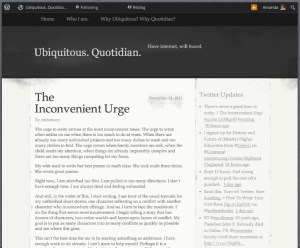
The first post I read this morning was by Robert Benson, on his blog Ubiquitous. Quotidian, called The Inconvenient Urge.

The post discusses how the need and inspiration to write comes at the worst possible times:

“The urge to write often settles on me when there is too much to do at work. When there are already too many unfinished projects and too many dishes to wash and too many clothes to fold. The urge comes when family members are sick, when the child needs my attention, when things are already impossibly complex and there are too many things competing for my focus.”

Aside from the fact that it’s nice to hear a man also complaining about the laundry and the dishes (hurrah it isn’t just me!) it is also a feeling I can completely relate to. I went to write in the local Motorway Services this morning (it’s not far from preschool and I find if I go there, rather than going home, I get more done. Especially when the internet isn’t working!) Even though the WiFi was on today, meaning I wrote fewer than half of the 4,000 words I wrote last Monday, I still got engrossed enough in Claire’s journey to forget to get my McD breakfast before 10.30am. 🙂

I’ve been known to be late for the school run, or lose several hours of what is meant to be productive housework time, or forget to walk the dog, because I’m wrapped up in another world. As Robert Benson concludes, however, “the urge to write comes when it will. Be grateful. Be ready. It is always inconvenient.”

Thought Catalog Article

Thought Catalog Article

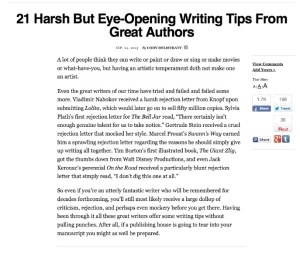
The second post I read today (via http://jeryder.blogspot.co.uk) was a list of great quotes on writing by famous authors, on the Thought Catalog blog. Entitled 21 Harsh But Eye-Opening Writing Tips by Great Authors, my favourites include these:

11. Imagine that you are dying. If you had a terminal disease would you finish this book? Why not? The thing that annoys this 10-weeks-to-live self is the thing that is wrong with the book. So change it. Stop arguing with yourself. Change it. See? Easy. And no one had to die. – Anne Enright

and

17. Substitute ‘damn’ every time you’re inclined to write ‘very’; your editor will delete it and the writing will be just as it should be. – Mark Twain

The final blog I read today, by the Write Practice, was called Write Naked, and it discusses a favourite topic of mine: writing what you know. Like the author of the article, I used to think that suggested you could only write about your personal sphere of experience: meaning I could only write stories about marketing managers who had been to New Zealand. (Well, actually, that does feature quite a lot in my stories! Ahem.)

Write Naked

Write Naked

But that isn’t what it means. It means writing about the sensations you can relate to. It isn’t the detail of the job you do that defines it, but the emotions you experience along the way.

So, even though Dragon Wraiths is about a sixteen-year-old orphan, and that wasn’t my childhood, I could still draw from enough experiences of my life growing up to write authentically about loneliness and not fitting in and the exhilaration of being outside in nature.

In the article, Sophie Novak says:

“Write naked. The raw can be a million times more powerful than the best polish. Do you know why? Because truth shines.  It can’t be beaten by invention. Just forget any inhibitions, and share the truth. Your truth. It’s quite scary, and absolutely worth it.”

Or, as Neil Gaiman puts it, “The moment that you feel that just possibly you are walking down the street naked…that’s the moment you may be starting to get it right.”

________________________________________________________________________________

Below is the next installment in my novel Two-Hundred Steps Home: written in daily posts since 1st January as part of my 2013 365 Challenge. Read about the challenge here.You can catch up by downloading the free ebook volumes on the right hand side of the blog:

________________________________________________________________________________

“Right, boys, get dressed, we’ve got a busy day ahead.”

Claire laughed at the groans emanating from the bunks as she stuck her head around the door. The hostel had been mostly empty when they arrived, and they’d been able to secure adjacent rooms. After sharing with the boys for a week at the previous hostel, Claire was glad to go back to her own, private, sweet-smelling space.

The only movement her words provoked was a pulling up of duvets, muffling the grumbling protests that it was too early. Claire thought there had to be a happy medium between Sky waking up with the birds, and these boys who needed a rocket under them to get them going in the morning.

With a sly glance she said, “I guess I’ll have to cancel the motor boat trip then, and we’ll go to the seal sanctuary after all.”

The duvets flung back and first Jack and then Alex sat up in bed.

“Motor boat? Are we going water skiing?” Jack asked, looking adorable with his tousled hair and sleepy excited eyes.

Claire’s smile drooped. “Ah, no. We’re going on a day out on the estuary.” She watched their excitement fade, and thought quickly. “But we’re taking the boat out on our own. Have you steered a motor boat before? And are you any good at map reading?”

Alex’s expression remained disgruntled, but Jack jumped up. “Bagsy I get to steer the boat first. Thank you, Aunt– I mean Claire.” He ran over and gave her an impulsive hug.

Claire returned the embrace, a little surprised at the gesture. The boys were not very tactile, unless you included thumping each other and wrestling on the bedroom floor.

“You’re welcome, Jack. Come on boys, get dressed. This hostel is self-catering, so we’re going out for a fry up.” She’d learnt that a hearty breakfast was essential. As with men, so with boys: regular feeding was a core requirement of good relations.

*

Claire looked at the tiny craft bobbing on the water, and thought better of her great idea. For something licensed to hold six people it looked tiny.

And very vulnerable, she thought, watching the boat pull at its mooring as the wake of a passing yacht stirred up the water.

“You boys taking your Mum fishing?”

All three of them turned to look over as a man approached them, his lined face split in a wide grin. “They’ll be biting today. It’s high tide around mid-morning, but you’re best to wait until the afternoon. Forecast is good. Did you want to borrow some rods? I’m sure I can find something.”

Claire shuddered, and hoped the boys were more interested in steering the boat than pulling slimy squirming creatures from the water.

“Can we, Claire, can we, please? I’d love to catch something. I’ve never been sea fishing before.” Jack’s voice rose high with eagerness.

“Doesn’t Robert take you?” As she said the words, she tried to imagine her brother, as she knew him now, attaching maggots to a hook. “Never mind. Er, yes, if you can borrow all the gear I don’t see why not. Just don’t expect me to touch them. If you catch something you’re on your own.”

The answering grin from both boys was electric. Claire hoped the friendly stranger was wrong, and the fish weren’t biting. Leaving them discussing the merits of various types of bait with the man from the boat yard, Claire wandered off in search of caffeine. It was going to be a long day.

***

Bringing Scenes to Life: 2013 365 Challenge #325

Satellite view of St Mawes Castle

Satellite view of St Mawes Castle

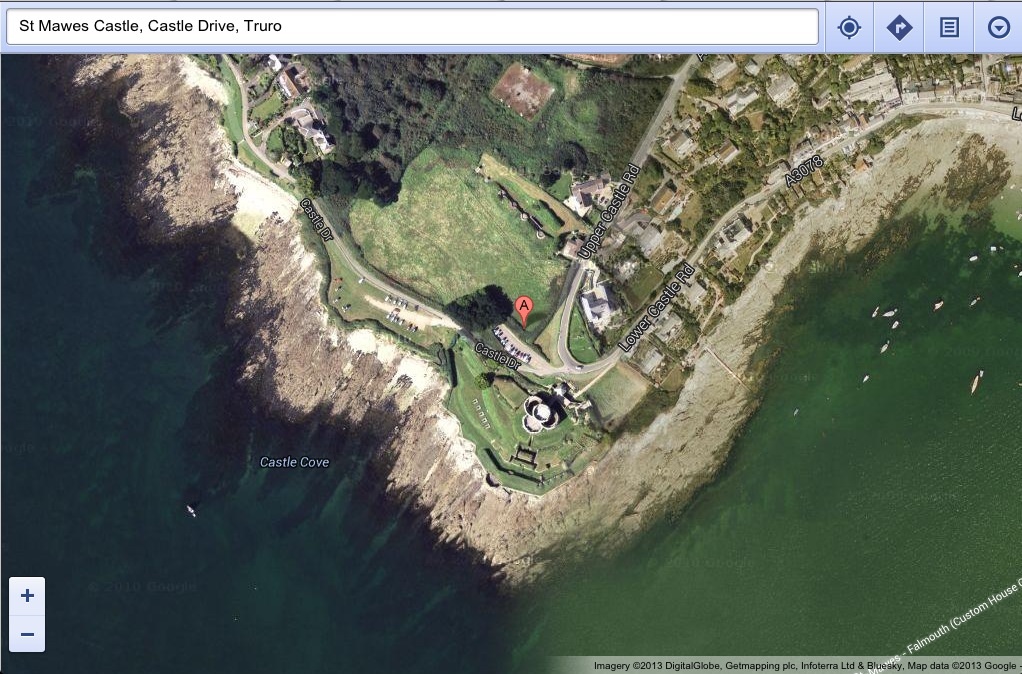
As part of my writing challenge this year, I have had to do a lot of research on the locations that Claire visits in Two-Hundred Steps Home, to make it plausible. Of course I could have made her journey entirely fictional, but that would have been considerably harder for me.

Because, while I can write dialogue in my sleep, I cannot visualise places. My brain, my imagination, doesn’t think in 3D or in colour.

Even when I’m reading a well-described fantasy novel, I struggle to picture the scene being described. And I’m okay with that.

I read for characters, for dialogue and stories and action. I’m not overly fussed about what a castle looks like, or how the armies are set out on the battlefield. Tell me a mystical city is beautiful and has spires and walkways, and that’s enough. No need to describe it in detail, I’ll only pull myself out of the story trying to build the picture in my mind, and get frustrated when I fail.

A house Claire could buy in Cornwall

A house Claire could buy in Cornwall

However, not everyone is like me, happy to exist inside a vague grey mist when they read. Some people like to be able to see the scene, to know the sea is visible in the distance, or whether the building is Georgian or Victorian or Modern.

Not only that; having characters exist in a three-dimensional space makes the action work. If a character is moving, even if it’s only drinking a glass of wine, it pulls the story forward.

My inability to visualise places used to be a major cause of writer’s block. I’d try and figure out what a character’s house looked like, and whether the phone was in the lounge, or if the post fell on the mat or into a box, and it would paralyse me.

Then I discovered the wonders of research and stealing appropriation, and I’ve never looked back. In the UK the main property website is Rightmove (although there are others). If I need a house for a character, I pop on Rightmove and find one.

Reviews on Tripadvisor

Reviews on Tripadvisor

I usually have an idea whether my characters live in a cottage or an apartment, what they might be able to afford, and I generally have a city or town or village in mind. When I’ve found the right one, (and pulled myself away from dreaming about cottages in Cornwall or houses in Wales) I print out the details (important because they disappear off the website when the house is sold, and are gone forever), and put it in a scrap-book.

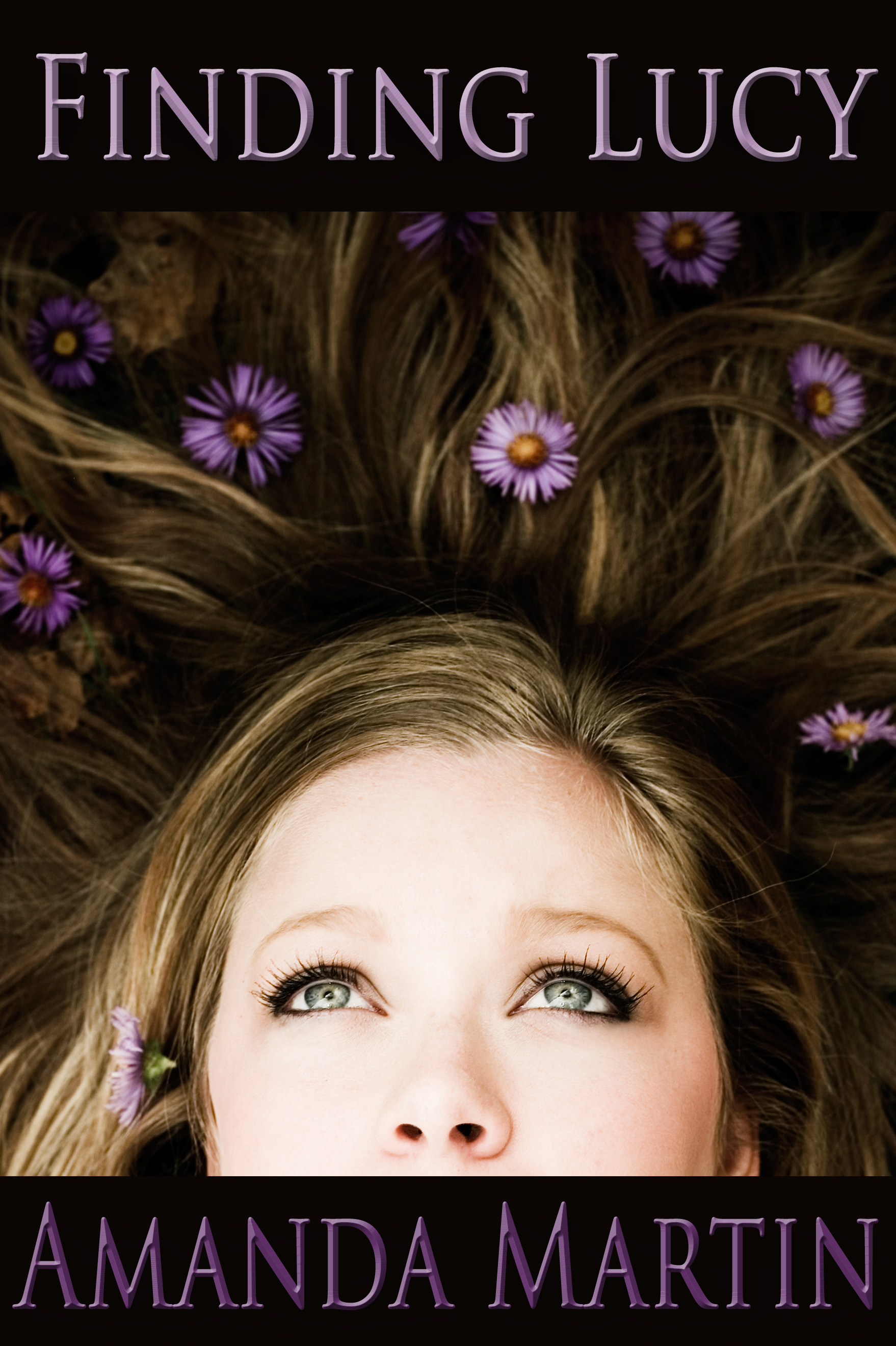
In Finding Lucy, (my first, though still unfinished, novel), I have the floor plans and everything for Lucy’s grandmother’s house. I know where the TV is, and the telephones. I don’t worry quite so much about that level of detail now, although it is useful for adding depth to a scene.

For example, instead of “Lucy ran down the stairs to answer the phone,” I can write, “Lucy took the steep stairs two at a time, knocking her hip against the breakfast bar as she reached for the phone. She kept forgetting her grandmother’s cottage was so darn small.”

Another thing I’ve found useful is Google Streetview. Looking at a two-dimensional photograph of a location is useful, but it can be misleading. If you go to streetview, though, (assuming the location is covered), you can literally walk down the road and spin round for a 360 view. You can see that there is a cemetery across the road, or that the bus stop is dirty, or that there are cars parked all along the street.

Streetview of St Mawes car park

Streetview of St Mawes car park

You can even get an idea about the weather. For a recent scene in THSH, it had been sunny all day in the story. Then I “drove” the road out to the hostel, as Claire did in a towering rage, and the streetview photos had stacked clouds along the horizon. Hey presto, her rage is mirrored by the approaching storm.

Incidentally, for Baby Blues and Wedding Shoes, which is set in London, I actually visited the street where I had located Helen’s apartment. I walked her route to the tube station and sat in the park where she first thinks she might be pregnant. It added extra detail, such as the smells and sounds, and how close the buses got to the pavement. You can’t beat first hand research, but I’d have to put in a lot of miles to follow Claire’s journey around the UK!
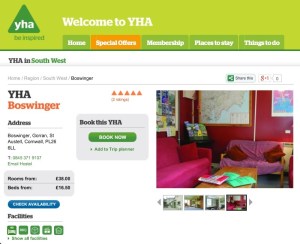
Hostel Claire's in currently

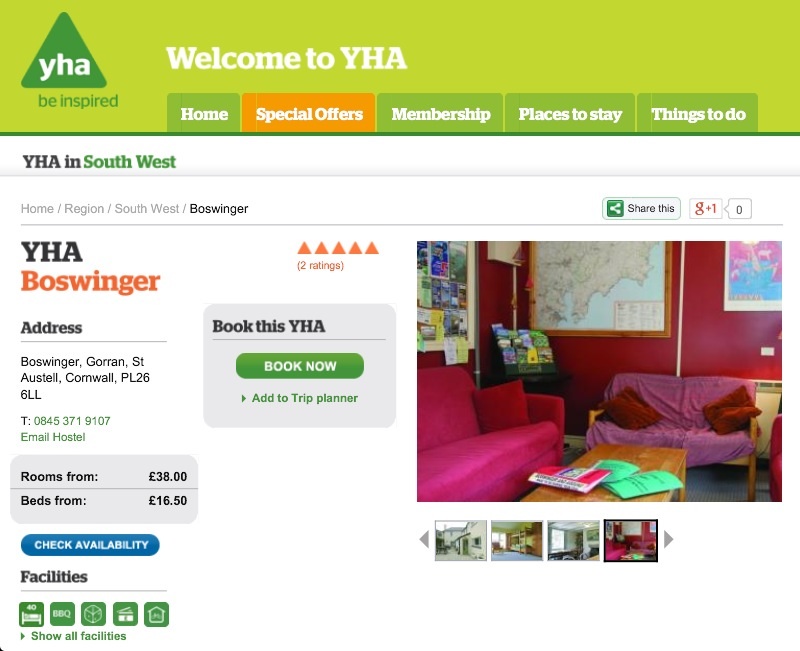
Hostel Claire’s in currently

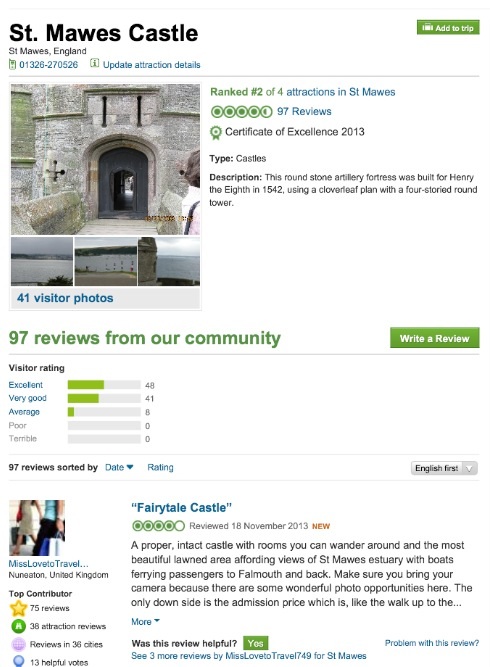
The final site I go to often for internet research is Tripadvisor, particularly for the places that Claire visits. I’ve never been to the Eden Project, Pendennis Castle or even Cornwall for that matter.

The YHA website has a few reviews and things to do, but for variety it helps to read a lot of different perspectives. Tripadvisor is how I found out that the Eden Project has a problem with queueing because of gift aid or how the English Heritage will ask you if you want to pay a thousand pounds for lifetime membership.

There isn’t a single activity that Claire has done, or a café that she’s visited, in the UK or New Zealand, that isn’t based on fact. I’ve even been known to check the opening times of the Starbucks and write the story around it! If you wanted to, with some planning, you could follow in Claire’s footsteps for about 95% of the story.

I try and get two or three reviews that agree before I write something (I’m always a bit worried about libel!) but it would be easy enough to make the place fictional, just to be safe. Reviews are brilliant, because they’re genuine and colloquial and so very varied. Two people can visit the same place, in the same week, and have completely different experiences, based on how easy it is to get in, the weather, who they are with, and their expectations. There’s half your story written, right there.

The world is at your fingertips, with a good internet connection and some patience. Sometimes it feels like cheating. But I prefer to call it research! 🙂

________________________________________________________________________________

Below is the next installment in my novel Two-Hundred Steps Home: written in daily posts since 1st January as part of my 2013 365 Challenge. Read about the challenge here.You can catch up by downloading the free ebook volumes on the right hand side of the blog:

________________________________________________________________________________

“Hello, how’s it going? I thought I’d call and make sure you’re still alive. Or, more to the point, that your brother is. The look on your face when you left the restaurant was something to behold.”

Claire cradled the phone to her ear and looked across to see if the boys were listening. They appeared to be engrossed in some car show on the TV. Even so, Claire kept her voice low as she replied to her boss’s question.

“We’re all still alive. Just. Have you any idea how far you have to go to find a McDonalds in Cornwall? Robert’s gone back to Geneva.”

“With a flea in his ear?” She could hear the grin in Conor’s voice.

“I never understood that phrase. But if you mean did I let him know I was cross with him: I tried. Might as well attempt to chastise an elephant for all the good it did me.”

“And the boys? Do you think you’ll cope?” The tone of concern in his voice was almost masked by the humour, but not quite. It made Claire’s stomach twist and squirm.

“Jack will be fine. He’s a nice lad; open and enthusiastic, if a little eager to emulate his brother.”

“And the other one?”

“Alex. Hmmm. Let’s say he’s practising hard for his teenage years. If the chip on his shoulder gets any bigger he’ll fall out of his bunk at night.”

“Must be tough, not having a settled home at that age. He might even have girl trouble.”

“At twelve?” Claire’s voice rose, and Jack glanced at her before turning back to the screen.

“Oh, yes. Didn’t you say they were at boarding school? Is it mixed? Not that that matters. Twelve was about when I, well, never mind.”

“Twelve?” Claire felt the blood drain from her face. “Seriously?” She tried to remember how old she was when she first even noticed boys. Then she realised it wasn’t the conversation to have with her boss, and she coughed. “Anyway, if that’s it, I’m sure it will blow over. They’re only here for a fortnight.”

“Did you want me to come out with you guys tomorrow, help you ease into it a bit? I’ve got brothers and nephews; I might be able to help.”

The surge of gratitude warmed Claire from her toes to the tips of her fingers. Then she realised what impression it might give and the words of acceptance died on her lips.

“Think of it as a work assignment,” Conor added, apparently as an afterthought. “We can go visit a castle or something and take notes together.”

“Are you checking up on me?”

“Would I? No, you’d be doing me a favour, actually. I’m meant to be going to Mass in the morning, for the baptism of some random cousin in Birmingham. I can live without it. Mum thinks because I’m in the same country I should go.”

“Same country, yes, but Birmingham is miles away. Is that why you came to St Austell; to hide? You don’t have a work appointment at all, do you?”

“You’ve found me out, I confess,” he said, then fell silent.

Claire’s mind filled with conjecture. Escaping a Baptism seemed a flimsy excuse to drive all the way to Cornwall. She didn’t want to think about it too deeply, so she said, “Well, if you’re sure, that would be great. Thanks.”

They agreed a time and place to meet in the morning and hung up the phone. Claire curled into the corner of the sofa and let her mind wander.

*

Claire’s heart gave a little hiccup when she saw Conor strolling towards them. It had been a difficult morning already and it wasn’t yet ten o’clock. Alex and Jack had bickered non-stop over breakfast, and then Alex had refused to come with them to the castle, insisting he was old enough to stay at the hostel by himself. He tried to hide it, but Claire saw him with a phone clutched in his hand, and she began to suspect that Conor might have been right.

Damn him.

The boys had moaned all the way up from the car park and now, looking at the site from the outside, Claire thought they should probably have gone back to Pendennis Castle, on the other side of the water.

“Top of the morning to you.” Conor said in greeting as he approached, and Claire recognised the jovial Irish man act he’d put on for her mother, what felt like months ago.

She rolled her eyes at him, then gave him a meaningful look, trying to convey some sense of the morning they’d had. He gave a tiny wink, barely more than a crinkling of one cheek, and turned to face the children.

“Hello, I’m Jack.” Claire’s youngest nephew said brightly, holding out his hand. Conor shook it formally then turned to face Alex.

“And yer man must be Alex. Pleased to meet you.” Conor had the sense not to hold out his hand to be left hanging. Alex stood with his hands buried deep in his jeans pockets and stared at the ground. With a twinkle in his eye, Conor winked at Claire again.

“Shall we go in?” Claire said, leading the way to the entrance and trying to ignore Alex’s fit of the sullens. She’d hidden most of Robert’s money at the hostel, retaining enough to pay for their tickets and lunch. When she handed over the fifty-pound note to a suspicious cashier, Conor sidled up behind her.

“Big brother flashed the cash then? At least you haven’t got to pay for his grumpy kids as well.”

“You mean Alex? I think you might have been right,” she murmured. “He’s been clutching his phone like a lifeline all morning.”

“Ah, love’s sweet torment.”

She blushed hotly and she turned away in confusion. With a throaty chuckle, Conor moved to stand by Jack. She heard him ask about the boy’s home town and school, and felt able to breathe again.

Just what game is he playing?

Whatever it was, she wished she knew some of the rules.

***

Why I will always be a Pantser: 2013 365 Challenge #323

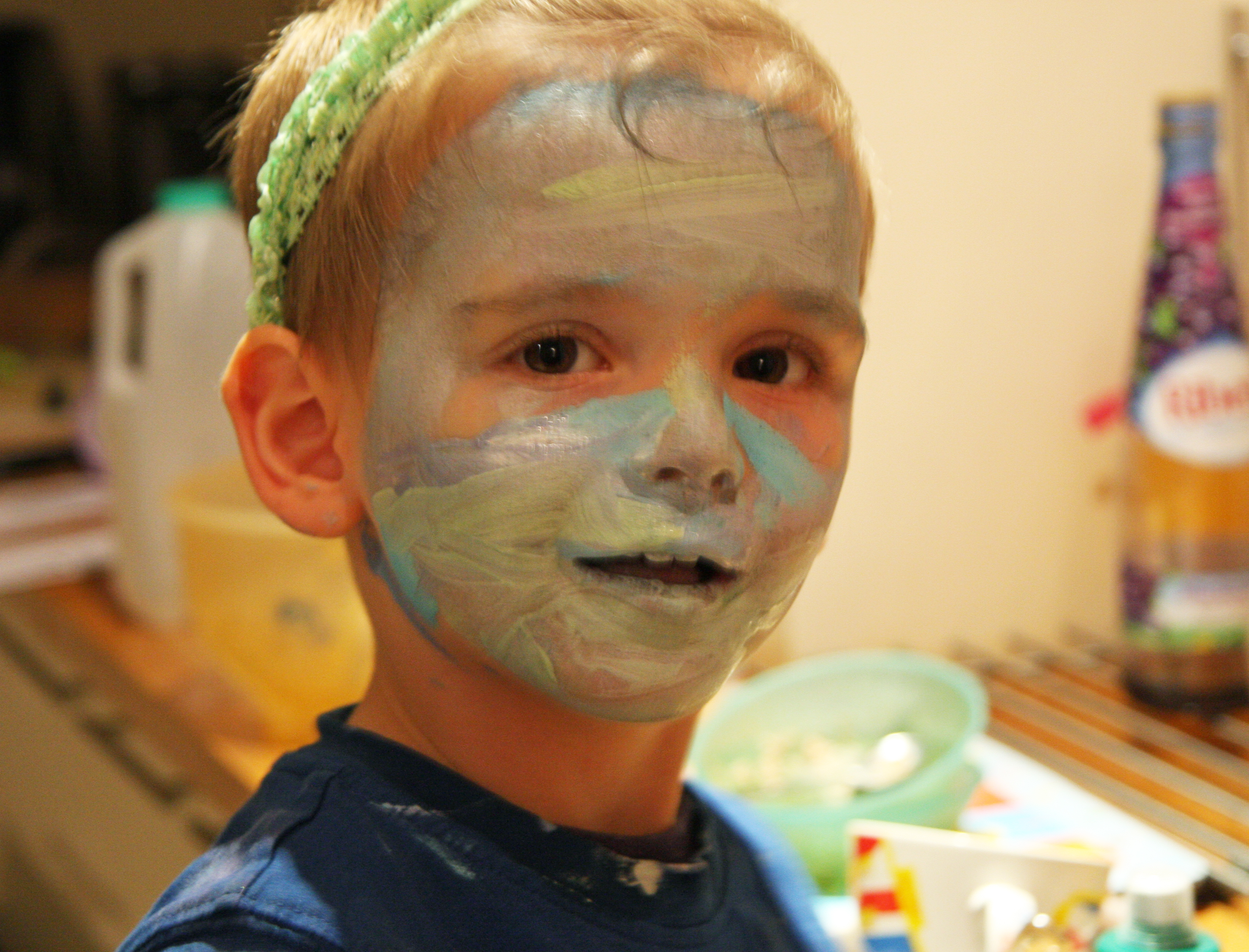
Letting the kids paint their own faces

Letting the kids paint their own faces

In a fit of inspiration on Sunday morning, I wrote notes for the next few installments of Two-Hundred Steps Home. I don’t do it very often, partly because my mind goes blank as soon as I’ve written the day’s 500-1000 words and partly because planning isn’t in my nature. When I write, I have a (very) rough idea of how a story will end but that can and does change as I come to know my characters better.

With THSH I’ve thought of a dozen endings, all of which have been scrapped as the story has followed its twists and turns. I admire people who plan even one book, never mind a whole series, as Two-Hundred Steps Home has become.

Incidentally the books I’m reading at the moment are one story told over ten volumes (although the second set of five possibly were added after the first five were finished) and it all hangs together. They were published year after year, with no chance to go back and change stuff, yet there are hints in book one that only come to fruition in book five or ten. My response to that is Wow. Since writing Claire’s story, there are loads of things I’d go back and change if I could, if I wasn’t writing it live, as it were.

Artistic face painting!

Artistic face painting!

Maybe it’s because they’re plot driven rather than character driven stories. Maybe I’m just missing a writing gene. All I know is that, if I plan for something to happen, my characters always mess it up.

For example my notes had Claire falling apart in her confrontation with Robert, because she’s all emotional about Conor. One commenter on yesterday’s post suggested Conor should come and punch Robert. Neither situation suited Claire. To be honest Robert was not really on her radar except as the person who ended her lunch with Conor early.

She was angry but still in control. How far she’s come, I’m so proud. 🙂 She doesn’t need a man fighting for her and she won’t let Robert’s arrogance derail her. Besides, he’s her brother, she’s used to him being an arse (and doesn’t he do it well?)

Without intention, Claire has allowed me to set up a comparison between Robert and Conor, a parenting story line and some fun dialogue. Much better than my ideas, that’s for sure. My advice? Trust your characters, they know what they’re doing.

________________________________________________________________________________

Below is the next installment in my novel Two-Hundred Steps Home: written in daily posts since 1st January as part of my 2013 365 Challenge. Read about the challenge here.You can catch up by downloading the free ebook volumes on the right hand side of the blog:

________________________________________________________________________________

Claire let the warmth from the chipped mug soothe her as she inhaled the reviving scent of Earl Grey. Her skin prickled and her body remained still only under sufferance. She wanted to pull her hiking boots on and stride down to the beach, to let the sea breeze blow the dark thoughts from her mind. But outside the window, the mountainous clouds had turned black and the wind dragged at the tree tops, sending the green leaves dancing.

She knew, also, that despite extreme provocation, she wasn’t about to send the boys back to Geneva with their father. If it meant buying a phrase book or spending a fortnight doing sign language, she wouldn’t quit now.

I’m sure some of it will come back. I learnt the language for eleven years, some of it has to have stuck.

Her brain presented her with a range of French phrases, none of which were appropriate for communicating with two pre-teen boys. Her ire at Robert’s duplicity rose again, and she gripped the mug tightly before taking a calming sip of tea. Despite her desire to punch him, she knew from experience that she might as well smack a rock.

Footsteps approached down the corridor, accompanied by a deep voice murmuring dire consequences. Claire braced herself for confrontation, focussing on the steam rising from her mug as if it was a meditation candle.

“Ah, Claire, there you are.”

Robert’s urbane tone rolled around the small room, and Claire wondered if he ever lost his cool. She glanced up and saw him in the doorway, phone in one hand, the other hand buried in his pocket. Behind him the boys giggled and shoved each other in the arm. She took a moment to look at them properly, as much to avoid having to endure Robert’s bland, appraising, stare. She knew if she looked her brother in the eye she was likely to lose her temper again and she wouldn’t give him the satisfaction.

The boys were almost as tall as their father, but with the boyish round faces and gangly limbs of the adolescent. The tallest boy had dark hair, thick like his dad’s. The youngest was fairer and his hair tended to curly. It reminded her of Conor’s, although both lads had dark brown eyes and eyelashes that would be the envy of future girlfriends. She tried to picture Francesca in her mind, and remembered that she, too, was a dark beauty.

As if sensing Claire’s resolve, Robert turned his attention to his sons. “That’s enough, boys. Now you apologise to your Aunt or I will take the iPads back with me.”

His words provoked muttering and hanging of heads. Claire wondered what they had to apologise for, noting also that the boys clearly understood English, even if they didn’t speak it. As she watched, a suspicion crept into her mind, fanning the flames of her latent fury.

The kitchen filled with silence. Claire added her stare to her brother’s and eventually the younger boy cracked.

“We’re sorry we pretended not to speak English, Auntie Claire. It was only meant to be a joke.”

His voice held no trace of the French accent from earlier, but rather rang out with the public school boy vowels of his father.

Robert didn’t acknowledge his son’s apology, he merely transferred his gaze to the elder child. When he remained silent, Robert said in a low, menacing, tone, “Alex?”

“Sorry,” the boy spat out, his face turning sullen at his father’s reprimand. Robert raised an eyebrow at him with a clear message and the boy glared back. “Sorry, Aunt Claire,” he amended, in a tone no more friendly than before.

It seemed to Claire that her brother wasn’t going to let it go, so she pushed back from the table and walked over to the boys.

“That’s okay, guys. Great trick, you certainly had me fooled.” She gave them both what she hoped was a non-patronising smile and was rewarded with a grin from the younger boy. Relieved, she glanced up at Robert’s face and came to a decision. “Can you give me a minute to chat with your dad? Have you been allocated a room?”

Jack nodded, while Alex folded his arms and stared at the floor. Claire swallowed a sigh.

“Great. Why don’t you go and play some games on your iPads, then? I’ll come get you when your father is ready to leave.”

She shooed them out with her hands, waiting until their footsteps had faded, before she turned back to Robert.

“Well?” She said in a low voice.

“Well, what, Claire? I don’t really care for your tone.”

“And I don’t care for your behaviour. Treating me like one of your PAs, whispering sweet nothings to your new lady friend while your boys try to convince me they only speak French. And what was that all about?” She jerked her chin to indicate she meant the scene that had just taken place in the kitchen. “You acted like they’d mugged me. It was only a game; you didn’t need to be so hard on them. I’m sure we did much worse when we were kids.”

She knew she wasn’t making sense, but the thoughts were all jumbled in her mind. Robert stood motionless and absorbed her anger like a sponge.

When she ran out of words, he said calmly, “Boys need a firm hand. You’ll find that out, assuming you’ve recovered from your fit of pique and are still going to take them?”

Claire’s palms itched and she stalked back to the table to collect her tea. It was safer if she gave her hands something to do other than slap her brother. She wondered why he was being so hostile. What happened to the brother who had sat in the hospital with her, worrying about Ruth?

“Let me get something straight,” she said, enunciating each word. “What you are asking me to do is beyond a little favour. I’m not one of your unfortunate staff and taking your boys for a fortnight is a big ask. In case it slipped your notice, I am working here. This isn’t a jolly, this is my job. I’m lucky my boss is understanding enough to let the boys tag along. They’re here on his goodwill as much as mine.”

“Ah yes, your boss that you have cosy lunches with.” He sneered and Claire’s eyes opened wide.

“Where do you get off, speaking like that, Robert? You dumped your wife and moved on to someone new. You’re in no position to judge.”

“So you are sleeping with your boss.”

“Not that it’s any of your business, but no, I’m not. Some of us have principles.” She thought back to her parting conversation with Conor and hoped Robert took the flush on her cheeks for anger. “This is all beside the point. I said I’ll take the boys and I will, but do not forget that I am helping you.”

Their eyes locked for an angry minute, then Robert suddenly smiled. “Thank you, Claire. I’m sorry; I don’t mean to be ungrateful. There’s a lot going on.” He took his wallet out of a pocket and retrieved a roll of notes.

“Here. This should cover it, but if you need any more let me know, and I’ll wire it to you. I have to go now.”

Claire took the money mutely, wondering if it was too late to inflict violence. She looked at the notes in her hand and decided her brother would pay, one way or another.

***

Tips for NaNoWriMo: 2013 365 Challenge #285

My NaNoWriMo Baby

My NaNoWriMo Baby

Okay, confession time: I’m going to steal most of today’s post, from myself!

With my sister and her family over at the moment, there just aren’t enough hours in the day to write my Claire installment and find something to say for this top part (unless you want to hear how totally cute my niece and nephew are!)

So, today’s thoughts originally appeared back in October 2012 in this post.

NaNoWriMo Thoughts

It’s almost that time of year again when people kiss goodbye to their families, put the takeaway numbers on speed dial, stock up on coffee and chocolate, and launch themselves into NaNoWriMo.

For those of you who have never heard of it, NaNoWriMo stands for National Novel Writers Month, and is about “Thirty days and nights of literary abandon” (or writing 50,000 words in the month of November, but that doesn’t sound as poetic or inspiring!)

Most of my novels started life in November. Two years ago, whilst also running my first solo art exhibition and looking after my two young children, I took part in my fourth NaNo and wrote the first fifty thousand words of what (eventually) became Baby Blues and Wedding Shoes.

There are thousands of posts written about NaNoWriMo every year (and chances are, if you’re not a writer or you’re not taking part, you’re a bit sick of hearing about NaNo already!) I’m not qualified to discuss how to plan your NaNoWriMo adventure so your first draft doesn’t become a hot mess. As a Pantser I don’t do much planning; although if I do find time to take part this year, I will definitely reread Jami’s post and take notes. It’s much easier to fix a first draft if it actually has a vague story or character arc to carry it through.

I guess everything to do with NaNoWriMo has been written about already, given what a phenomenon it is. However, for those that have no idea what NaNo is, or are contemplating trying it for the first time this year, I thought I would tap out my thoughts on how to get the most out of your thirty days.

My first NaNo novel (not yet finished)

My first NaNo novel (not yet finished)

My NaNoWriMo Top Tips:

1. Write something on Day One. Anything. Even if you’re a Pantser and your mind is blank, make up a character from five items in your work space and think of something awful that might be happening to them. The longer you leave it before getting words on the page the less likely you are to start at all.

2 Try and keep up with the word-count chart but don’t panic if you fall behind. Once you get some momentum you can do astounding things (I wrote something like 17k words in my last 36 hours last year.)

3. Do not re-read more than your last line (just to see where you got to) when you sit down to write. Even better, end your writing session with a couple of notes about what might happen next so you can start writing the minute you sit at your desk.

4. DO NOT EDIT. If you can handle it by all means leave spell check on and fix as you go. If that causes you to re-read, worry, and question the quality of your work, turn spell check off or – better still – write in Notepad or equivalent.

5. Engage with the community. Read some Facebook posts, follow on Twitter. If you can afford it, donate to NaNo and get all the motivational emails. They’re the reason I come back each year.

At the end of November you won’t have a finished novel. As most novels are nearer 100k than 50k you won’t even have a finished first draft. (If possible, carry on writing until you reach the end of your story, even if it means leaving out chunks to fill in later. If you don’t at least sketch out the ending while the NaNo momentum is carrying you, it’s much more likely to remain unfinished.).

Your fifty thousand words will represent an amazing achievement. Even if you bin half, or put the whole thing in a hidden folder on your computer, you will still have something to be proud of.

Before discovering NaNoWriMo I was convinced I couldn’t write a novel because I had no imagination. I was wrong. I may not have the sharpest literary mind in the world but I can spin a yarn. I’ve discovered I’m more Pantser than Plotter and my main weakness is generating conflict. I know I can write good dialogue and that I can churn out 50k words of reasonable first draft in 4 weeks, even when it isn’t November. Without my NaNo training I would never have survived so far in my daily novel-by-installments challenge this year. (Each monthly Two-Hundred Steps Home volume is a half-NaNo, and that doesn’t include the blog post words written each day).

I may not take part this year. Something has to give in my busy schedule. But I still want to hear about everyone else’s adventures, so please stop by and let me know how you’re getting on. If you’re still dithering about whether or not to sign up: do it. What have you got to lose? You never know what might happen. In a year or two you might be looking at your novel, there on Amazon or Barnes & Noble, and get to say, “I wrote that.” It’s a great feeling.

________________________________________________________________________________

Below is the next installment in my novel Two-Hundred Steps Home: written in daily posts since 1st January as part of my 2013 365 Challenge. Read about the challenge here.You can catch up by downloading the free ebook volumes on the right hand side of the blog:

________________________________________________________________________________

“So, ladies, where will you be off to in the morning?”

As Conor smiled at them, Claire noticed that the wary expression was beginning to leave his face when he looked at Kim. Since their first introduction, an hour or two before, he had acted as if her friend were a bomb about to explode.

Kim had said very little through dinner, although Claire was relieved to see her eat some of her food. It wasn’t much, but it was a start.

She turned to Conor to answer his question. “I think we’ll aim for somewhere in Devon, tomorrow. The weather is meant to get better, and it would be a shame to spend too much time in the car. I thought we might head along the coast to Exeter: then I can get a feel for some of the local Dorset towns before we leave the county.”

Conor nodded, but Claire got the impression he wasn’t really listening. They hadn’t talked much about the job during dinner. It unnerved her. A job was meant to come with a contract and a start date and, most importantly, a sense of how much and when she would be paid.

As if reading her mind, Conor caught her eye. “As I said before, we can’t do much in the way of expenses, but you will be getting paid. As it’s on contract for six months, I can pay you weekly if that would help?”

Claire nodded, wondering if it was so obvious that she was completely skint. It was hard to read her new boss. Sometimes, such as during her travels when he texted her, he felt almost like a friend or a benevolent uncle. At other times, like this evening, he was every inch her boss; keeping his distance and maintaining a flow of polite, neutral conversation. It made her feel like an idiot.

Did I imagine the tone of friendship in his texts, or read more into them? And what about picking me up from the airport: what was that all about? What on earth is it going to be like, working for him every day?

She shivered. For the first time she felt a sense of apprehension. In some ways it was easier to manage a boss like Carl, who made it his mission to keep her on her toes. What did you do with someone who seemed like your friend one minute and your master the next?

Claire glanced at Kim, hoping to be able to pick her brains later, to see what she made of Conor. Kim had her hands wrapped around her mug of hot chocolate and was staring into the dark liquid as if it held the secrets of the future.

If only.

Noticing the darkening bags beneath her friend’s eyes, Claire decided it was time to head back to the B&B. She had hoped finally sitting down with Conor to discuss work would leave her feeling more settled and sure that she had made the right decision. Instead it felt similar to waiting in the aircraft, trying to anticipate when the man strapped to her back was going to jump out and drag her with him.

Maybe I shouldn’t have burned my bridges quite so emphatically with Carl. Perhaps they’re right when they say better the devil you know.

She looked up and caught Conor staring at her, his eyes glittering in the low light of the restaurant. Her mouth felt dry. Reaching for her drink, she nearly knocked it flying across the table. Glad for an excuse to look away, Claire tried to ignore the hot flush rising up her cheeks.

***

Daily Blogging has taught me to say, “Bring it on”: 2013 365 Challenge #284

Happiest on the mountain top

Happiest on the mountain top

I wrote a couple of days ago about how I am content with life and was surprised to realise that, beneath the depression and the tiredness, it’s true.

After our discussion on the importance of a five-year plan, hubbie commented on how much I’ve changed over the last few weeks. I don’t think I have, or if I have it isn’t over weeks but months. But I do feel a change in me: an increase in confidence, in self-belief and in courage. I believe in my choices – both as a writer and a parent – and I’m starting to be able to take life in my stride.

I happened to mention to a friend recently that I have a first class degree. She immediately joked, “Oh, I only have a 2:1, but I had a life at university.” And I didn’t get upset and defensive. It’s true: I didn’t have much of a life outside study at university. It used to bother me, like I did it wrong somehow. That university should have been about making amazing life-long friendships, drinking until two in the morning, or winning at hockey.

Conquering mountains

Conquering mountains

I spent university in the library. Sometimes in the gym (to avoid being in the library). In my second year I had terrible depression and I remember spending most of the year in my dark and damp uni accommodation, listening to Metallica, not sleeping much and feeling miserable.

During the vacation before my third year I worked in a bar and made some great friends. I met a lad and thought all I wanted to do in life was be a bar manager.

I realise now that was because I found somewhere I belonged. Behind a bar I could be me: I didn’t have to keep up with the pretty girls or the brainy academics. People were nice to me because they wanted me to serve them and not throw them out. It was fun. When the lad dumped me at New Year (in hindsight, thank god!) I thought my life was over. It took until Easter (and the support of my amazing flatmates, bless you), for me to put my world back together. I then worked twelve hours a day for six weeks to get my dissertation written and still get my first.

Knee agony but still smiling

Knee agony but still smiling

I seem to have spent my whole life since then trying to fit, trying to work out why I don’t have life-long friends; why I don’t want to go drinking or talk about fashion. I found my place, briefly, when I joined the Guide Association as a leader and realised hiking mountains is in my soul (if not in my knees!) But I lost that connection through depression, when I quit everything and went travelling (and climbed some more mountains!)

Since having kids I’ve tried to be the perfect parent: to get the right mix of love and discipline, together-time and independence, crafty mess and tidying up. Mostly I felt like I was doing it wrong.

Then, I started the daily blog challenge, and everything changed. I found my place in the world. Through writing every day I found that I like and I’m good at it. Not brilliant, not amazing, but good enough. I discovered how to edit, and to find a pleasure in editing. I met some amazing friends: friends who see the world the way I do. Through sharing my parenting highs and lows, and reading the stories of other mums, I’ve discovered I’m doing okay.

I lived my life after uni

I lived my life after uni

The support, community and daily contact of the blog has built a wall of confidence around me that I never had before.  The amazing thing is, even though I can feel the depression pulling at me: even though I’ve had days recently when I wanted to end it all, I can see that it’s mostly caused by lack of sleep. On a day, like today, when I managed to get five hours’ sleep in a row, I feel like I could sprint up Mount Everest. (Except I’m still so goddamn tired!)

My daily blog challenge has pushed me to the limits. But it’s stretched me open and connected me to a whole world of like-minded people. Ones I didn’t necessarily come across at school or university or even in my day-to-day life. Not that I don’t love the friends I’ve made in all those places. Now I’m more confident I love the differences, too. I love that I can have someone tell me I didn’t have a life at university and I can nod, and think quietly, “I had my life. I had the life I like to live: I read, I slept, I ran, I studied. It was enough. I did all that other stuff after I graduated.” I’m no longer making excuses for who I am or where I’ve come from. I feel empowered.

Blogging daily is a bit like therapy. A bit like life. Sometimes it hurts and you don’t want to do it: but those are the times when you learn the most about yourself and what you are capable of. To anyone considering taking on this crazy challenge next year, or to anyone thinking of taking part in NaNoWriMo, or any other challenge where you push yourself and commit yourself to finding out what’s beneath your skin, I’d advise you to say, “Bring it on.”

________________________________________________________________________________

Below is the next installment in my novel Two-Hundred Steps Home: written in daily posts since 1st January as part of my 2013 365 Challenge. Read about the challenge here.You can catch up by downloading the free ebook volumes on the right hand side of the blog:

________________________________________________________________________________

“So, this is the place that’s lured you away from city life?” Kim looked out the window at the painted houses, dull beneath the clouds covering the summer sky, and snorted. “It’s not really your style. Is there even a Starbucks in this town?”

Claire tried to ignore the mockery in Kim’s voice. “I won’t be living here, at least not for a while. And, for your information, I no longer need to live within five minutes of a decent cup of coffee. I’ve broadened my horizons.” She dropped her prim voice and added, “Besides, there’s  Starbucks in Poole, so I can nip over on the ferry.”

The girls laughed and, for a moment, it felt like the old days. Then Kim sighed. “You’ll be so far away. I feel like I’ve hardly seen you since you left home.”

“That was nearly ten years ago. We’ve never seen much of each other – we went to different schools and different universities. You moved in with Jeff, I went to Manchester. We don’t have to be in walking distance to be friends you know.”

“It’s not the same. I wanted to bike over and talk to you, and you weren’t there.” Her voice held a hint of accusation and Claire braced herself for further attacks.

Kim sighed again. “Sorry. I know this isn’t your fault. Jeff says I accused you of causing the miscarriage – when you came to see the play. I don’t really remember; everything is foggy. If I did, I’m sorry.”

“That’s okay. I’m sorry I thought Michael could be trusted to keep his big gob shut.”

“Things are definitely over between you two, then?”

Claire thought about all the things her friend didn’t know about; Josh and the unnamed Scottish man and even Neal. For the first time it felt like a hundred years had passed since they’d last spoken.”

“Definitely.”

“I can’t say I’m disappointed. He never seemed right for you. Too boring. You need someone to make you laugh.” She stopped. “Poor Jeff, I’ve made his life a misery and he must be grieving as well. Even though it was only early on, it was his baby too.”

She fell silent again, and Claire glanced over, worried she was crying. Her face revealed dark thoughts, but she seemed in control of her emotions.

Turning her attention back to the road, Claire followed the SatNav’s instructions to take them to their B&B. They hadn’t managed to get beds in the hostel and Claire had to admit she wasn’t disappointed. She wasn’t entirely sure Kim was up to staying with strangers.

*

The B&B overlooked the bay. Claire looked out at the slate grey water, topped with white. The skies had grown darker and darker as they drove south and now they hung ominously overhead. Claire hoped it wasn’t a sign that they should have stopped driving and turned back.

“What do you want to do?” She looked over at Kim, who was also staring out across the sea. “Are you hungry?”

Kim looked blankly at her and the gloomy light from the window highlighted her sunken cheeks and the flatness of her eyes. She turned her face back to the window without speaking.

When she didn’t answer, Claire filled the silence with bright and brittle words. “Well, I’m hungry. Plus I need to contact Conor, see if we can catch up tonight. Then we can carry on into Devon and Cornwall tomorrow. You’ll like Conor, he’s full of Irish charm.”

She ran out of words. It felt like trying to get through to Sky when she was having a tantrum. Only much worse. All the emotions in Kim were raging on the inside; like watching a storm through thick glass.

“Do you want me to take you home?”

“I want to go to sleep and never wake up.”

Kim’s words poured like ice water over Claire. Her mind went blank. She wanted to bundle Kim in the car and take her back to Jeff, or the hospital. To people better suited to deal with the despair. Instead she took a deep breath, letting the air fill her lungs, and forced her lips to smile.

“Well, I’m not going to let you do that. Let’s go for a walk along the beach, spend some coppers in the amusement arcade then let Conor buy us dinner. It will all seem better tomorrow.”

She tugged her friend gently and was relieved when she allowed herself to be pulled to her feet. As she led her from the room, Claire looked one last time at the wind-tossed sea and hoped she was right that it would be better in the morning. It couldn’t be worse.

***