So, I have another job interview next week. Another organisation to deep dive in a few days, so I don’t go to pieces in the moment.
(Spoiler: I will go to pieces, I hate interviews. They are an ND nightmare.)
The difference is, I understand this organisation, this role. And, amazingly, they have a robust marketing department already (Unlike most roles advertised at present, that want you to be twenty people for a smidge above minimum wage.)
(Ooh I could write posts upon posts just from these parentheses.)
Anyway, dragging it back to the point…
As I have been researching the charity, and learning where medical emergency response sits on a donor’s emotional spectrum, my AI threw up this line:
Humans are wired to value help given with no expectation of return.
This made me pause. Are we? Are we? Then it said humans are driven by the idea that:
Someone I will never meet helped someone they didn’t know.
And then it made sense. In times of trouble, when it all feels overwhelming, the advice is to look for the helpers.
We love reels of ordinary people rescuing dogs from frozen lakes, catching babies from balconies, talking down a suicidal stranger. We honour the person who challenges the knife-wielder or who shields someone they don’t know, at risk to themselves.
We want to be that person, or to know that – when it matters most – someone like that will come to our aid. And the chances are they will.
We allow our politicians to talk of an island of strangers, to worry us about immigration or people on benefits or just people who are different. We allow our journalists to foster hate because it sells newspapers.
But when faced with immediate need, I believe the majority of us would help. And if we were in need, we would hope that someone would come. And I doubt we’d care too much if the person who saved our dog, our child, ourselves looked like us or not.
And if we really are becoming an island of strangers, I believe it’s because the infrastructure of society is being eroded: high streets lost to supermarkets, schools breaking trust with parents, doctor visits becoming sought-after transactional moments, till staff replaced by machines. We can’t value our neighbours if we never actually speak to them.
We learned to isolate during Covid, now we need to be taught how to mingle again. To form connections, to talk to strangers and realise they’re just like us.
Incidentally, if you want to see this most eloquently presented by Ian McKellen, in the words of Shakespeare, Watch this Video
In a world being damaged by exploitation and excessive profit and divisive language, I truly hope we still value ‘help given with no expectation of return.’
I’ve heard it said that you need to apply for about sixty jobs before you find a new role. Actually, I’ve seen anywhere from 20 to 100, but sixty suits the purpose of this post, since it means I’m halfway there. [Cue a blast of Living on a Prayer. IYKYK.]
So, what have I learnt through applying for thirty jobs?
Firstly, job hunting these days is hard.
I mean, it’s always been hard. And I’ve always been rubbish at it. Before I knew I was neurodivergent, I thought I was just crap. Now I know I was trying to go through a ritual without anyone telling me the rules in a way that I understood.
Thankfully, there are now so many more tools available online, it’s actually been easier for me personally than ever before. Websites like this one, which not only tells you the questions you might be asked in an interview but also tells you what employers are looking for by asking AND suggests possible answers! Game changer. If only I could type my answers during the interview, so they don’t get garbled between brain and mouth!
But the market is hard. I’m looking for remote or nearby hybrid jobs, so I’m competing with a huge number of people. And, because marketing is the first part of a company to be jettisoned in an economic downturn, and often the least understood, some of the roles being advertised are bonkers (see octopus image above). They might as well say, “Please can you replace the whole brand and performance marketing and creative team we accidentally made redundant and then realised we needed, oh, but in a 40 hour week for a fairly average salary.” Er. No.
Joking aside, one of the skills I am honing is the ability to really understand the role from the job description, and then to judge it against my personal abilities. Not just, could I do that, but could I do that without hitting burnout in six months? I personally love variety in a role. I’m happy to become your email campaign/paid ad/SEO/landing page/adobe expert. But not if you expect me to have ten years’ experience in each of those functions, and not when you throw in expecting full analytics and ROI, event management, staff mentoring, and international travel. That’s just not feasible for one person.
Then the actual applications vary considerably.
The majority of my applications are through sites like LinkedIn and Indeed, and are straightforward – add CV, sometimes a cover letter, hit send. Unsurprisingly, those are the ones that get hundreds of applications.
I’ve been asked to do an online assessment, through LinkedIn as part of an application (not for an interview). Thankfully they only asked once, and I’ve been able to use the results for many more applications. Turns out, I’m Expert level on grammar, punctuation and fact checking/error spotting. Thank goodness for that, or I’m in the wrong line of work.
I was asked to prepare a short marketing outline for the application for Rewilding Britain (again, application stage, not interview stage). Being the overdelivering, out of work and bored marketeer that I am, I created a full webpage of assets, including video. It wasn’t looked at, as far as I can tell. But if you fancy a gander at what I can do, have a look.
Rewilding Britain also made a point of asking that AI not be used for CV, Cover Letter, or the marketing outline, which I found interesting. Because I’ve been using ChatGPT a lot.
There are lots of discussions online about the use of AI in job applications. But, as one person pointed out, if you’re a Plumber (say), then crafting cover letters is not your wheelhouse, and ChatGPT is just a tool. Particularly if you’re applying for the recommended 10-15 jobs a week.
I don’t have that excuse. I’m a wordsmith. However, I am also neurodivergent, and cover letters are another one of those areas that don’t come with guidelines. Do you want war and peace? Do you want me to pick up every part of the job description that I can do and give you an example? Isn’t that what an interview is for? So, I drop the job description into ChatGPT and ask it to provide a semi-formal cover letter up to 500 words. You have to say semi-formal or it sounds like a nineteenth century novel. And then – and this is the important bit – you REWRITE it, with your own experience and in your own style.
Similarly, I did use AI for my marketing outline for Rewilding Britain, despite being told not to. Perhaps that’s why I didn’t make the interview, perhaps they could tell. But I don’t have personal experience of promoting an environmental charity, and I didn’t have a week to research it. (I might have spent that time making videos about soil. Oops.) The lovely AI bot gave me brilliant ideas in about 30 seconds, that I was then able to build into a meaningful plan. It’s a tool, people, not a monster.
I have at least managed to get three interviews so far, which is well within the 8% success rate of application to interview, so that’s encouraging.
The interviews I’ve had have all been very different too. We won’t mention the one that triggered the bout of depression, as least said now is hopefully soonest mended. But of the other two, the online one was far preferable to the in-person one. As I said in my last post, it’s much more neurodivergent friendly. And even though I didn’t get the job, I felt I performed better by being more relaxed.
That was also the first interview where I received the interview questions in advance.
This is the positive of the whole process so far, for me. Being able to own being neurodivergent (even without a diagnosis. No one has asked for evidence. And I do have a diagnosis for Anxiety, which also counts as a disability).
Thanks to creating a wonderful echo chamber of neurodivergent-friendly people on LinkedIn, I feel comfortable asking for accommodations now, whether it’s if a job can be hybrid when it hasn’t been advertised as such, or asking for the interview questions in advance. For the latter, I would say that that’s just common sense. I was able to give much more meaningful answers to the competency questions by having an hour to think it through first.
Anyway, I didn’t meant this to be such a long post, and I’m not sure it’s interesting to anyone but me (and my husband, who I am now also applying for jobs for). I think it’s just useful to see how far I have come.
It’s easy to get discouraged, particularly when I had a job I loved that I had to leave and that wouldn’t have me back. But I do believe that everything, even the shitty things, can have a positive outcome.
Hopefully this one will be a meaningful job that I can do in all my ND weirdness. Preferably before the money runs out!
I originally wrote this on a LinkedIn post a couple of weeks ago, but I feel it deserves to be said again, even if I didn’t get the job!
Virtual Interviews for the win!
There are many ways that the pandemic heralded changes that were neurodivergent-friendly: hybrid working, learning about personal space, normalising not wanting to be touched, and, my favourite, the McDonalds app 😂
I have a job interview at lunchtime today. I’m sat in my PJs, eating breakfast and running through my presentation. I hope to shortly receive the interview questions, two hours in advance, as a requested accommodation.
And I’m calm.
Sort of.
There are still things that can go wrong:
– Dodgy internet – Power cut – Barking dogs – Panic attack
But what I don’t have to worry about is:
– What to wear, particularly on my feet (all shoes are awful, I can be barefoot) – Driving (tiring for my ADHD brain) – Traffic (stressful) – Getting to the right place (something I failed to do on my last interview due to a Google Maps error) – Where to park – How to get into the building – Finding a bathroom – External distractions in a new environment – Somewhere to put my notes to help me focus – The technology for sharing my presentation
Well, actually, that might crop up, as it has before, so I’ll email it over beforehand just in case. [As an aside, I did have difficulties sharing it, and was very glad I had emailed it in advance).
But you get the idea.
Teams interviews aren’t perfect. I have auditory processing difficulties, so sometimes it’s easier in person (where I can lip read). I don’t always know when it’s my turn to speak. It’s harder to avoid prolonged eye-contact. I dislike seeing myself on camera. Did I mention noisy dogs? 🐕
But the point is, the choice is there.
Interviews are hard for everyone, but particularly for neurodivergent people. And I for one am happy to be doing this one in my own office.
One of the things I’m learning as a neurodivergent is how to follow the flow of energy. When it’s right to rest and when it’s actually better to move, do something, anything, and how to sneak up on my brain if it’s resistant.
I was raised to see rest as idleness, self-care as decadence. It’s taken a really long time to even begin to deprogram myself from that. I also realise, with hindsight, that I pushed those values onto my husband. He used to understand the need to sit and just be, was an expert at it, but I saw it as laziness. Sorry, husband 😔
In my defence, it wasn’t just upbringing. Our whole Western culture celebrates productivity. We are told to “fill the unforgiving minute | With sixty seconds’ worth of distance run”.
From infancy, our worth is defined by our achievements. You spoke! You walked! You can count to ten, you passed your exams. What a clever girl, I’m so proud of you. Haven’t you worked hard.
The message is never that it’s okay to just be. That the world is somehow better with you in it, regardless of whether you win awards or die trying.
When I was working, Monday morning chat filled me with dread. “What did you get up to this weekend?” caused my truthful autistic brain to stumble. Somehow, “I slept and did laundry” wasn’t the answer they were after 😂
But weekends were for rest and recovery, ready for another week of work. Harvesting energy, so I could pour it into my job. Which is why it was fortunate that I loved it (most of the time). I was excited by Mondays, revved and ready to tackle the challenges and test my brain to see what it could do.
Without that, under-employed as I currently am, (I won’t say unemployed, because there is still a house to run, a family to feed and clothe), managing my energy is so much harder.
Firstly, there isn’t much challenge in laundry, so it isn’t all that exciting. Feeding a house of ARFID is challenging, but in a tax-return sort of way that’s pretty fucking miserable, I won’t lie. My newly-freed-from-work husband is doing All. The. Things. Decorating, landscaping, renovating. Wonderful stuff, but it’s not where my energy is currently at.
So I read and apply for jobs and try not to panic.
And I learn about energy.
I’ve learned that my energy flows best in an empty house. Which is a bit of a bugger at the moment. I’m back to hanging out in coffee shops for solitude and cake. My waist is expanding at an alarming rate 😉
I’ve learned that I can sneak up on energy, like a skittish horse, if I pretend to be resting and then suddenly leap up, put running clothes on, and get stuck into a task before my brain’s caught up.
I have remembered the power of a playlist. Metallica blaring through headphones got me through periods of post-procrastination panic-productivity at university, enabling me to write a term’s worth of essays in a sleepless week. I don’t recommend it, but if you must, then diet coke and …And Justice for All are what you need. Just don’t forget the headphones.
I am also learning about creative energy. It’s like trying to catch a Roborovski hamster. Or like the end of Crystal Maze, grabbing the gold tokens flying around. The clever contestants waited and gathered them as they landed rather than snatching at air.
Take this post. It’s weeks overdue, and the third I’ve started in my head. But today I waited until the ideas started to gather, then grabbed at them as they pooled in my mind. I started at 5a.m. The Notes file on my phone is full of 5a.m. thoughts. 😂 I had a slight side-quest, trying to find an image of a Crystal Maze contestant grabbing at tokens. I couldn’t, but am learning to limit these perfection-searches where I can. That way danger lies. (The same reason I can’t have Instagram or TikTok on my phone.)
My brain, when under-utilised, is like the Crystal Dome all the darn time. Ideas flap around me, all shiny, but I can’t get hold of them. Or I grab randomly and get a hodgepodge that I can’t sift through. Since leaving work to look after my daughter I’ve knitted, cross-stitched, crocheted, made a book trailer video, redesigned a book cover, drawn illustrations, updated my website, and come up with a dozen crazy ideas for new projects.
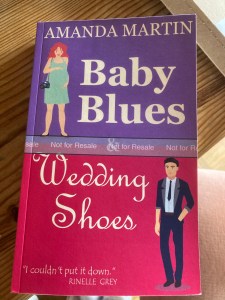
New cover design
But having to job-hunt is depleting my energy, because it’s all the things I hate. It’s trying to believe in myself and sell myself, it’s trying to say what recruiters want to hear, in cover letters and interviews. It’s searching, and reading through the job-speak trying to understand what is actually expected in a role.
And it’s waiting.
Waiting is ADHD Kryptonite. A 4 o’clock appointment will kill a day. Add to that a daughter who is still in recovery and a hyper-productive husband doing ten projects at once, and managing my own energy is getting really hard.
So I read. And rest. And sneak up on my brain, holding a chocolate bar and a coffee to tempt it to submit.



 writermummy