Blog Post Revisited: Using Life’s What Ifs

My Three Darlings

My Three Darlings

I finally sent a complete draft of Class Act to my fabulous Beta Reader yesterday, and found myself at a loose end. I know it needs more work but, quite frankly, I’m sick of the sight of it and am starting to doubt whether it even works as a story. Time for a change.

I want to start something new, rather than working on one of the three or four half-finished manuscripts I have on my laptop, courtesy of years of NaNoWriMo. But I’m a bit all chick-litted out, after Two-Hundred Steps Home and working on Class Act. So I got to thinking about other ideas I’ve had, and I remembered the Middle Grade Novel idea I had nearly a year ago. This is a bit on how it started.

A few days after writing that post, I wrote the one below. A little insight into where some of my writing ideas come from.

-––––––———

Writing out some of the background for my new novel today I realised I was inadvertently writing a ‘what if’ about my own life, or one tiny aspect of my life. I think sometimes that’s what writers do. They use their words, their imaginations, to explore different lives they might have lived. Mine is a little thing that might have been huge.

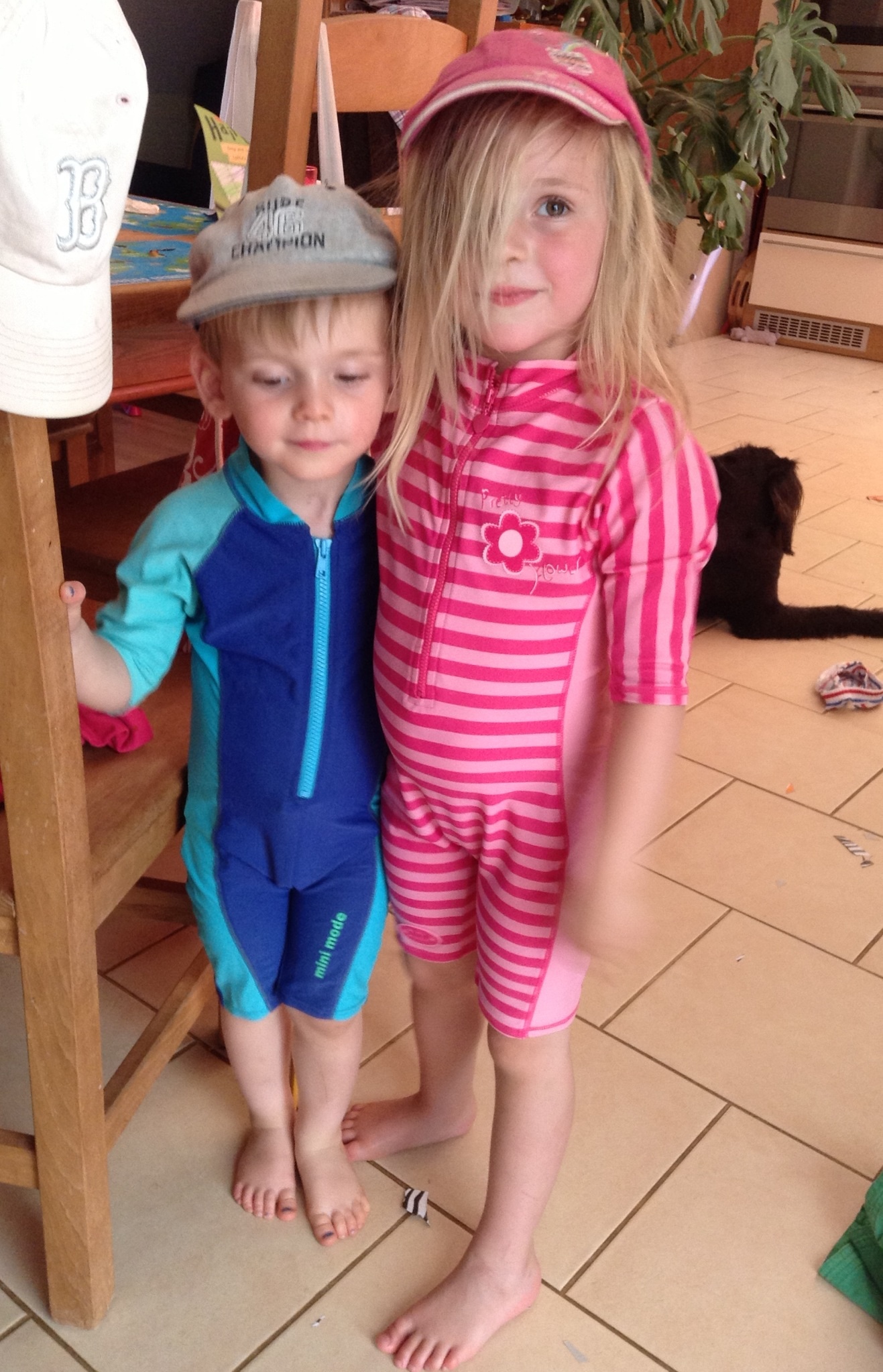
Close Siblings

Close Siblings

I was late for my period this month: second month in a row. Now, we’re careful. We have two beautiful children and I’m in my late thirties. My first child was born at 37 weeks, the second at 35 weeks. My pediatrician friend said that a trend to premature babies could easily continue.

So, even if we wanted more children (which we don’t – only when I get occasionally broody) the risks are far too high. And I KNEW I wasn’t pregnant. I’m more likely to be menopausal, as early menopause runs in the family. But, still, you start putting two and two together and making five. I was tired, grumpy, teary and, above all, late.

The protagonist in Baby Blues & Wedding Shoes gets pregnant against the odds. These things happen. I worried. I read up about menopause at 2am on my phone. And, being me, I re-planned my future with a third child in it. I needed to be prepared, just in case. I worked out the age gap, when the third would start school. I decided it would be nice for my son to have a play mate when my daughter starts school in September. I tried to decide whether I’d prefer a boy or a girl. I’m a writer: I wove stories.

Drove hubbie nuts.

Then I decided I ought to actually get a test and part of me was actually a bit excited (damn you, breeding hormones). I didn’t need the test, as it turned out. As if just buying it was enough, I knew before I got home that it was no longer required. In a tiny way I felt as if I’d lost a baby, even though no baby existed. Because I had made the scary future so plausible.

I wasn’t going to talk about it on the blog – it seems to come under the ‘too much information’ category. Until I started writing out my character list for the new book this morning:

George: 11. Two siblings, Ben (14) and Susie (16). George suspects he wasn’t planned. His sister tells him their mother used to say ‘I’ve only got two hands’ or ‘one of each, job done’. George feels unwanted and an outsider. Susie is academic, Ben is musical. They’re close. George likes football and computer games and being lazy.

My Little Bean

My Little Bean

I realised, half way through writing it, that George is my imaginary third child. The things I worried about at 2am were all there: that any other children born into our family would feel left out because my two are so close in age; that my eldest would remember me saying ‘one of each, job done’; that a third child would feel alienated, like my Uncle and my Mum – both the last of three kids.

The loss of my imaginary child, that hurt for a day, doesn’t hurt so much now. When I see the kids needing another play mate I do wish I had started my family earlier, so more children was a possibility. But now I can write them in to existence instead.

So much cheaper and no need for cots, bottles, stretch marks, swollen ankles and endless dirty nappies. Hurrah.

What’s Your Character’s Love Language?

Do you know your characters' love languages?

Do you know your characters’ love languages?

It’s no secret, here on the blog, that I was strongly affected by reading The Five Love Languages by Gary Chapman, and coming to understand mine and my husband’s particular languages. It has strengthened our relationship and helped us communicate. I’m also now looking at the children and trying to understand how they feel love.

But, being me, I never miss an opportunity to put my life lessons to work on my writing.

Today, at the end of walking the dog – it taking that long for my drugged brain to start working – I turned my mind to the dilemma of my current writer’s block. I’m trying to pen an emotional scene in Class Act, to get my protagonist Rebecca past a difficult experience in her life, without having any direct knowledge of the issue.

I don’t want to belabour the point. Like the postnatal depression in Baby Blues & Wedding Shoes (which I do have experience of), the issues in Rebecca’s past are important for the effect they have on her character and relationships, but I don’t want them forming the be all and end all of the novel. I’m writing genre fiction not literary fiction and aiming for a happy ever after, albeit a plausible one that survives challenges.

So I wondered how I could help Rebecca get through the difficulty most quickly, and whether that could be done genuinely with the right man without it all seeming too convenient and unrealistic. It made me ponder what her Love Language might be and I realised that – for her – the love language has to be Words of Affirmation. Therefore Alex, the love interest, needs to talk to her, reassure her, convince her of his sincerity. I’m not sure what his Love Language is yet. I think his might be Quality Time. That’s the thing lacking from his childhood and the thing he yearned for in his failed relationship at the start of the novel.

I feel as empowered in my writing as I did in my marriage by looking at things this way. I have also realised that I know my characters better than I might give myself credit for. I think I’ll use the five love languages again when considering my romantic protagonists. It’s a new, interesting and simple way to ensure coherent, three-dimensional characters, particularly in the Romance genre.

Just goes to show, you can learn from the strangest of sources. As a friend of mine used to say, “Every day’s a school day.”

Eking Out The Words

Sometimes you have to get down to graft

Sometimes you have to get down to graft

I finally got back to work on Class Act this week but, my goodness, it’s like pulling teeth. I’m unfortunately at a juncture in the novel where the protagonist is tackling something from her past as her relationship with the male lead hots up.

I didn’t write these scenes the first time through – not deliberately, it just didn’t come out in the first draft. I don’t do sex and I don’t do conflict, and these scenes have both. Only, writing them in my current frame of mind, I feel like I’m trying to make a porcelain tea set using a hammer and chisel.

It’s tempting to delete everything I’ve painfully written this morning – all three hundred measly words – but sometimes you just need something on the page to edit, and move on.

Occasionally you look back and it isn’t as awful as you remember. Mostly, you look back and get out a big fat red pen and fix it. All I know is I’ll never have a manuscript to get to Beta Readers if I don’t push on through. As lovely as it is that I sold 30 copies of Baby Blues and got a new five star review (and it is lovely!) it’s only going to work if I keep writing.

Sometimes the 300 words, eked out one cup of tea at a time, are as important and precious as the three thousand rattled off in good order. They’re all steps up the mountain.

Research and The Raven Boys

What Alex's London flat might look like

What Alex’s London flat might look like

I miss Claire. There, I’ve said it. I miss writing an installment of her journey each day, with a reasonable idea of where she was in the world, at least, and where her story was going. I miss guaranteed word count.

I’m in redrafting hell at present, trying to rescue two characters I love from a badly plotted and planned novel awash with backstory. The problem with loading a first draft with backstory is that changing one thing has a rippling effect across the entire manuscript, especially if you’re trying to rewrite two lines of throwaway history into a whole chapter or even two.

My lead man Alex has a friend called Philip who is essential to the story. Starting In Media Res I didn’t have to worry too much about their relationship before; where they first met, how they met, considering they’re so different. Now, though, we first see them catching up down the pub, setting up the rest of the story’s action, and I have to understand all these things. How do people from different backgrounds meet? How do their different careers and incomes affect their friendship? What’s the age difference? I managed 700 words of stilted dialogue today and gave up in disgust.

I’m also trying not to be overly influenced by the book I’m reading – The Raven Boys by Maggie Stiefvater – as her novel contains a character that could be, or at least have known, Alex as a public school boy. Maggie Stiefvater’s character is so convincing I’m finding parts of him creeping into my prose: except Raven Boys is set in America, whereas Alex would have gone to an English boarding school (which I know very little about, another fact that wasn’t especially important before.)

As each of these random strands of research crop up, I keep losing the flow of writing because I need to research the role of a stage hand or investigate pubs in North London or apartments in Chelsea. I might even have to watch an episode of Made in Chelsea – *shudder* – to try and understand Alex’s present girlfriend Paige more, as again she has moved from a paragraph of explanation to a speaking part.

I swear this is the last time I rescue an old manuscript by moving the timeline back a few months. Next time it starts where it starts and that’s that!

A Pantser Plans

Using Beat Sheets to plan my revisions

Using Beat Sheets to plan my revisions

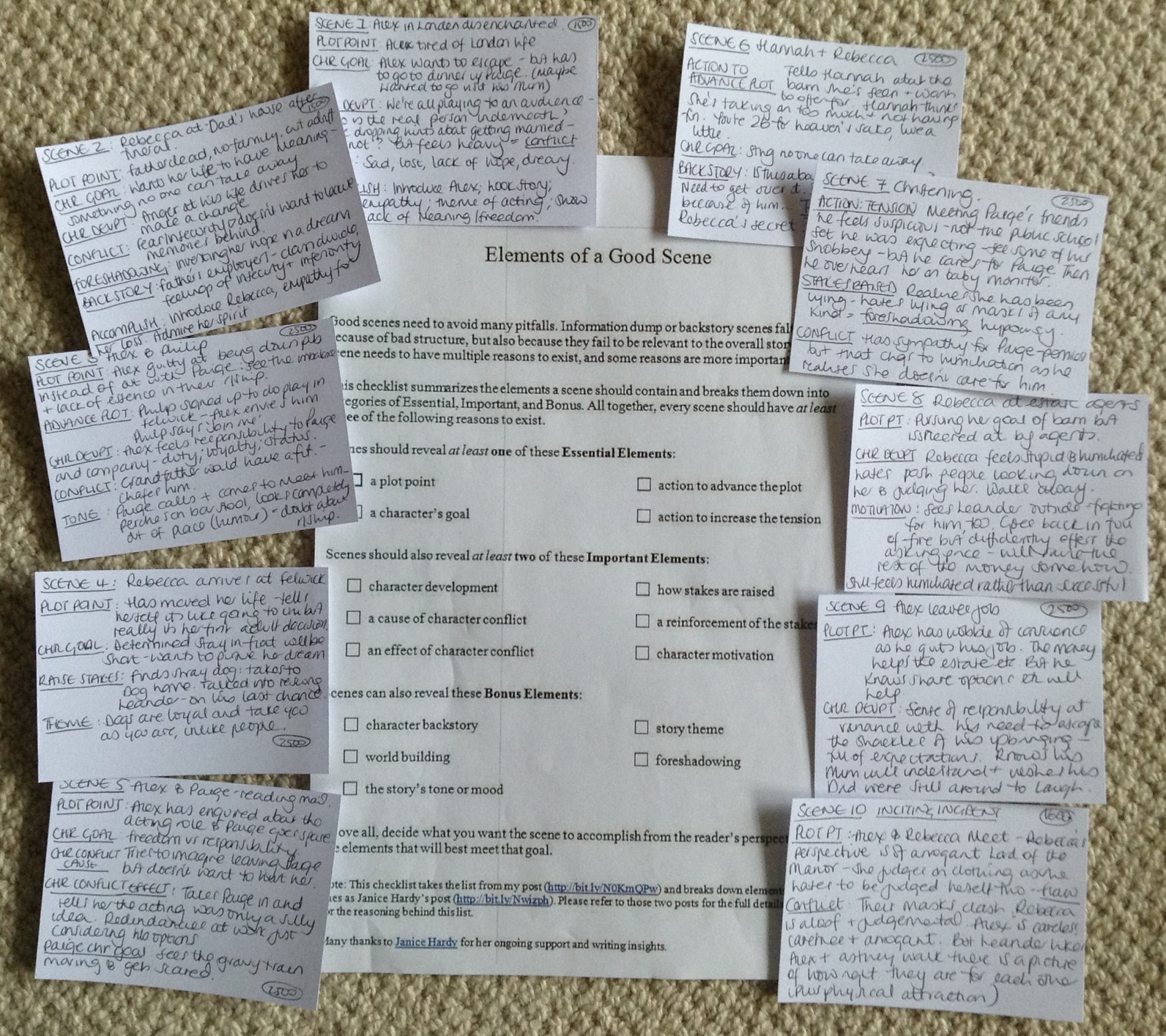
The unthinkable happened today. I did planning. With beat sheets and notecards and everything. I’m a Pantser to the core: analysing a scene down to the tiny details paralyses me. Especially if I do it before I write, as I have done for the extra third of a novel I’m putting at the front of Class Act. But actually, do you know what, it wasn’t so bad.

I’m still working on some of the terminology, for example pinch points and black moments, although instinctively I have a shrewd idea what they are. I have done it before, actually, for all my seat-of-the-pants writing preference, and I’m always relieved at how much of the necessary detail I already have. Sometimes it just needs writing down to reassure myself I do know something (although a VERY VERY long way from everything) about this novel writing lark.

I had gathered much of the required information during my last craft session (the sporadic times when I read through a load of blogs and books to refresh or learn elements of writing craft.). My favourite resource is Jami Gold: as a Pantser and a romance writer, I feel she understands my pain. In fact her Beat Sheet for Romance Writers formed a large part of my morning’s work. She explains that if, like me, you can’t pkan in detail for fear of frightening off the Muse, you can use beats – points in the story – to make sure things are developing as they should.

I also used her posts based on a Michael Hauge workshop she attended to put more thought into my characters’ development, flaws and ultimate romance. The key ones I used were Are These Characters the Perfect Match and An Antidote to “Love at First Sight”. Both of these look at two elements of characterisation – a character’s Mask (the role they play, based on their longings, fears, wounds and beliefs: their emotional armour) and a character’s Essence (who they are inside, behind the masks, or who they have the potential to be). In a good romance, attraction will be based on Essence rather than Mask.

Planning Elements of a Scene

Planning Elements of a Scene

So, in Baby Blues, Helen was attracted to Daniel because his businessman forceful character Mask played to her career orientated Mask. But Marcio was her right love interest, because they both had the same essence underneath: a love of creativity and interpreting the world through their art, and a desire for home and family.

The concept really helps when a character moves from one relationship to another (as mine often do.) You don’t want the protagonist to look like an idiot because the previous relationship was flawed, and also you don’t want the previous partner to be a stereotype or a villain (although Daniel, in Baby Blues, is a bit of both!)

The other thing I’ve been trying to use is an Elements of a Good Scene checklist, which I also found on Jami’s Blog, the idea for which came from Janice Hardy’s blog. I feel exposed, using something like this, as I feel I don’t know the difference between “Plot point” and “action to advance the plot” or “how the stakes are raised” versus “reinforcement of the stakes”. I suspect that might be why I find it hard to write tense page turners! In my head, though, I’ve summarised it as “plot development”, “character development”, “conflict” and “backstory/theme/tone/foreshadowing”. As long as the scene has some of those that’s good. Well, it’s a start!

Of course, I was right – at the beginning when I said planning paralyses me. I need to start writing, before I spend so long on planning I’m fed up with the story or too scared to start. But it was a useful day’s work and hopefully, when I sit at my desk on Monday, I’ll be able to write some of the additional 45,000 words the story needs to get to a full length novel!

Anyway, hopefully now I have a plan this will be the last of the ‘I’ve forgotten how to do manuscript revision’ posts and I’ll get on to writing something more interesting for the non-writers who follow my blog! Thank you for your patience.

The Tricky Question of Backstory

Challenging my views of writing!

Challenging my views of writing!

Following on from yesterday’s request for advice and opinion, I need to ask about back-story. It’s the bane of my life, and Class Act is littered with it. Baby Blues & Wedding Shoes was, too, in the early drafts, and I solved the problem by starting the novel six months earlier.

That will work to some extent for Class Act, (lovely – another massive re-write! 🙂 ) but there are two incidents in the female protagonist Rebecca’s early life that impact on her current personality, and I don’t know how to integrate them. At present they’re written as flashbacks. Shudder. Unfortunately I actually like how they’re written so it’s easy to become attached to the scenes rather than put them in the bin where they should be.

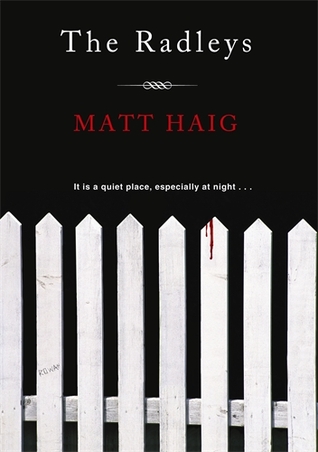
The problem is I get defensive of my characters and want to explain why they have the flaws they do. But how much detail is necessary or desirable, and when should it be revealed? In The Radleys, by Matt Haig, the back story is cleverly integrated and is also overlaid with the character’s perception, so you start out with a half truth that colours your view of a character’s actions, and that view evolves and changes towards the climax of the novel. Masterful stuff. I’m pretty certain I’m not skilled enough just yet to pull it off without getting in a muddle.

The other problem is defining the novel’s inciting incident. Really, both bits of backstory are. Or the moment where the lead protagonists meet, which is where the novel currently opens. Baby Blues originally started with when the love interests meet, too, and after the rewrite that scene ended up a third of the way through the book. I like it, because you get to know the characters first, but then it blows wide open what the first turning point should be. We make decisions every day which, with hindsight, turn out to be inciting incidents. The job we take,   or the bus we catch that breaks down or gets blown up.

Incidentally, Jami Gold has a great post on the importance of getting these elements or ‘beats’ right in a novel and how defining them isn’t always straightforward! See Why Story Structure Matters. Unfortunately, even with her helpful Beat Sheets, getting the right elements into a story at the right time is (for me) the hardest part of writing.

So, right now my options are revelation through phone conversations with a friend (tricky), adding a prologue (generally advised against), or vague hints that might be missed or misunderstood. It was much easier with Claire in Two-Hundred Steps Home, as she didn’t really have a back story that mattered!

What are your views? Any great examples of how inciting incidents in childhood or early adulthood have been successfully integrated into a story? How much do you need/like to relive past experiences that have influenced a character? When do you need to know the details? Do you need to already care about a character, or do they help you care? Sometimes it feels like I’ve forgotten how to write a novel!

How Many Heads?

How many viewpoints in a novel?

How many viewpoints in a novel?

When you’re reading a modern third-person limited perspective novel (he said, she said from inside a single character’s head – see this great post for an explanation on narrative modes in literature) how many heads are acceptable?

When I first wrote Baby Blues & Wedding Shoes, which is written from two key protagonists’ perspectives, I switched from head to head without thinking about it, and would quite often jump into the head of minor characters. Strictly speaking that’s nearer third person omniscient, without that irritating ‘know-it-all-ness’ of an Eighteenth Century narrator.

I didn’t give it much thought, until a Beta Reader pointed out that head-hopping within a scene can be confusing and is generally avoided, and that it wasn’t a good idea to see inside the head of minor as well as major characters. It came as a surprise, because I didn’t really think about it as I wrote – the almost-omniscient style seems to be my default.

That probably reflects the literature I read: authors like Georgette Heyer, who write in what I suppose to be omniscient third person. Even though Heyer spends most of the time following one person’s viewpoint, she’s happy to hop into the thoughts of anyone relevant to explain the scene. Even though I’ve studied the theory and know the principles I still struggle when I write (and even when I read) to always know the difference. I read this great article today that helps to explain it.

That’s why Dragon Wraiths was refreshing – in first-person-present you only know what the main character sees, hears and feels. It adds other challenges to do with character development and so on, but you don’t have to worry about head-hopping.

Class Act Cover

Class Act Cover

I’ve just been through my first draft of Class Act and, like Baby Blues, it’s littered with head-hopping. That’s fine, I can fix that. But, also like Baby Blues, some of my favourite writing is inside the heads of secondary characters. I cut it all out in Baby Blues but now I’m wondering if that was entirely necessary. Maybe it’s just my voice, my style. Maybe I tend more towards multi-voice perspective or omniscient than tight third person (sticking to one head). Maybe I should embrace it rather than fix it.

I say this only because I’ve just finished The Radleys by Matt Haig and it reads like a soap opera script, seen from everyone’s perspective. I have to admit it added to my enjoyment of the novel rather than detracting from it. (Possibly because I love omniscient authors like Heyer.)

Now Haig is a much more experienced and talented writer than I am, and my execution is bound to fall a long way short, but that’s no reason not to try.

So, my question is, if you were reading a novel that took you on a brief trip inside the mind of the mum or the best friend, would that confuse or irritate you? I guess until I finish my revisions and send it out to Beta readers I won’t know. Here’s an example scene to show what I mean.

Daphne looked up, and her smile was like the sun rising over the horizon. She put the tapestry aside and rose to her feet, holding both hands out in greeting. Alex took two paces forwards and enveloped her in a bear hug, her scent infusing the space between them, bringing with it all the comfort and memories of childhood. He hadn’t been home for weeks, not since he’d started rehearsing the play, even though it wasn’t that far away. He felt terrible, but his mother of all people understood his need to carve his own way in the world, away from Sidderton.

“Alex, darling, how lovely to see you,” she said as she finally released him from the embrace. “Sit down. Does your grandfather know you’re here yet?”

“No, I came to see you first, of course.”

“You mean you crept around the side like a naughty school boy?”

His smile made him look every inch as she’d described him. “Maybe. I need to ask for something and I thought I’d ask your advice about the best approach.”

“You need money? I thought you’d got a handsome settlement when you left your last place of employment? Didn’t you talk of share options?”

“I don’t need money, and as if I’d ask Grandfather if I did! He’d roast me alive. No, it’s more complicated than that.”

“Then it’s about a girl. Have you got someone in trouble?”

“Mother!” Alex was genuinely shocked. “What do you think of me? Firstly, no, I haven’t got some poor girl pregnant. Secondly, this is the twenty-first century, not Downton Abbey. We don’t buy the servants and wenches off with money these days you know.” His tone was ironic and gently chiding. Sometimes he thought living here at the hall had confused his mother into believing they lived in the eighteenth century.

“You are partly right though,” he continued, “it is about a girl.”

“I thought you had decided girls were all fortune hunters out to ensnare you? Has one managed to catch you?” She looked worried, and he laid a hand on hers to reassure her.

“Well, I suppose I have been snared, but not for my fortune. She doesn’t know anything about it.”

“What do you mean? Does she think we are one of those impoverished families who spend every penny on their crumbling manor?”

Alex thought about the immaculate interior of Sidderton Hall – Mother had been an interior designer before she married – and laughed. The laughter lit his handsome face from within, like the sun breaking suddenly from behind storm clouds. Then the clouds drew across the light again, as he realised his charade was no laughing matter. He had to think of a way to make Rebecca love him despite his background. He had to get to the bottom of her dislike of the landed gentry – there had to be more to it than a few idiots being rude to their gardener. That was for another day. He was here to help her build her future, whether that included him or not. Acts of altruism were not part of his general make up, and he found he quite liked the sensation.

Daphne sat patiently whilst these thoughts played out across her son’s even features. She was used to her son’s internal dialogue and knew he would present his conclusions when he was ready. He shifted his position on the ancient and battered leather sofa that dominated the family room and she knew he was ready to speak.

“I need to get grandfather to agree to sell the old hay barn down in the south east corner.”

Whatever Daphne was expecting, it wasn’t that. She spoke aloud her first thought.

“No Sidderton has ever sold one inch of the estate, not even when they faced bankruptcy”.

Alex laughed suddenly as she said it. She gave him a bewildered look and he clarified: “That’s what the estate manager said to me, and I thought the same recently when I was talking with Rebecca about buying property. It must be a mantra that we’ve all been brainwashed with.”

“What makes you think you’ll convince grandfather otherwise, when you know it is so much against the family way?”

“Because I have to,” his voice was urgent, “Because it’s important. Just because that’s the way something has always been doesn’t mean that’s the way it always has to be. Because I want to help the woman I love, and – if I’m really lucky and dig myself out of the huge hole I’m in – it won’t be out of the family for long.” His words came out in a rush, as if to explain it all to his mother suddenly seemed both difficult and vital.

In limited third person the entire scene should be either from Alex’s or Daphne’s perspective, or there should be a scene break when it hops from Alex’s to Daphne’s head. But, to me, the scene works fine as it is. Maybe it’s the subject matter: there is an air of Heyer, or of nineteenth-century romance, about the novel. Should I have the same consistent voice across all my novels or is it permissible to shift it according to the needs of the novel. Answers on a postcard, please… 🙂

The End. For Now. 2013 365 Challenge #365

The Final THSH Cover

The Final THSH Cover

Hurrah. I made it. Claire’s journey is finished, for now. She’s found a new home and what I suspect will be only the beginning of fresh adventures. Already the new characters intrigue me. Timothy, for example: he’s Maggie’s gentleman friend but for some reason I think he might lean the other way. Eddie is going to be a real handful. And the quiet Kayla might surprise everyone.

You’ll have to wait though. I have other novels to write, sleep to catch up on, books to read, before I even think about picking up Claire’s journey again. I want to start immediately, but I think we all need a break. I’ll be making notes, though, and any feedback is of course always gratefully received.

If you enjoyed the series, tell your friends. I hope to pull the entire 365 installments into one ebook at some point soon, although I won’t be editing it (except for any typos that I discover). The raw first draft (albeit one that was line-edited as I went along) is part of the challenge and should stand untouched. I’m proud of it as it is.

So, what’s next? After the sleeping and the reading and the hopefully shifting this cold finally because I’ve had it for weeks? Well, Class Act needs work. It’s currently a 50,000 word romance that I have plans to extend into a full length novel. Then there’s Finding Lucy. And a sequel to Dragon Wraiths. And of course a continuation of Claire’s adventures in Cornwall. I’m going to miss her and Conor, although it’s good to miss people!

The blog might be quiet for a while. Or it might not. I think stopping blogging might be like coming off the Christmas chocolate: both a challenge and a relief. I’ll see you when I see you. Please hang about and if you see only this post for a while, please understand! Maybe I’ll have more time to read and comment on some of your blogs now. That said, as it has been raining for the last two days, and my head is fizzing with blog entry ideas, it might not be quiet for all that long!

Wishing you all an amazing New Year and here’s to a 2014 full of words.

________________________________________________________________________________

Below is the next installment in my novel Two-Hundred Steps Home: written in daily posts since 1st January as part of my 2013 365 Challenge. Read about the challenge here.You can catch up by downloading the free ebook volumes on the right hand side of the blog:

________________________________________________________________________________

Her clothes filled the small wardrobe; her rucksack sat empty in the dark recess of the cupboard, tatty after its long journey. She could never have imagined, back when Carl had presented her with it as a leaving gift, that she could become so attached to a bag.

“We’ve come a long way, you and I. Time for a rest, for you at least.”

Claire laughed as she realised talking to an inanimate object was probably the first sign of craziness.

Maybe I am crazy. Do crazy people ever actually know that they are?

She thought about leaving Conor standing alone on the beach, and shivered. It had been two days and he hadn’t tried to contact her. She didn’t know if that made it easier or not. Dozens of unsent messages sat on her phone, taunting her. Her last words echoed continually in her mind, like a song stuck on repeat.

The man I love like breathing.

She considered it, as she walked across the tiny room to gaze at the ever-changing view of the sea. Was it true? Did she love him? Could you love someone on such a short acquaintance?

But it wasn’t short, was it? Four months is a long time, and he’s been there for me since day one. All the time in New Zealand and every time I needed someone since I returned.

Dwelling only intensified the pain. She cast one last look around her room and felt a glimmer of a smile through her grief. Her room. It felt good.

Downstairs, the children were finishing dinner. Claire hadn’t spent much time with them over the weekend. Timothy seemed to instinctively know she needed space to settle in, and had quietly assured her that she had no duties until Monday morning. She attended meals and sat in the shared lounge to read and think. Sometimes she nestled in the window seat she’d discovered along a corridor, overlooking the sea, and listened to the children giggling in their rooms. The sound of laughter rang constantly throughout the old building.

Outside, the sky hung overcast. She wandered through the bushes and trees until she reached the rolling lawn that led down towards the sea. Within minutes she had scrambled down the rocky path to the private beach.

A group of children clambered amongst the rock pools under the watchful eye of Eddie. He raised his hand in greeting and she nodded in return before heading to the other end of the sand.

Thinking she really needed to buy a surfboard, Claire found her favourite rock and climbed on it. Sitting with her arms clasped around her knees she stared out at the horizon and let the peace wrap around her like a blanket.

*

A tapping at the door roused Claire from a doze. She checked the time and was surprised to discover she’d been asleep for an hour. Thinking it must be Timothy wanting to remind her about something for the morning, she rolled off the bed and went to open the door.

She grasped the frame for support as her questioning gaze met a pair of familiar green eyes.

“Hello, Claire.”

“What? How did you know where to find me? How did you get in?”

“A bit of research found the centre and a chat with your man Timothy meant he let me in. Seems he’s a sucker for a romance.”

“You could be a stalker or a murderer.” She frowned, unsure how she felt about the invasion of her privacy.

“I showed him this.” Conor held up his phone to show a photograph of the two of them in bed, tangled in the sheets.

Claire stepped back into the room to hide the blood rushing to her cheeks. “You’d better come in.”

Uncomfortably aware that the room held only a bed, she waited for Conor to perch on one end of it, before going to stand, arms folded, by the window.

“Why are you here?”

“To ask why you keep running away from me without letting me speak, woman. I had something to add to your marvellous speech, you know.”

He stood up and crossed the room, coming to a stop only inches away from her. He leant in until his lips brushed the hair near her ear, sending flurries of heat across her skin.

“I love you, too.”

*

Claire rested her head against Conor’s shoulder and stared out the window at the multi-hued sky. They had talked long into the night, until the dawn light began to paint the horizon in stripes of silver and pink. Her head ached with the fog of missed sleep, and she knew her first day at work was going to be a disaster, but her heart felt like a bird floating on an updraft.

She looked around the tiny room, listening to the heartbeat and slow, sonorous, breathing of the man beside her. It wasn’t ideal, agreeing to a long-distance love affair, but she didn’t care. He loved her and she loved him; that was all that mattered. The rest was just geography.

As she lay in his arms and watched the sun rise, she realised she had finally found what she had searched for through two hundred long days – through a lifetime – something that wasn’t outside the window, or even in the room, but rather in her heart. A contentment; a sense of belonging and of peace.

She was home.

***

But, Therefore: 2013 365 Challenge #205

My Mammoth Research Session

My Mammoth Research Session

In my mammoth research session yesterday into plotting and planning, I came across this great article on Janice Hardy’s blog, The Other Side of the Story.

Janice shares the two tips on plotting that she wishes she had written, both to do with cause and effect. The first one particularly made an impact on me because it helped me identify what I know to be a weakness in my writing.

I don’t want to rewrite Janice’s whole article – she has written it far better than I ever could – but the essence is about how to know you are moving your story forward with every scene.

Summarising advice from South Park creators Trey Parker and Matt Stone, she writes:

Every scene in your story is connected, and how you connect them will determine whether or not they’re moving the story or just showing stuff happening. If you can say “and then” between them, they’re not advancing the story. If you can say “but” or “therefore” then something happens that forces a conflict or a decision and the story advances.

This really brought home to me why Baby Blues lacks punch, particularly when compared to Dragon Wraiths. Because Dragon Wraiths is written in the first person, and starts In Media Res (albeit it with back-story in the form of diary entries), the scenes are linked far more with But and Therefore, rather than And Then.

12-year-old Leah does a lot of running away

12-year-old Leah does a lot of running away

For example, in the diary segments (where most of the action sits at the beginning), it is Leah’s 12th birthday. She wants art supplies, therefore her family take the car rather than the train to town, therefore their enemies are able to attack them on the way home. Her mother tells her to run and keep running, therefore Leah leaves her behind and runs, but she collapses from exhaustion. Her goal is thwarted by her weakness. Therefore she ends up in hospital, but she doesn’t tell anyone who she is, therefore she ends up in care, but her mother told her to keep running. The story progresses because of Leah’s decisions, or the machinations of her unseen enemies.

In Baby Blues, on the other hand, the scenes are much more ‘and then’. Helen hosts a dinner party, and then sleeps with her boyfriend, and then realises she’s late for a photography shoot. Or maybe that’s a ‘therefore’? She stays up late because of her duty to Daniel, therefore she is nearly late for a photography shoot. However she isn’t late, so there is no cause and effect. No conflict. If she had missed her photography shoot and her career had been blighted by it, her resentment of Daniel might have been greater and the first third of the novel have more punch and pace.

As you can see, it can be tricky to identify the ‘but’ and ‘therefore’ points. Janice offers some key things to remember with this technique:

  • When you’re identifying your but, make sure what happens is in conflict with the character’s goal or action.
  • When you’re identifying your therefore, make sure it’s a choice made in response to what has just happened
I want happy smiley protagonists, not conflict

I want happy smiley protagonists, not conflict

It all comes down to conflict. I hate inflicting conflict and pain. I actually find it painful to watch a TV show where a bad decision leads to people dying. I don’t sit on the edge of my seat, I rue the What If and wonder how the character (albeit a fictional one) lives with the guilt.

As a result my writing is pretty and descriptive and explores the inner character of protagonists, but it doesn’t speed along. Janice Hardy even has a post about it: Do you Suffer from NWS? Living with Nice Writer Syndrome. Er, yes, that would be me!

I’ve accepted that it is too tricky to change the way I’m writing Two Hundred Steps Home, as building in cause and effect every single day would probably stretch my ability to keep up with the story (unless I have England attacked by blood-sucking aliens. Now there’s an idea!).

But as I tackle Class Act, I will have this advice in mind. Time to get tough.

________________________________________________________________________________

Below is the next installment in my novel Two-Hundred Steps Home: written in daily posts since 1st January as part of my 2013 365 Challenge. Read about the challenge here.You can catch up by downloading the free ebook volumes on the right hand side of the blog: 

________________________________________________________________________________

“Claire? It’s Carl.”

Claire paused in her walk along the bay and perched on the stone wall, gazing out to sea. I knew I shouldn’t have answered the phone. After believing her boss was trying to force her out for months, it was hard not to be confused by his sudden terrier-like behaviour, now she had finally resigned.

“Have you had a chance to consider my offer?” Carl spoke into the silence.

“What offer?” Claire watched as a couple wandered along the sand, fingers entwined. Behind her the amusement arcades advertised their wares with raucous music and flashing lights. The air smelled of salt and candyfloss.

“I sent you an email.” Carl’s voice sliced through her reverie.

“I’ve been busy. Catching up on the blog and collating my notes together to pass to my replacement.”

Carl didn’t respond immediately, and the scream of hungry seagulls rent the still evening air. Claire envied them their freedom of expression.

When Carl spoke again, his tone was nonchalant. “I merely emailed you with a counter-offer, as is standard procedure when someone resigns in the middle of a critical project or contract negotiation.”

Claire wasn’t fooled by Carl’s insouciance. Sitting up straight, she narrowed her eyes and glared at the arm of fields stretching into the sea, as if embracing the bay.

“And are we? In the middle of contract negotiations? With whom? Happy Cola? The YHA? Both? That would have been rather pertinent to our conversation earlier this week, don’t you think?”

“So, you’ll reconsider?” Claire imagined his tail wagging furiously. “Both accounts are more than pleased with the early results of your social media activity. The YHA have seen a marked increase in bookings at the hostels you’ve written about and Happy Cola have cited a significant increase in the healthy associations of their brand in recent regional market research.”

He sounded like Sky explaining why she should be allowed ten minutes more on the iPad, or a second chocolate bar. Claire felt her cheeks twitching in a smile, while her head reeled with possibilities. Her fingers itched to load her email and discover exactly how big Carl’s counter-offer was. Not that it’s actually a counter-offer, unless I am offered the Purbeck role, but he doesn’t need to know that.

Claire was swept up in a tide of emotion. From being the outcast black sheep of the organisation, she belonged again. No more nasty challenges from Julia, or scrawled queries on her expenses forms. If she was the king pin securing two important deals, the world was her oyster.

Although a grin stretched her cheeks, Claire forced her voice low and doubtful. “I don’t know, I’ll have to think about it. The job here is a fantastic opportunity for me to make a difference.”

“Promise you’ll think it over? Look at the counter-offer. It’s not set in stone.”

Glee surged through Claire as she heard the panic in her boss’s voice. She could imagine the strain on his face as he rehearsed the conversation with the Board that centred on granting her a significant pay increase.

Blind to the beauty of the orange sun sliding across the sky, staining the sea blood-red, Claire said farewell to Carl and loaded up her emails.

***

Beat Sheets: 2013 365 Challenge #204

Coffee Shop Catastrophe

Coffee Shop Catastrophe

Apologies to anyone who received yesterday’s post without the Claire installment attached. Technical issues were to blame (combined with crawling to bed last night without finishing my Claire Installment).

On a Monday I often write the remaining part of my post in the coffee shop (because Sunday night is the hardest time to write). I have some of the post scheduled to go live if all else fails. This morning was the first time (I think) that it happened, only because the internet was down in coffee shop I chose to visit. I’ve learned my lesson! (I spent the morning wandering round town discovering which businesses have free WiFi!)

Today I have been looking at Beat Sheets and other planning tools. Following on from recent discussions about how hard it is to plan a novel if you’re a Pantser, I’ve been doing more internet research, specifically around planning romance novels (although most things seem to be quite generic). I came across the most amazing collection of resources on the website of an author of Paranormal fiction: Jami Gold. Jami has even written a post called A Pantser’s Guide to Beat Sheets. Perfect.

Even Pantsers can have structure!

Even Pantsers can have structure!

The thing I love about the post, and beat sheets, is that they can be used against a first draft, rather than (or as well as) for pre-planning, as a way to see how well the draft is structured. I spent this afternoon trying to map Baby Blues against Jami’s Romance Beat Sheet, with mixed results.

It would seem that (as suspected) my climax and ending fit the right pattern, but my opening third is way off beat. I also am not entirely sure what my inciting incident or first plot point is. I searched around some more to get a real definition of these, but haven’t reached a consensus of exactly what they are or where they should come in the novel.

I see my inciting incident as Helen finding out she’s pregnant and then leaving Daniel (apologies about spoilers!). In the Romance Beat Sheet, it suggests the inciting incident should involve both protagonists. Except Helen doesn’t even meet Marcio until a third of the way through the novel. One of my Beta readers did comment on this fact, but I admit I like the first third for setting Helen on her journey without it being about Marcio. Maybe it makes the book more Chick Lit than Romance (which is how I have categorised it anyway) or maybe it’s just plain wrong. Interestingly, both Baby Blues and Class Act originally started with the meeting between lead girl and lead boy, but I pulled the action back so that the backstory didn’t become overwhelming.

Pillow Talk by Freya North

I am looking forward to using beat sheets to rebuild Class Act and, had I had something similar before I rebuilt Baby Blues, I suspect it would be tighter. These things are all about learning. If I had used the sheets, though, would I have invented Sharni and given her so much air-time? She’s one of my favourite characters and I would hate to lose her.

I seem to recall that I was reading Pillow Talk, by Freya North, at the time of redrafting Baby Blues, and the structure of that novel may well have had an impact on me (as there are super-strong secondary characters and the love interest comes later). If it’s good enough for Freya North, then maybe it isn’t so bad!

What’s your view? Can you have a Romance/Chick Lit novel where the lovers don’t meet until a third of the novel has passed? Does it give you a chance to understand why they’re made for each other or would you have given up on the novel before that point? They say to write the novel you want to read, but that’s only going to work if others want to read it too!

________________________________________________________________________________

Below is the next installment in my novel Two-Hundred Steps Home: written in daily posts since 1st January as part of my 2013 365 Challenge. Read about the challenge here.You can catch up by downloading the free ebook volumes on the right hand side of the blog: 

________________________________________________________________________________

Claire closed her iPad and looked out the hostel window. In contrast to the dark wood furniture in the dim room, the view that beckoned sparkled in the late evening sunlight. In the distance the sea reflected the blue of the sky, in a deeper hue. Behind the strip of water, a long barrow of land jutted out into the ocean. Claire could just make out fields falling into the limestone cliffs of the Jurassic Coast. Her research informed her there were several pleasant walks up from the National Trust car park near the Bankes Arms pub in Studland. If the sun continued to shine in the morning, she knew where she would be.

So far, her impression of Swanage matched Conor’s description. The faded seaside town showed glimpses of its former glory, in the amusement arcades and the long wooden pier. Rather than Victorian ladies promenading along its length, Claire met only blue-rinse grannies out for their afternoon constitutional. As she had driven around looking for the youth hostel, she had seen more signs for retirement complexes than B&Bs.

It would be a tough ask to increase tourism here. She knew that Purbeck included other towns, but Swanage was the main seaside resort.

There’s also a nudist beach, but I can’t see Jason signing off tourism promoting that particular asset.

She tried to imagine living in the town for any length of time. If she had envisioned an end to her wanderings, this didn’t seem the natural place. No Waitrose, no Starbucks, so mainline train, nobody under fifty. It’s not really selling itself to me. Poole or Bournemouth were marginally better, as far as she could tell as she came through. At least Poole had Waitrose and a Starbucks, as well as being the home of the Sunseeker luxury yacht factory.

Not that I could afford one, even if I saved every penny they’d be paying me for a dozen years. Still, maybe I could hang out with the rich and famous at Sandbanks and hitch a lift.

Claire sighed and reached for her tea. One sip told her it was stone cold, and she replaced the mug with a bang on the dark wood table. Assuming Conor wasn’t exaggerating his ability to influence Jason, and I wouldn’t put it past him to do so, I will have a job offer to consider by the weekend. Two, if you include New Zealand. So why don’t I feel better?

She thought about the imminent trip back north to see Kim’s opening night. Butterflies reared in her stomach and she discovered at least one cause for her unease. It was more than fear of facing her erstwhile best friend, though. Normally she would have a gut feel for whether a job offer was the right one. Now, there was nothing. Only confusion

If only Josh were here, he would advise me what to do.

The thought took hold in her mind and grew. With a quick mental calculation, she worked out how many hours before she could call him. Without pausing to consider the wisdom of her decision, Claire gathered up her things and headed to her room to wait.

***