
Using Beat Sheets to plan my revisions
The unthinkable happened today. I did planning. With beat sheets and notecards and everything. I’m a Pantser to the core: analysing a scene down to the tiny details paralyses me. Especially if I do it before I write, as I have done for the extra third of a novel I’m putting at the front of Class Act. But actually, do you know what, it wasn’t so bad.
I’m still working on some of the terminology, for example pinch points and black moments, although instinctively I have a shrewd idea what they are. I have done it before, actually, for all my seat-of-the-pants writing preference, and I’m always relieved at how much of the necessary detail I already have. Sometimes it just needs writing down to reassure myself I do know something (although a VERY VERY long way from everything) about this novel writing lark.
I had gathered much of the required information during my last craft session (the sporadic times when I read through a load of blogs and books to refresh or learn elements of writing craft.). My favourite resource is Jami Gold: as a Pantser and a romance writer, I feel she understands my pain. In fact her Beat Sheet for Romance Writers formed a large part of my morning’s work. She explains that if, like me, you can’t pkan in detail for fear of frightening off the Muse, you can use beats – points in the story – to make sure things are developing as they should.
I also used her posts based on a Michael Hauge workshop she attended to put more thought into my characters’ development, flaws and ultimate romance. The key ones I used were Are These Characters the Perfect Match and An Antidote to “Love at First Sight”. Both of these look at two elements of characterisation – a character’s Mask (the role they play, based on their longings, fears, wounds and beliefs: their emotional armour) and a character’s Essence (who they are inside, behind the masks, or who they have the potential to be). In a good romance, attraction will be based on Essence rather than Mask.
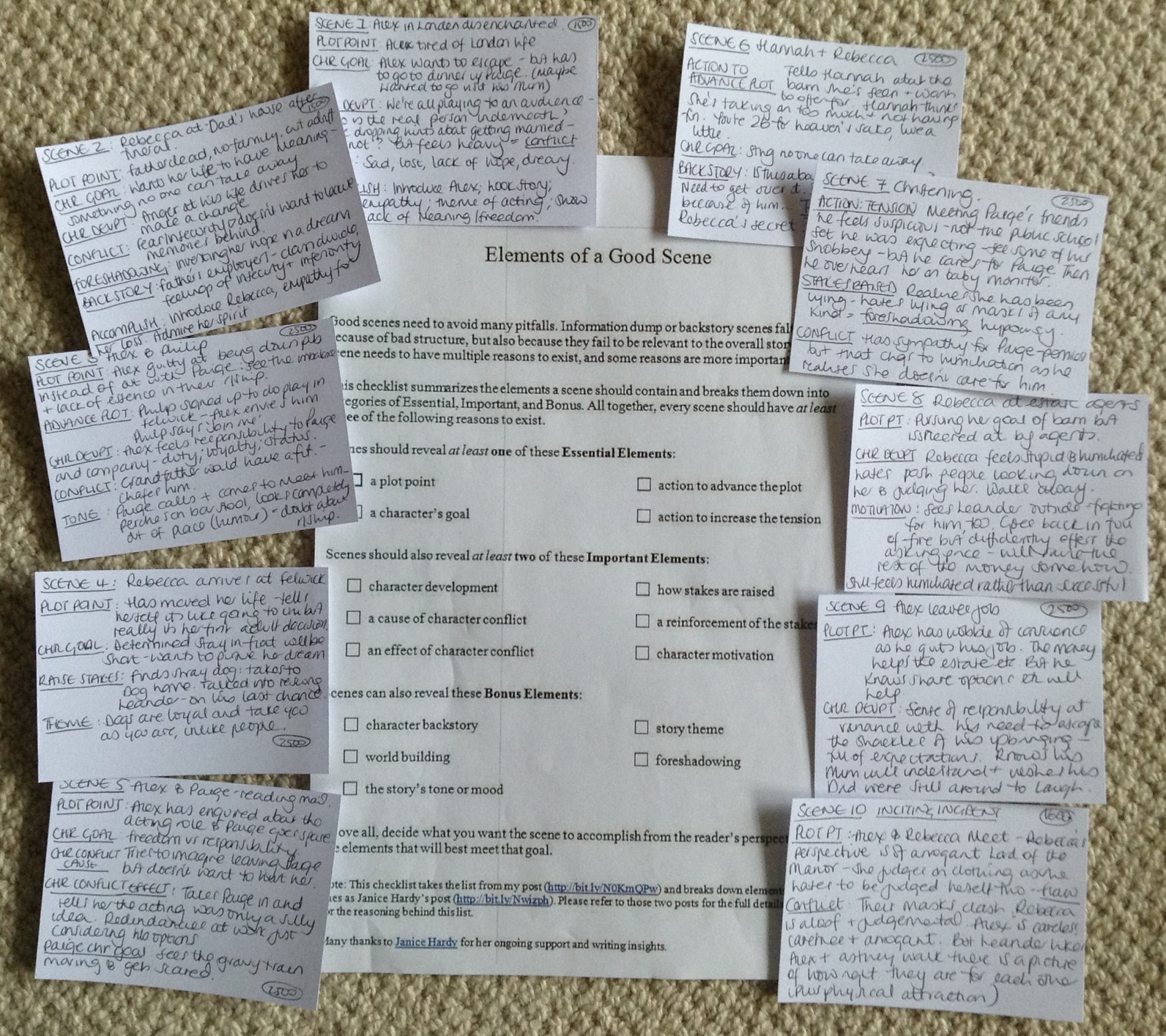
Planning Elements of a Scene
So, in Baby Blues, Helen was attracted to Daniel because his businessman forceful character Mask played to her career orientated Mask. But Marcio was her right love interest, because they both had the same essence underneath: a love of creativity and interpreting the world through their art, and a desire for home and family.
The concept really helps when a character moves from one relationship to another (as mine often do.) You don’t want the protagonist to look like an idiot because the previous relationship was flawed, and also you don’t want the previous partner to be a stereotype or a villain (although Daniel, in Baby Blues, is a bit of both!)
The other thing I’ve been trying to use is an Elements of a Good Scene checklist, which I also found on Jami’s Blog, the idea for which came from Janice Hardy’s blog. I feel exposed, using something like this, as I feel I don’t know the difference between “Plot point” and “action to advance the plot” or “how the stakes are raised” versus “reinforcement of the stakes”. I suspect that might be why I find it hard to write tense page turners! In my head, though, I’ve summarised it as “plot development”, “character development”, “conflict” and “backstory/theme/tone/foreshadowing”. As long as the scene has some of those that’s good. Well, it’s a start!
Of course, I was right – at the beginning when I said planning paralyses me. I need to start writing, before I spend so long on planning I’m fed up with the story or too scared to start. But it was a useful day’s work and hopefully, when I sit at my desk on Monday, I’ll be able to write some of the additional 45,000 words the story needs to get to a full length novel!
Anyway, hopefully now I have a plan this will be the last of the ‘I’ve forgotten how to do manuscript revision’ posts and I’ll get on to writing something more interesting for the non-writers who follow my blog! Thank you for your patience.


 writermummy