The Parent I Am and the One I Aspire to be (reblog)

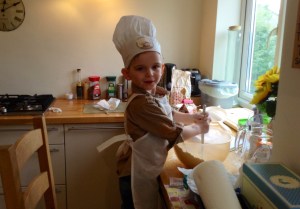
Forgiving son as we finally did baking

Forgiving son as we finally did baking

Today has been a pig of a day, from a half-five start with my up-with-the-lark daughter, through yelling at my son because he wanted my attention when I was trying to restore order in a filthy house, to losing it entirely and sobbing for a whole evening after the dentist told me my three-year-old has two cavities (does parenting fail get any lower than knowing you didn’t control sweets/juice/teeth brushing enough in two short years to stop him having bad teeth like you?)  finishing with an evening staring blankly at a su doku trying to numb my brain because I just don’t want to be me anymore.

Hubbie has watched me like a hawk to make sure I don’t do anything stupid and all I can think is I don’t want such love because I don’t deserve it.
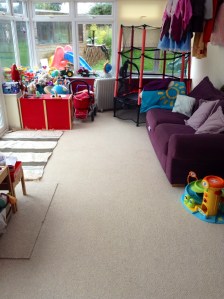
Was this worth yelling for ten minutes because I'm sick of being the only one who cleans anything?

Was this worth yelling for ten minutes because I’m sick of being the only one who cleans anything?

So, as I often do, when happy words for the blog won’t come, I hit ‘random post’ to reread an old blog entry for inspiration. And I found this one, from 7th April last year. Seems appropriate (If slightly worrying that I have these days so often).

I don’t have many words today.

Lack of sleep and residual illness has turned me into at least four of the seven dwarfs. I’ll let you figure out which.

Instead of waffling on as usual, I’d like instead to share two thoughtful and beautiful posts about being a parent: both written as letters to a child.

One describes the parent I’d like to be, the other the parent I am far too often. Again, I’ll let you decide which.

It won’t be hard.

An Open Letter to My Son:

Like some poor, naïve fairytale mother, I’m trying to help you navigate your way through a forest that’s by turns enchanted and haunted. The path is familiar, as if I walked it once years ago, but different, too; overgrown and seemingly impassable in some parts, and unexpectedly clear in others. And as we pick our way through the undergrowth, as we do our best not to trip on twisted roots and sharp stones, I try to remember the lessons I’ve learned from all folktales I used to know.

For example, I won’t make the mistake that Sleeping Beauty’s parents did when sending out invitations to her christening. Unlike them, I’ll be sure to invite the dark fairy godmothers as well as the good ones, because I know that they’ll come anyway, slipping in through back doors and lurking in corners where you least expect them. I’ll let them give you their murky gifts in broad daylight, so that I can look them in the eye while they do so. Then I’ll smile and thank them, recognizing that I have to let life give you the bad as well as the good.

And when I send you out into the world alone, as I know that I will someday have to, I’ll give you something more substantial than bread crumbs with which to find your way back home.

And I won’t make you go to your grandmother’s house alone until I can be sure that you can tell the difference between an old woman and a wolf in a nightgown.

I Wasn’t a Good Mom:

Dear Daughter,

Today, I wasn’t a good mom. The morning came too soon after a long and exhausting night. I rolled out of bed and put pants on an hour before you normally woke up. When I came into your room you were ready for me, your hair tousled and your smile crooked. “I up!” You said reaching your arms out to me. “I pay wif toys!”

I didn’t smile, not because I don’t love you, but because I just needed more sleep. And then the day came and you stuck stickers to the couch and I grumbled under my breath. You tried to play tag and kicked me in the chest and I yelled, “BE NICE TO MOM!” I realize now, I wasn’t yelling that at you. I was just yelling at the world. But how could you know that? You couldn’t, and I’m sorry.

And when I went upstairs to go to the bathroom and you said, “NO MAM GO PODDY!” And I said, “Shut up!” It wasn’t my finest hour of parenthood.

I’m sorry I cried when you ate my lunch. The lunch I bought for both of us to feed my feelings. Because my feelings needed chicken nuggets, but apparently so did you. And I’m sorry I put you in time out when you made your plate do a little dance on the table. I’m sorry I didn’t kiss you when I put you down for nap, choosing instead to run away and lay in the guest room bed and just dwell in some silence.

These are only extracts of the posts. I encourage you to read the full version, and to follow these inspiring blogs. They get me through many hard days as a mother and a writer.

The Incarceration of Avery Edison

Shocking reading, please share

Anne Thériault's avatarThe Belle Jar

Here in Canada, we tend to think of ourselves as claiming a sort of moral high ground when it comes to social justice issues. We think of ourselves as liberated, fair, and anti-oppression; we look down on other countries for their medieval legislature, patting ourselves on the back for being so good, so forward-thinking, so tolerant. And then, every once in a while, an event occurs that proves just how awful and backwards we really are.

On Monday morning, 25 year old British comedian Avery Edison tried to enter Canada through Toronto’s Pearson International Airport, hoping to visit her partner and pick up a few of the possessions she had left behind after moving home to England. Knowing that she had previously overstayed her student visa, she travelled on a non-refundable return ticket and brought with her a copy of her London lease – unfortunately, this was not good…

View original post 1,154 more words

Defining the Climb

My Latest Read

My Latest Read

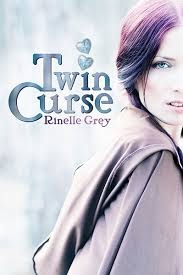
I finally started reading Twin Curse by Rinelle Grey this evening, having decided I’m ready to go back to kindle reading after a month of library paperbacks. And I realised, after my self-deprecating discussion of my own writing recently, that there is a place for all types of reads.

Not to suggest that Rinelle’s writing is anything other than great, because I love her work (I feel I’m digging a hole here. Bear with me!)  but, after the flowery dense descriptions of Maggie Stiefvater, it’s refreshing to get to grips with a standard format book, with clear limited third-person perspective, relatable characters and a promising storyline.

I started it for five minutes before bed (after mooching Facebook all evening because I’m between books and feeling poorly) and I’m already 14% through. I might never write the awe-inspiring prose I admired in The Dream Thieves, but if I can learn to spin a riveting yarn, then that’s good enough for me. (Again, I feel I’m unintentionally comparing Rinelle’s books unfavourably to Maggie’s. It’s not my aim. Sigh. Moving on.)

As I just got another low rating on Goodreads for one of my books (without a text review to explain why) I clearly still have some way to go. But a mountain is climbed one step at a time, and maybe sometimes it’s worth accepting that Ben Nevis is fine, and we can’t all conquer Everest.

And maybe sometime soon we’ll all stop being ill and I’ll be able to get back to climbing my mountains without poorly husband and child in tow!

A Rant and a Plea: Stop the Madness

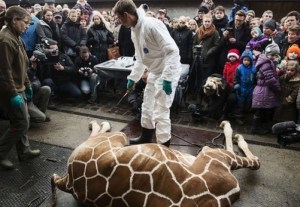
Giraffe put down at Copenhagen Zoo

Giraffe put down at Copenhagen Zoo

More and more, as I hear stories on the news, read posts on social media or receive letters from the charities I support, I am disgusted to be part of the human race. It feels like the world has gone mad. Except it’s only that I hear more about it now. The awful thing is that it’s nothing new. But it has to stop. Here is just a selection of the horrific stories in my Facebook newsfeed today; the mere tip of the melting iceberg.

Copenhagen Zoo killing a young giraffe, skinning it and feeding it to the lions, in front of children, when another zoo had offered to rehome it, because it’s not genetically strong (one of 20-30 animals put down at Copenhagen zoo each year.)

Slaughtering families of dolphins in Taiji, Japan, even though evidence suggests they’re probably as intelligent as we are (more so, I reckon).

The so-called protectors of the Great Barrier Reef giving permission to dredge the sea bed and dump 3m cubic metres of dredged mud in its waters.

In its ruling on Friday, the Great Barrier Reef Marine Park Authority, an environmental watchdog, said the approval was in line with its view that port development along the reef’s coastline should be limited to existing ports.

Hundreds of rangers killed trying to protect nature’s most endangered animals, as an average of three rhinos are killed a day.

  • Rhino poaching increased by over 7,500% between 2007-13, with an average of three killed a day.
  • There are more captive tigers in the US than there are left in the wild
  • Since 2004, Central Africa has lost two-thirds of its elephant population.
  • At least 1,000 park rangers have been killed in 35 different countries over the last decade alone as they work to protect wildlife.
Trying to make a difference

Trying to make a difference

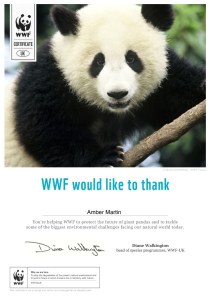
No wonder my daughter woke up from a nightmare, in inconsolable tears, worrying about the bears, after learning about the destruction of the Giant Panda’s natural habitat at school. She’s five and already she cares more than most people I know. Over breakfast we sponsored a Giant Panda through WWF and it felt like a tiny spec of dust taking on a tsunami. But maybe her taking the certificate (and cuddly toy) into school for show and tell help spread the word a tiny bit.

We are parasites, The Matrix had it right. The more I watch Cbeebies programes with my children – Octonauts, Tinger Tinger Tales, 64 Zoo Lane – that celebrate the wondrous diversity of the world on land and in the oceans, the more I am sickened by the knowledge that we destroy the world around us in our arrogance, ignorance and greed.

In this time of social media we need to make a change for good. So, please, I beg you, sign the online petitions, spread the word. Save the future for your children, before seeing animals put down in zoos, or dolphins performing tricks at Sea World, or documentaries on their 40″ TVs, is the closest they’ll ever get to the wonder of the living world.

Descriptions That Breathe – Bringing Writing to Life

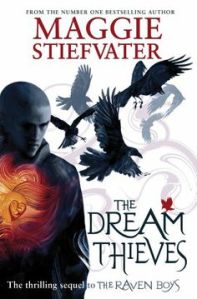
The Dream Thieves

The Dream Thieves

When I write, both in my blog and my novels, I know that my language is straightforward – no deviation between signifier and signified. No real stretch of the imagination necessary to obtain meaning. I gently lead the reader by the hand as they wander through my stories without minimal effort required on their part.

Thinking about it this morning, I’ve decided this is due to three things: My inexperience as a writer of fiction, my background as an analyst and academic, and my constant lack of sleep. Taking those in order, this is how I see it:

1. My inexperience as a writer means I lack confidence and bravery. I over-explain to make sure the reader understands my story, knows what my characters are thinking and feeling. I dread “I don’t get it” and as a result probably get “I don’t feel it.”  Any tendency towards being different is slashed so that I can find acceptance. Any flowery description is deleted as ‘purple prose.’ (The person who edited Baby Blues crossed-out half the similes, saying, for example, “Or just ‘he slept'”)

2. Similarly, my business and academic background have kept my language uncomplex. Actually, that isn’t true of the academic writing: what that did for me was ingrain the passive tense as an acceptable form of language usage. “One could argue that …” is a historian’s stock phrase.

But marketing was all about saying what you meant in easy words. There’s a phrase in marketing, summarised as the acronym KISS – Keep It Simple Stupid. One of my jobs working in Internal Comms was to take complex business documents and ‘translate’ them into briefings for the staff. I was good at seeing through difficult ideas and getting to the essence of the message.

It’s a useful skill as a parent of young children. I am constantly trying to break abstract ideas down into basic language. Unfortunately, nothing kills vocabulary quicker than not using it. Oh, apart from lack of sleep.

3. I can barely remember the colours of the rainbow on fewer than six hours’ continuous sleep and I hardly ever get anything near that these days. I remember at university, when I would pull all-nighters to complete essays: I’d stumble into the communal kitchen at 7 a.m., bleary eyed, and ask my housemates, “What’s another way to say Stalin was pissed off?”

Bereft that I've finished it!

Bereft that I’ve finished it!

Why am I writing this defence of my unsophisticated prose? I finished The Dream Thieves by Maggie Stiefvater last night, and was as blown away as I was by The Raven Boys (and slightly less put out at the ending, having braced myself with the knowledge that it’s a quartet of books.)

Maggie Stiefvater’s writing is beautifully rich. Meanings have to be wrestled from the often dense and opaque prose. Motivations, character’s feelings, and even the basic plot, are often hard to fathom, despite the novel being written in omnipotent third person. It is not a passive read.

What I love most is the way the language is mixed up. I’m struggling to describe it (for all the reasons listed above!) but the closest I can come is to say the descriptions are alive. Just as Death is anthropomorphised in the Terry Pratchett novels, so is everything in The Dream Thieves. It seems appropriate, in a novel where the trees speak Latin and half the characters are psychics, that you can have an “ardently yellow” polo shirt or a “desolate” washing line (pp 7 and 57 respectively. All references taken from the paperback version, UK, 2013.)

Some of the language reminds me of my favourite poet, Gerard Manley Hopkins, who was known for stringing words together, like “dapple-dawn-drawn Falcon, in his riding | Of the rolling level underneath him steady air” (from The Windhover.”). Compare Maggie’s description of one of the characters visiting the family house:

“When Ronan opened the door, the car was immediately filled with the damp-earth, green-walled, mould-stone scent of home.” (p147)

All the senses invoked in one description, without apparent effort. You don’t have to analyse what the character feels, smells, sees, because it’s all there.

For the first time I wish I’d read the book in e-form, as I’m struggling to locate some of my favourite phrases. But here are a few (none of which, I hope, give any story away):

“Adam’s hand glided over her bare elbow. The touch was a whisper in a language she didn’t speak very well.” (p9)

“Gansey’s furiously orange-red ancient Camaro.” (p21)

“Blue Sargent was pretty in a way that was physically painful to him. He was attracted to her like a heart attack.” (p60)

“Then the engine expired … The engine ticked like a dying man’s foot.” (p122)

“Declan looked shocked and poisonous. He was always so alarmed by the truth.” (p411)

“The past was something that had happened to another version of himself, a version that could be lit and hurled away.” (p221)

“Cicadas sang madly from the trees. It was so impossibly summer.” (p340)

“She smiled at him. It was a tiny, secretive thing, like a bird peering from branches.” (p360)

“The crowd, drunk and high and gullible and desirous of wonders, screamed their support.” (p432)

“It was deadly like a cancer. Like radiation.” (p434)

It would be disingenuous to write in Maggie Stiefvater’s style. It is so clearly and unequivocally hers. But reading books like this stretch my vocabulary muscles and build up their strength. They encourage me to be braver and self-censor slightly less. Above all, they transport me to a place where words are everything, reminding me of their power. A place where emotions aren’t described as “her heart thumped like a hammer” (there are a lot of thumping hearts in my prose!)

To read is to learn and to learn is to grow. Bring it on.

And I Am Free

The view from my childhood home

The view from my childhood home

Did you ever run away from home, as a child? My childhood memories are sketchy at best. I recall the hullabaloo when my sister ran away, and was subsequently discovered hiding out in the neighbour’s garden.

I seem to remember a similar ruckus to do with me walking to or from Brownies by myself (it was several miles away along a deserted road) because Mum couldn’t take me.

My childhood comes back in vague flashes that I’ve learned not to rely on as the truth. But I do know that I was often away from the house. I roamed the fields, climbed trees, waded through rivers, either with friends or alone. Home was not a happy place and I avoided it when I could. (When a psychiatrist asked me to name a significant adult I remembered from childhood, I couldn’t, settling eventually on a neighbour who used to breed rabbits and whose house I used to haunt.)

The other place I escaped to was inside a book. No friends outside school? No matter. I had the Sweet Valley High twins, Nancy Drew and the Famous Five. No boyfriend? Never mind. I had a hundred romance stories, from Georgette Heyer and Mills and Boon, to Jane Austen and Emily Bronte. All the happy ever afters you could desire (what they did to my expectations of love and marriage is another post entirely.)

Roaming the fields near home

Roaming the fields near home

As an adult little changed. My roaming got further afield, to the Lake District and Scotland, Morocco and New Zealand. My reading switched, unfortunately, to Nineteenth Century Russian History, to be rescued by Shakespeare and Gerard Manley Hopkins.

And now? Now I long to run away. To roam the fields unfettered without rushing for the school run. I long to drive more than ten miles from home, to be by myself with wide open skies and roaring rivers. To not be ruled by the clock and the routine and the responsibilities. To get through a night without drawing on compassion that doesn’t come naturally or survive a day with no need for patience.

So I escape, into books, and discover that writing has become my salvation. Many writers I know have always been writers. They’ve known from the beginning that that is what they were meant to be. Not me. I wanted to an academic and control words, as I couldn’t control life. I had all the freedom I needed in the mountains I climbed and the books I read.

Escaping to the Lakes

Escaping to the Lakes

Then I became a mother, and my world contracted to a tiny point of endless worry. Even reading wasn’t always an escape (husbands and children don’t understand “this is a good bit” and are sure to interrupt at the climax, never mind my new inability to read anything where people suffer.)

I couldn’t find the books I needed, so I wrote them. I write of all I’ve learned, all the things I’ve done, the people I’ve been, to remind myself. I write of painting huge canvasses or taking photographs, hiking mountains and travelling far from home. I write to remember and I write to forget.

And I read, with my fingers in my ears. I hoard the last chapter until I know I can enjoy it uninterrupted. I read fantasy books by brilliant authors who let me live other lives for a while and make me want to be a better writer. I read at the school gate, and write in the supermarket, and plot and plan in the dark hours of coughing and crying and complaining and cuddles.

And I am free.

Who Says Money Can’t Buy Happiness?

Kids find happiness in the rain

Kids find happiness in the rain

I read this great post by Valerie Alexander on her Speak Happiness blog today about our inalienable right to pursue happiness (well, for the Americans anyway, I’m not sure anyone has told us Brits. Complaining is a national sport!) and how there is nothing noble in suffering.

It came at a good time. The combination of rain and illness over the last few weeks has completely stolen my fairly fragile mojo. It’s good to be reminded that happiness costs nothing, and that “suffering and happiness are not mutually exclusive.  You can survive immense difficulties and still remain a happy person.”

Not that a family full of cold and coughs, a few sleepless nights, and the most miserable weather count as immense suffering. I can see the ridiculousness in that idea. Still, there is something horrible about shuttling small children through puddles and mud, angry parents and umbrellas, twice a day that leaves me grumpy.

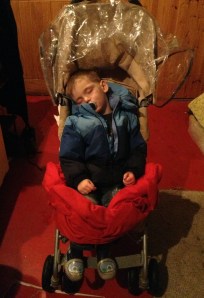
Actually, it reminds me of the phrase, “there’s no such thing as bad weather, only the wrong clothing.” I don’t mind the rain so much when I’m walking the dog, in (mostly) waterproof boots and coat (although the sea of mud around us at the moment makes walking a treacherous thing.) But walking to school, juggling umbrella, school bags and – at the moment – pushchair for poorly child, with my feet slowly soaking in my long-since lacking in waterproofness shoes, and with my drag-in-the-puddles jeans drinking up rainwater, I am only reminded how long it’s been since I afforded myself the luxury of new clothes or footwear (have you seen the price of kids’ shoes these days? None left for Mummy!)

Grrr there I go again, full of misery and self pity. So I’m going to try and follow Valerie’s excellent advice; “I will embrace and grow my happiness, regardless of what challenges the world throws at me.” And I will start by buying myself some new shoes! Who says money can’t buy happiness? 😉

Revisions and The Raven Boys

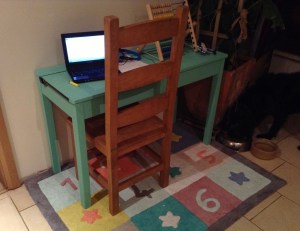
My new workstation - the kids' homework desk!

My new workstation – the kids’ homework desk!

I finally managed to get back to some work today, having packed my almost-better children off to school and nursery. I felt guilty about it, because they probably should have been at home, but I needed the space and silence and absence of sick to start feeling human again.

It felt good to work on my manuscript for the first time in ten days, even though I failed at the numbers game. That’s the thing with revision: you write and write and cut and edit and, at the end of several hours, you have 200 words fewer than you started with.

It’s disheartening.

I’m editing and expanding with this novel, so there are still thousands of words to write to fill the gaps. It’s not uncommon for me. When I write my first drafts I tend to write the highlights; something like an extended synopsis. I write for the romantic ending, the big scenes, the turning points. Then, fifty thousand words later, I look through what I have written and think what?! How did I get from there to there? How did she go from hating to loving him? Why have I given all the secrets away in the first chapter? How much backstory? Then I have to go through and unpick the mess. Fill in the motivations, flesh out the hundred-word paragraphs that really should be two-thousand word chapters. It’s tiresome work, because I write to discover the ending. Once I’ve reached the end, I’m not that interested in filling in the spaces.

I read that way, too. I usually have to read a book twice because, the first time through, (if the book’s any good at story pace or suspense) I skim-read whole chapters to get to the essence, the plot point, the drama. I miss all the great language, the unfolding of characters and personalities, the subplots, the themes. I devour the book, barely tasting it, and then have to go back through and vacuum up the crumbs.

Revision leaves me feeling like this

Revision leaves me feeling like this

I’m reading the sequel to The Raven Boys – The Dream Thieves – at the moment (despite my rant about the abrupt and unsatisfying ending of the first one) and I’m utterly hooked. Now that I know it’s a four-parter, I’m not worrying too much about story resolution (although I’m still skimming ahead for the drama, of which there is plenty). I feel that I’m reading the book in a language other than my native tongue, as if it’s in Old English or something, because the writing is dense and complex and poetically beautiful, but for some reason that’s okay.

But it hasn’t helped my revision. Because, when I put the book down and reluctantly get back to work, I read through my oh-so-obvious story line, with my two-dimensional, unintriguing characters, and I want to chuck the lot in the bin. My Alex and Rebecca are pale imitations (not imitations, because I wrote them before I read Maggie Stiefvater, but you know what I mean), pale shadows of Gansey and Ronan, Adam and Blue. And I want them to shine and live, like Maggie’s characters do. It’s exhausting.

No one says writing a novel is easy. Actually, writing it is the easy part. Making it make sense, making it shine: that’s the impossible task. Reading the words of a master is at once both inspiring and crushing. Never mind. I shall slog on, ignoring the expert sprinting past to the finish, and climb my own climb, one step at a time. It’s worked before. I have faith. I’ll see you at the summit!

Reblog: “All Retch and No Vomit”

Freedom: From the Alan Watts video

Freedom: From the Alan Watts video

Things are still hanging on by a feverish thread here in the Martin household, with little man peeling away my last layers of patience with his fractious, “Mummy, but..” “Mummy, can we just…” “Mummy, I’m bored / tired / miss Daddy” and “Mummy, I’m hungry…” followed by a refusal to eat anything, on eternal loop.

I  decided to look back twelve months to see if this is normal January/February stuff. It is. We need to holiday somewhere hot in the winter to avoid this annual decimation of the family health and happiness and to preserve my ongoing sanity.

In the meantime, as I have no words, I’ve decided to steal a post from back then, 9th February 2013 to be exact, to keep the blog alive in my absence. The title seemed very fitting, as it describes the coughing noise that’s become the soundtrack to my life! (Sorry, too much info!). Joking aside, the Alan Watts speech resonated with me back then and, listening to it again, now my daughter has started school, it has even more meaning now. This is the original post:

________

The Alan Watts video, What if Money Didn’t Matter?, came my way today via Facebook. It’s been around a while so I’m sure most people have seen it. If you haven’t, check it out on YouTube.

My favourite line (describing schooling and how we raise our kids to want the things we want) is

“it’s all retch and no vomit.”

You can’t beat that for an image with impact.

Actually the line that truly resonated was this:

“Better to have a short life that is full of what you like doing than a long life spent in a miserable way.”

What if Money Didn't Matter?

What if Money Didn’t Matter?

Now I know if you have kids, responsibilities, mortgages and so forth, this is a difficult thing to fit into your life. Many of the less positive comments beneath the video are along the lines of “that’s all well and good but I’m a single mum / I have a mortgage / I have bills to pay, I can’t afford to do what I want.” Or my favourite, “what; do I tell my kids not to bother with their homework?”.

To me that has missed the point. It doesn’t have to be so black and white. We can knuckle down to hard work and try to direct that towards something we will love doing in the future. And if in some ways we are already caught in the trap, stuck in a career that’s more about money than happiness, it doesn’t mean we can’t try and pass a different ethos onto our children.

Yes kids still need to do their homework.

Having aspirations doesn’t mean it won’t take hard work to realise them. I think the message is to find something you love and put it nearer the centre of your career than the need to get rich.

When my husband first watched the video he realised he didn’t know what he would do if he didn’t have to earn money. That’s a sad realisation at forty. He’s given it some thought and come up with some answers but I think it’s important to know what you love doing even if it isn’t possible to do it.

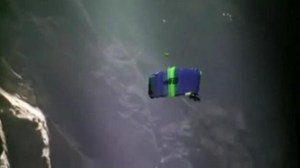
I’m probably rambling making no sense: it’s been a long day on little sleep and too much coughing. I might revisit this topic when I’m feeling more lucid. In the meantime I love the first screenshot I captured, I think it encapsulates the journey Claire is on as she realises life is about more than earning enough money to buy the next must-have designer shoes.

P.S. Why did I never have Claire parascend into a cave? That would have been amazing! One for the sequel maybe…

Finding The Positives

Getting ready for school!

Getting ready for school!

1. It’s not raining

2. Our house isn’t flooded

3. I have two wonderful, loving children

4. I can still get up and look after everyone

5. My daughter doesn’t have a temperature and can go to school

6. The doctor says my son’s cold hands and feet don’t automatically mean he has septicaemia

7. The kitchen is clean after my “I’m ill so I must do housework” blitz yesterday

8. I remembered to buy milk and found some tea bags in the back of the cupboard

9. I no longer have to worry about planning a party

10. I sold a copy of Dragon Wraiths