Halfway there

The picture is of an unhappy toddler in a pink octopus suit. The centre of the picture has the label 'Marketers' and each leg of the octopus is labeled with marketing roles 'Paid Ads, Conversion Funnels, Local Markets, Events, Social Media Management, Content Creation, Email Marketing, Landing Pages' as a humourous reference to the number of different skills required in one role
Marketing Job Adverts: Please do ALL the things

I’ve heard it said that you need to apply for about sixty jobs before you find a new role. Actually, I’ve seen anywhere from 20 to 100, but sixty suits the purpose of this post, since it means I’m halfway there. [Cue a blast of Living on a Prayer. IYKYK.]

So, what have I learnt through applying for thirty jobs?

Firstly, job hunting these days is hard.

I mean, it’s always been hard. And I’ve always been rubbish at it. Before I knew I was neurodivergent, I thought I was just crap. Now I know I was trying to go through a ritual without anyone telling me the rules in a way that I understood.

Thankfully, there are now so many more tools available online, it’s actually been easier for me personally than ever before. Websites like this one, which not only tells you the questions you might be asked in an interview but also tells you what employers are looking for by asking AND suggests possible answers! Game changer. If only I could type my answers during the interview, so they don’t get garbled between brain and mouth!

But the market is hard. I’m looking for remote or nearby hybrid jobs, so I’m competing with a huge number of people. And, because marketing is the first part of a company to be jettisoned in an economic downturn, and often the least understood, some of the roles being advertised are bonkers (see octopus image above). They might as well say, “Please can you replace the whole brand and performance marketing and creative team we accidentally made redundant and then realised we needed, oh, but in a 40 hour week for a fairly average salary.” Er. No.

Joking aside, one of the skills I am honing is the ability to really understand the role from the job description, and then to judge it against my personal abilities. Not just, could I do that, but could I do that without hitting burnout in six months? I personally love variety in a role. I’m happy to become your email campaign/paid ad/SEO/landing page/adobe expert. But not if you expect me to have ten years’ experience in each of those functions, and not when you throw in expecting full analytics and ROI, event management, staff mentoring, and international travel. That’s just not feasible for one person.

Then the actual applications vary considerably.

The majority of my applications are through sites like LinkedIn and Indeed, and are straightforward – add CV, sometimes a cover letter, hit send. Unsurprisingly, those are the ones that get hundreds of applications.

I’ve been asked to do an online assessment, through LinkedIn as part of an application (not for an interview). Thankfully they only asked once, and I’ve been able to use the results for many more applications. Turns out, I’m Expert level on grammar, punctuation and fact checking/error spotting. Thank goodness for that, or I’m in the wrong line of work.

I was asked to prepare a short marketing outline for the application for Rewilding Britain (again, application stage, not interview stage). Being the overdelivering, out of work and bored marketeer that I am, I created a full webpage of assets, including video. It wasn’t looked at, as far as I can tell. But if you fancy a gander at what I can do, have a look.

Rewilding Britain also made a point of asking that AI not be used for CV, Cover Letter, or the marketing outline, which I found interesting. Because I’ve been using ChatGPT a lot.

There are lots of discussions online about the use of AI in job applications. But, as one person pointed out, if you’re a Plumber (say), then crafting cover letters is not your wheelhouse, and ChatGPT is just a tool. Particularly if you’re applying for the recommended 10-15 jobs a week.

I don’t have that excuse. I’m a wordsmith. However, I am also neurodivergent, and cover letters are another one of those areas that don’t come with guidelines. Do you want war and peace? Do you want me to pick up every part of the job description that I can do and give you an example? Isn’t that what an interview is for? So, I drop the job description into ChatGPT and ask it to provide a semi-formal cover letter up to 500 words. You have to say semi-formal or it sounds like a nineteenth century novel. And then – and this is the important bit – you REWRITE it, with your own experience and in your own style.

Similarly, I did use AI for my marketing outline for Rewilding Britain, despite being told not to. Perhaps that’s why I didn’t make the interview, perhaps they could tell. But I don’t have personal experience of promoting an environmental charity, and I didn’t have a week to research it. (I might have spent that time making videos about soil. Oops.) The lovely AI bot gave me brilliant ideas in about 30 seconds, that I was then able to build into a meaningful plan. It’s a tool, people, not a monster.

I have at least managed to get three interviews so far, which is well within the 8% success rate of application to interview, so that’s encouraging.

The interviews I’ve had have all been very different too. We won’t mention the one that triggered the bout of depression, as least said now is hopefully soonest mended. But of the other two, the online one was far preferable to the in-person one. As I said in my last post, it’s much more neurodivergent friendly. And even though I didn’t get the job, I felt I performed better by being more relaxed.

That was also the first interview where I received the interview questions in advance.

This is the positive of the whole process so far, for me. Being able to own being neurodivergent (even without a diagnosis. No one has asked for evidence. And I do have a diagnosis for Anxiety, which also counts as a disability).

Thanks to creating a wonderful echo chamber of neurodivergent-friendly people on LinkedIn, I feel comfortable asking for accommodations now, whether it’s if a job can be hybrid when it hasn’t been advertised as such, or asking for the interview questions in advance. For the latter, I would say that that’s just common sense. I was able to give much more meaningful answers to the competency questions by having an hour to think it through first.

Anyway, I didn’t meant this to be such a long post, and I’m not sure it’s interesting to anyone but me (and my husband, who I am now also applying for jobs for). I think it’s just useful to see how far I have come.

It’s easy to get discouraged, particularly when I had a job I loved that I had to leave and that wouldn’t have me back. But I do believe that everything, even the shitty things, can have a positive outcome.

Hopefully this one will be a meaningful job that I can do in all my ND weirdness. Preferably before the money runs out!

ND-Friendly Interviews? Yes Please

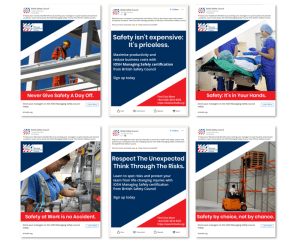
The picture shows six social media advert mock ups for the Charity British Safety Council, designed for a job interview
Images for my Interview Presentation

I originally wrote this on a LinkedIn post a couple of weeks ago, but I feel it deserves to be said again, even if I didn’t get the job!

Virtual Interviews for the win!

There are many ways that the pandemic heralded changes that were neurodivergent-friendly: hybrid working, learning about personal space, normalising not wanting to be touched, and, my favourite, the McDonalds app 😂

I have a job interview at lunchtime today. I’m sat in my PJs, eating breakfast and running through my presentation. I hope to shortly receive the interview questions, two hours in advance, as a requested accommodation.

And I’m calm.

Sort of.

There are still things that can go wrong:

– Dodgy internet
– Power cut
– Barking dogs
– Panic attack

But what I don’t have to worry about is:

– What to wear, particularly on my feet (all shoes are awful, I can be barefoot)
– Driving (tiring for my ADHD brain)
– Traffic (stressful)
– Getting to the right place (something I failed to do on my last interview due to a Google Maps error)
– Where to park
– How to get into the building
– Finding a bathroom
– External distractions in a new environment
– Somewhere to put my notes to help me focus
– The technology for sharing my presentation

Well, actually, that might crop up, as it has before, so I’ll email it over beforehand just in case. [As an aside, I did have difficulties sharing it, and was very glad I had emailed it in advance).

But you get the idea.

Teams interviews aren’t perfect. I have auditory processing difficulties, so sometimes it’s easier in person (where I can lip read). I don’t always know when it’s my turn to speak. It’s harder to avoid prolonged eye-contact. I dislike seeing myself on camera. Did I mention noisy dogs? 🐕

But the point is, the choice is there.

Interviews are hard for everyone, but particularly for neurodivergent people. And I for one am happy to be doing this one in my own office.

Music for Mental Health

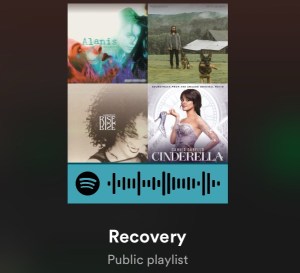
The picture is of a playlist barcode from Spotify, and four album covers (Alanis Morrissette, Noah Kahan, Gabrielle, and the soundtrack to Cinderella featuring Camila Cabello)

So, rather ironically, I missed mental health week due to a recent bout of quite severe depression. 

I’m still recovering but I can feel myself slowly coming back to life.  Something that has always helped me do this is the right playlist. 

One of the most amazing modern inventions for me is the ability to carry music in your pocket, from a walkman to an iPod and now on my phone. And, thanks to online streaming, I can create a playlist for any mood without tape-to-tape faffery. 

Being a word person, finding a song that speaks to me, to the place I’m at, is massively supportive of my mental health. This time my depression was caused by something quite specific and I hoped that I would, I knew that I would, survive it. But it has been one of the worst attacks in recent years. 

And music has been really important. 

I put together this short little Recovery playlist, that starts with feelings of abandonment, through realisation, finding the fighter, rebuilding a glimmer of hope, and then celebration of self. 

So I thought I would share it. 

I’m still not in a place to put together clever words myself but in this slightly belated mental health week post I encourage you to find the playlist that puts you on your own path of recovery.

Who Wrote the Rules?

A gold statue of lady justice holding a pair of scales

One of the hardest things for autistic people to get their heads around is injustice.

I noticed it first when my son was at school and he came home angry that his sports team lost a game because others were ‘cheating’. My own outrage matched his, and it took a while to realise that the cheating was in fact what I guess is called gamesmanship.

Gamesmanship is the use of dubious (although not technically illegal) methods to win or gain a serious advantage in a game or sport.

Wikipedia

The problem for autistic people is that there are so many shades of grey in this kind of behaviour, and our brains are more black and white. 

In the classroom, my son would end up in trouble for insisting loudly that a classmate adhere to the rules. My son would be seen as the disrupter and get told off. The injustice of such an accusation would be awful, combined then with a feeling that he had somehow broken a rule. It was my first real indication that he might be autistic.

My daughter struggles with the unfairness of teachers breaking a uniform code that is inflicted on children because they need to be ‘ready for the workplace’. So much wrong with that! Autistic people tend not to recognise hierarchy, so one rule for teachers and one for teenagers isn’t fair. And then there’s the illogical idea of an imaginary workplace that isn’t in fact where teachers work. Or her parents. In fact, noone she knows still wears a tie to work and can’t have jewellery.

I used to think my need for fairness was a Libra trait. I am learning that it’s probably a bit more than that.

Discovering I am (probably) autistic – and how glad will I be, like my daughter this week, when I finally get my diagnosis – makes so much sense of why I have struggled to find and keep an office job.

Firstly there’s not understanding hierarchy: turns out thinking ‘if you’re wrong, you’re wrong, whether you’re an admin assistant or a chief exec’ isn’t a popular view point. 😂

Then there’s following the rules. What rules? Who made them up? Where is it written that I wear heels and don’t swear and don’t tie my hair in a messy bun? It doesn’t affect my ability to do my job. Same with laughing too much, complaining about noise, or not wanting to eat lunch with the team. 

And fairness or things making sense? That’s just a minefield. Challenging that something shouldn’t be done just because it’s always been done that way is hugely unpopular. But if you do what you always did you get what you always got.

Needing to know WHY is another no-no apparently. But if I understand why a project is urgent, where it fits in, I might be able to deliver it quicker and change a process so it’s not urgent next time.

Right now, all these things are very much in my mind, for reasons I can’t discuss. It’s making me very sad, and I need to move on. But a combination of injustice and something just not making sense has caught my brain in a loop, trying to comprehend the incomprehensible.

It’ll pass.

In the meantime, if you have an autistic person in your life, and I hope you do as we’re pretty goddam awesome, try and appreciate their strengths even if it makes you uncomfortable. They might just fight for you with everything they have to make your world a better, fairer, place

Channeling Energy (or how to sneak up on your brain)

A photograph of the multi-faceted dome from the TV series Crystal Maze

One of the things I’m learning as a neurodivergent is how to follow the flow of energy. When it’s right to rest and when it’s actually better to move, do something, anything, and how to sneak up on my brain if it’s resistant.

I was raised to see rest as idleness, self-care as decadence. It’s taken a really long time to even begin to deprogram myself from that. I also realise, with hindsight, that I pushed those values onto my husband. He used to understand the need to sit and just be, was an expert at it, but I saw it as laziness. Sorry, husband 😔

In my defence, it wasn’t just upbringing. Our whole Western culture celebrates productivity. We are told to “fill the unforgiving minute | With sixty seconds’ worth of distance run”.    

From infancy, our worth is defined by our achievements. You spoke! You walked! You can count to ten, you passed your exams. What a clever girl, I’m so proud of you. Haven’t you worked hard.

The message is never that it’s okay to just be. That the world is somehow better with you in it, regardless of whether you win awards or die trying.

When I was working, Monday morning chat filled me with dread. “What did you get up to this weekend?” caused my truthful autistic brain to stumble. Somehow, “I slept and did laundry” wasn’t the answer they were after 😂

But weekends were for rest and recovery, ready for another week of work. Harvesting energy, so I could pour it into my job. Which is why it was fortunate that I loved it (most of the time). I was excited by Mondays, revved and ready to tackle the challenges and test my brain to see what it could do.

Without that, under-employed as I currently am, (I won’t say unemployed, because there is still a house to run, a family to feed and clothe), managing my energy is so much harder.

Firstly, there isn’t much challenge in laundry, so it isn’t all that exciting. Feeding a house of ARFID is challenging, but in a tax-return sort of way that’s pretty fucking miserable, I won’t lie. My newly-freed-from-work husband is doing All. The. Things. Decorating, landscaping, renovating. Wonderful stuff, but it’s not where my energy is currently at.

So I read and apply for jobs and try not to panic.

And I learn about energy.

I’ve learned that my energy flows best in an empty house. Which is a bit of a bugger at the moment. I’m back to hanging out in coffee shops for solitude and cake. My waist is expanding at an alarming rate 😉

I’ve learned that I can sneak up on energy, like a skittish horse, if I pretend to be resting and then suddenly leap up, put running clothes on, and get stuck into a task before my brain’s caught up. 

I have remembered the power of a playlist. Metallica blaring through headphones got me through periods of post-procrastination panic-productivity at university, enabling me to write a term’s worth of essays in a sleepless week. I don’t recommend it, but if you must, then diet coke and …And Justice for All are what you need. Just don’t forget the headphones.

I am also learning about creative energy. It’s like trying to catch a Roborovski hamster. Or like the end of Crystal Maze, grabbing the gold tokens flying around. The clever contestants waited and gathered them as they landed rather than snatching at air.

Take this post. It’s weeks overdue, and the third I’ve started in my head. But today I waited until the ideas started to gather, then grabbed at them as they pooled in my mind. I started at 5a.m. The Notes file on my phone is full of 5a.m. thoughts. 😂 I had a slight side-quest, trying to find an image of a Crystal Maze contestant grabbing at tokens. I couldn’t, but am learning to limit these perfection-searches where I can. That way danger lies. (The same reason I can’t have Instagram or TikTok on my phone.)

My brain, when under-utilised, is like the Crystal Dome all the darn time. Ideas flap around me, all shiny, but I can’t get hold of them. Or I grab randomly and get a hodgepodge that I can’t sift through. Since leaving work to look after my daughter I’ve knitted, cross-stitched, crocheted, made a book trailer video, redesigned a book cover, drawn illustrations, updated my website, and come up with a dozen crazy ideas for new projects.

New cover design

But having to job-hunt is depleting my energy, because it’s all the things I hate. It’s trying to believe in myself and sell myself, it’s trying to say what recruiters want to hear, in cover letters and interviews. It’s searching, and reading through the job-speak trying to understand what is actually expected in a role.

And it’s waiting.

Waiting is ADHD Kryptonite. A 4 o’clock appointment will kill a day.
Add to that a daughter who is still in recovery and a hyper-productive husband doing ten projects at once, and managing my own energy is getting really hard.

So I read. And rest. And sneak up on my brain, holding a chocolate bar and a coffee to tempt it to submit.

And I wait.

Daughter Power

The picture shows a terraced flowerbed freshly planted with tulips and hyacinths.

Allora, il mio marito è italiano (ma è cresciuto a Luton).

Purtroppo, io non capisco l’italiano. Studio, ma da solo è noioso. Ma ora la mia figlia bisognio di studiare l’italiano! E quando mia figlia vuole fare qualcosa, noi la facciamo!

Translation 

So, my husband is Italian (but grew up in Luton).

Unfortunately, I don’t understand Italian. I study, but it’s boring alone. But now my daughter needs to study Italian. And when my daughter wants to do something, we do it!

Last week, my daughter decided she needed her own bit of garden.

Now, here in the UK it’s been raining for a hundred years. The ground is sodden. Outside is damp and mossy and miserable and I’d prefer to pretend it doesn’t exist until June.

But I bought her some plants and I showed her the tools. And off she went. She needed help. I was grumpy and grudging and we fell out, because all of our RSD is turned up to ten. But she persisted.

And it’s beautiful.

And it made me do a little bit more weeding and tidying, and it was even nice. Until the skies opened again.

Yesterday she decided to paint the porch. I was reluctant, although I tried to be supportive. It felt like a big job and I’m poorly. We fell out. And then we bought paint, and she painted it with a bit of help. It looks great.

The same happened with the bathroom last year. She cleaned the tiles and suddenly we decided maybe we could just repaint it rather than redo the whole thing. And so I spent two weeks painting it and we re-did the floor and it’s great.

Spot the theme? She is so determined, it’s very hard to say no.

One of the common ADHD screening questions is ‘do you feel driven like by a motor’. Er, yes. And her energy pulls us along with her.

Which is fortunate, because my husband and I are overwhelmed by the immensity of renovating this neglected house and garden. So we do nothing. But we’ll do anything for our kids. 

And it’s not just house stuff. I’m doing regular skin care and taking care of my hair. I do more craft. Cook more. I am caught up in her ADHD whirlwind, not always willingly, but the results are the same.

Life is more.

Which is how, despite many many attempts over the 20 years of being with someone half-Italian, I am consistently doing my Duolingo. 100 day streak. I wrote the opening paragraph with only a little bit (okay a lot!) of help from Google. I understand it, though.

The learning doesn’t come easily, my memory is awful, my pronunciation worse. I still can’t talk in Italian to my family (so embarrassing!) but it’s a start. 

Grazie figlia 😊

My Creative Life

So, one of the things I haven’t wanted to talk about recently is my husband and his team being made redundant. It didn’t seem right to talk about it when it was so emotive and raw. Nine years is a long time to work somewhere to then find out you aren’t wanted. Aren’t needed (although we’ll choose to disagree on that). The problem with talking about it is that it’s the same place I worked, and hope to return to. And his team were friends, and they were all treated badly.

All the feels.

But in some ways, my husband leaving that job is a good thing. I’ve said for a long time that he needed a change. A break. A chance to rest and rethink. To do All. The. Things. It isn’t fair that I got to heal from burnout if he doesn’t as well.

It also means that I might be able to return to work sooner. Maybe to the same place if they’ll have me. If I’ll have them. But it feels like a betrayal to consider going back, even though it’s a big company and, stressful and spoon-depleting as it was, I appreciated being in a neurodivergent-friendly team.

But it makes me feel selfish to leave husband and daughter and hustle back to what I want to do, so that’s a not-to-talk-about-for-now.

Part of my stay-employable strategy, though, while I support my daughter, has been to improve my adobe skills and build a portfolio page. I’m doing a video-editing course with the OU, and playing with animation in Photoshop and Premiere. Not the best software for it, but it’s what I know.

What I didn’t expect was how healing it would be to review the things I’ve done, the lives I’ve lived and places I’ve been. To remember I’m more than a mum. I heartily recommend it, if you’re in a rut or need a confidence boost. In the end it was more than practice or a portfolio piece. It was an affirmation. With an irritatingly catchy bit of music 😂

So, here it is: my creative life:

Loading… please wait

So, I’m overdue a blog post.

I hadn’t realised how hard it was going to be, returning to regular writing now that the children are older. Now I am older.

Life at the moment is all about the difficult stuff. My weeks are not filled with visits to the farm, or getting the paddling pool out on a sunny day. School isn’t about World Book Day or cute concerts, once you have teens. Especially SEND teens.

And while there is a LOT to say about our education system, being a SEND teen, negotiating life and friendships in an interconnected world, they are not my tales to tell. I am sure my children will tell their stories in their own words one day.

It will blow you away.

So, I wait. I support, where I can. I feel the big emotions and lock them away. I have long conversations in my mind at 2am about all the things unsaid.

And, because I am me, I craft. And try to stay optimistic. Keep my sense of humour, even if no one else seems to get it. Enjoy nature. Soak in the spring sunshine. Breathe.

I’ll find a new story that I can share. Patience please. 

Writermummy is buffering.

Holidaying with Neurodivergents 

All the activities!

When I went on my honeymoon, I cried. Every day. I had no idea why. I wondered if I didn’t want to be married (I did). Later, I thought I’d had a breakdown. Now, I know it was burnout.

The year I got married, I also lost my dad unexpectedly, finished my Masters dissertation (on Divorce in 18th Century Literature!), moved house – twice – and turned 30, all while working full time in a stressful job. We honeymooned at Christmas in New Zealand, a place full of conflicting memories, and that 12 months caught up with me like an avalanche.

My husband dealt with it pretty well. We’d been together two years and knew each other a bit by then, though we’d not actually lived together all that long. I knew to give him food if he got snappy. He knew not to run after me if I left our accommodation and just kept walking. I’d come back eventually.

Years later, with two young children, I would often break down when we arrived at our holiday accommodation. I would have arranged everything, so would take every disappointment personally. There’d be tears and shouting. There still are sometimes.

The difference now is there is also understanding. For all of us. 

I know I get disregulated with the pressure of packing and remembering everything. My RSD kicks in if I think I didn’t choose the perfect cottage, or I forgot to pack my son’s breakfast bowl and spoon. And we get it.

When we arrive at a holiday destination, we separate to our own spaces (and accommodation is always booked to allow us LOTS of space) and we regulate. Scroll social media, drink tea, nap, unpack, have a lovely shit. 😂

And throughout the holiday, we practice low demand. 

It’s hard. 

Sometimes I really just want us all to go out for a meal in a nice restaurant. Or even a crappy café. But with tonnes of anxiety and ARFID, that’s never going to happen. Eating is a constant challenge and being in public is stressful. So I cater, even if that means less of a holiday for me.

*I’m pausing writing this because I’m on holiday and my daughter needs help regulating.*

Two days later…

And there, that’s exactly how we survive and even enjoy holidays. We lower our expectations and then lower them a bit further. And even if it feels like we’re giving up a bit of ourselves and a lot of what we might want to do, the result is a holiday that we can share together in our own unique way.

I have learned that the accommodation is everything. The largest expense always goes on the perfect Airbnb, because there’s a chance we might not leave it. It has to have three bedrooms rooms, hideaway spaces, a well-equipped kitchen, because I’ll be making all the food. 

WiFi is paramount. We learned that the hard way, when we couldn’t even get 4G in a place and my husband spent a lot of time parked in a Supermarket car park so my daughter could communicate with friends.

The second luxury is food. An all-expenses trip to Aldi on arrival has replaced the Waitrose home delivery now the children are older. If you’re not going to restaurants, you can splurge on all the best packet food, enough that hopefully someone will find something their anxiety allows them to eat. And then food intake MUST be monitored. Disaster is often caused by hanger.

We pack as if we’re moving, even for an overnight trip. Craft, puzzles, colouring, games, gadgets. The two-night break I just had with my daughter included the glue gun (to make pipe cleaner flowers). 

When they were little, it was a £50 Baker Ross order of easy craft kits. ADHD needs to be busy, but anxiety and autism get easily overwhelmed. If you can’t get entertainment on the beach or in the arcades because the anxiety-stars won’t align, then entertainment has to be available. It’s walking a tightrope, it gets easier with practice.

There are loads more little learnings, but they’re probably unique to us. The last bit that might be worth sharing is the most challenging. 

Day trips. 

It’s hard to book something in a low demand house. You might buy tickets you don’t use. We often do. Or we bear the ND-tax of paying on the gate, because booking ahead is too risky. 

Much research goes into something we can all do. Space to roam. Not too much walking. Interaction. Flexibility. Food. Toilets. Easy parking. Weather proof (especially in wind-phobia days). The learning curve was steep.

I took my kids to our nearest seaside town when they were both under 3. It’s a two-hour drive in summer, but I grew up by the sea and wanted them to have that. 

When we arrived, my daughter fell and cut her knee. I hadn’t yet learned to carry a first aid kit. We got to the beach, pebbly and very British. It turned out my son didn’t like the feeling of the sand. My daughter was scared of the moving water. I didn’t know we were all neurodivergent, but I knew we needed a different plan. 

And there was Sealife. 

My first visit. It was perfect. Pushchair friendly. Doors sealed so children could roam safely. Interesting, but not sensory overwhelming. Animals, fishes, stickers. A playground (which is sadly now gone, I noticed yesterday). A café. Even a lovely member of staff who agreed to plaster my daughter’s knee.

We were there for hours. And Sealife is a firm favourite in our lives. My daughter and I went yesterday, 12 years later, and the magic was the same.

Places like Sealife, where the children know what to expect, are a lifesaver for us. We have a few – Woburn Safari Park, Warwick Castle, the different Sealife centres – where we know we can survive. We might only stay a short time. One parent might need to sit in the car to regulate. We might divide and conquer. But it works.

The other thing about our holidays is making sure I know everyone’s ‘Must Haves’ list. My son’s ‘must haves’ are the amusement arcade, preferably every day to earn tickets for a prize, and mini golf. My daughter needs to shop for souvenirs and to watch a sunset. I need to have walked along the shore and to have a daily proper coffee. My husband is happy to do anything as long as he can have a lie in and some downtime. Once we’ve ticked all of those, we’ve had a holiday, even if we have to leave early because we’re all out of spoons. But don’t tick one? Not good.

I used to think holidaying with my wonderful neurodivergent family meant I was missing out. I’d see friends’ vacation photos and envy the museums and restaurants and theatre visits, when mine were of shingle beaches and captive penguins. They go on trips abroad to Paris or Disneyland or – now the kids are older – skiing and safari. Things we will never do as a family. 

But not things I have never done. As a lone traveler I have seen so many amazing places, and hope to again. But this time in my life is not about me. And that’s okay. 

I take my moments. Sitting up late painting while everyone is plugged in watching YouTube. Early mornings on the beach watching the sun rise. Or walking in the freezing rain, as I did this morning while my daughter packed. I could sneak out, because she was regulated. And then I was ready to do what she wanted, which turned out to be come home. And that was okay.

My last little observation is that, actually, those Facebook photos are important. I used to feel disingenuous, posting smiling photos of sunny beaches, when that might have been the one light moment of a difficult day. But my social media feed isn’t to show off to others, it’s my journal. In a year, two, five, Facebook will remind me, and I will smile. I’ll barely remember the hardships, I’ll just recall that I was with my family and there were glimmers of joy.

And hopefully that’s what they’ll remember too.

Blogging: The Art of Listening

I’m reposting this from ten (!) years ago as I stumbled across it today and realised that a) it’s still relevant and b) I still need to work on listening and not interrupting/fixing 😂

A potentially life-changing book

A potentially life-changing book

I started reading a (for me) life-changing book, yesterday, which I wish I’d read years ago, called The Five Love Languages by Gary Chapman. I haven’t finished reading it, so I won’t write too much about it here, but the basic premise is that we all speak one of five love languages and for us to maintain healthy relationships (be it parenting or marriage) we have to understand the other person’s language and learn to speak it.

The languages are Words of Affirmation, Quality Time, Receiving Gifts, Acts of Service and Physical Touch. (If you want to learn more before I finish reading the book, visit www.fivelovelanguages.com).

Rather like Valerie Alexander’s Happiness as a Second Language, it teaches hope, as it reassures that we can all learn these unknown languages, whatever our upbringing. I grew up in a house where happiness wasn’t really spoken and, equally, love wasn’t an open dialogue either. I’m slowly learning to speak these foreign tongues, and having phrasebooks is essential.

The part of the book that sparked today’s blog post came during the discussion of the love language Quality Time. The author speaks of each language having different dialects. For example, Words of Affirmation can include ‘verbal compliments’ or ‘encouraging words’ or ‘kind words’. Quality Time is about giving full attention to another person but this can include ‘quality conversation’ or ‘quality activities’.

On p.67 Chapman explains how hard it is for people to listen, particularly when a loved one wants to rant about a problem at work or similar. He says, “[w]e are trained to analyze problems and create solutions. We forget that marriage is a relationship, not a project to be completed or a problem to solve.”

This was particularly relevant for me yesterday as hubbie came home from work frustrated after having had to work on his personal development plan all day. Admitting there were things he wasn’t good as was hard. Instead of listening sympathetically, “with a view to understanding the other person’s thoughts, feelings, and desires,” I tried to fix the issue. And when he wouldn’t accept my brilliant advice I got angry. Crazy.

Chapman has some great (well worn) advice on listening attentively, but it was point five (p68) that grabbed me.

“Refuse to Interrupt. Recent research has indicated that the average individual listens for only seventeen seconds before interrupting and interjecting his own ideas.”

Oh my goodness, yes, guilty as charged. Interrupting is one of my greatest flaws and I hate myself every time I realise I’ve done it. Even when I’m interrupting to agree, to share an anecdote to say ‘me too!’ or to offer words of sympathy, I am still interrupting. I’m even worse with the children, because for the past five years I’ve had to interpret what they’re trying to say. Now, when they’re capable of explaining it themselves, I still do it and it drives them bonkers, especially the youngest one.

My head fills with words and it’s like I can’t actually carry on listening because my need to speak fills my mind and my words are too precious to waste. How arrogant. When the children interrupt me and I stop them, they often cry and say “I’ve forgotten what I wanted to say now”. My response is usually, “if it was important it will come back to you” but I know from experience that isn’t true. For me, words not said or written down are lost forever (especially the blog posts or character scenes I write in my head at 2am and don’t capture because I don’t want to wake everyone up by getting out of bed.)

I’ve been known to lose track of whole conversations with other people because of the nagging sensation that I was about to say something brilliant. Maybe it’s time to let that go and trust that the words, if important enough, will come back eventually.

Thinking about all this at 5am this morning I realised that is why people love blogging so much and why I love reading posts that other people write. You cannot interrupt. I can write all the way to the end of a thought, or read all the way through to the end of someone else’s explanation, discussion or revelation, without interruption. In a world where we are all so eager to speak, blogging teaches us to listen and allows us to be heard. I hit the like button (where there is one, and I hate it when there isn’t) when I get all the way to the end of a blog post, as if to say “I have listened”.

I also realised that, by reading all the way to the end of a post without interrupting, I often don’t have anything to say. There is nothing to fix, no need for shared anecdotes. The writer has often answered their own question or revealed that actually their situation isn’t exactly like that time when I … at all.

So, my mission is to learn to listen, to learn to let my words go so that I can hear the words of others. How can I write stories if I won’t ever listen to them?

And I’m also going to try really really hard not to beat myself up about past failures. My favourite quote so far in Chapman’s book is “I am amazed how many individuals mess up every new day with yesterday. They insist on bringing into today the failures of yesterday and in so doing, they pollute a potentially wonderful day.” (p47) The sun is shining outside, the children are happy and the husband is smiling. Who would want to pollute this day?

Happy listening.