I am not going to take my own life.
I say this to myself every day. Like an alcoholic choosing not to drink.
But I want to talk about it. If it’s going to be upsetting to you then, please, re-read the first sentence, and then perhaps give this post a miss.
Mental illness is talked about now. Suicide isn’t always seen as the coward’s way out. There is recognition that it’s an illness. But it still isn’t, and perhaps never will be, understood.
Because it is invisible.
Cancer. That’s another big killer. You can see cancer. You can see shadows on an x-ray. You can tell someone is doing battle by their scars: the hair loss, the weight loss. The look in their eye that says, ‘I’m going to beat this bastard, you see.’
And I’ve known people that did beat it. And some that didn’t.
But here’s the thing. It’s an ‘it’. It’s an intruder. It’s visible.
With depression, anxiety, suicidal thoughts, despair, ennui, whatever you want to call it, it’s ‘you’. It’s not ‘other’. It’s there inside your head. It sounds like you, thinks like you, it can control your emotions. It can make you cry uncontrollably. It can make you feel sick and shaky at the thought of dinner with friends. It can make you look at the river, every single time you walk past it with the dogs, and say, ‘Well, why not?’ So that the other you – and we all have several voices that chat in our heads, right? – the other you has to say, ‘SHUT UP. Don’t be so fucking melodramatic. I’ve got this. I don’t need to lie down and not get up.’
But imagine having to have chemo every day, with no one having a clue, not even nurses. Imagine that, on the occasions you wanted to say to someone, ‘Chemo makes me vomit, makes my hair fall out and my skin smell of chemicals and it’s horrid,’ but actually what you want to say is, ‘I see no point in living, I get up every day because I have to. I love my family, but that doesn’t fill the darkness inside. I stay because I know they would blame me if I went, but I just want to sleep and never wake up.’ Yeah, I can see how that would go. Selfish, much? Or, my favourite, ‘we all have days like that.’
Did you ever say to someone having chemo, ‘yeah, I had it yesterday, it’s a bitch right?’
My dad had chemo. He fought cancer and beat it. But he died anyway, of septicaemia. But do you know what I think actually finished him? He lost the will to live. Literally. It’s complicated, and it hurts to think of it, but certain events in the weeks before he died made me think that he had just had enough.
I know three people (or three people that have told me) that have lost loved ones to suicide. And I’ve heard that confusion, betrayal, despair. The, ‘Why didn’t they just ask for help?’ The heartrending, ‘What could I have done? Why did they leave when people loved them?’
I’ve felt some of that with Dad. I should have been there that weekend, when he got pneumonia. I mean, I actually should have been there, but we changed our plans. I’d meant to buy him a heater for his room, but for some reason (too expensive?) I didn’t. I didn’t find out he had died for two days. It took me years to get over that guilt. But I never once thought, ‘Why did he give up, he had family that loved him.’
Because the thing is, when it comes down to it, it’s just you and the illness. You’re not thinking in big pictures. Love can feel like a burden, because it’s anchoring you to a place you don’t want to be. When you drag yourself out of bed every day, to give yourself to others, in search of meaning, or out of duty, the love gets twisted, lost.
I’m better if I’m busy. If I don’t give the thoughts room to talk and grow and suffocate me, I can reach contentment. But, here’s the kicker: my illness makes work very difficult. I am easily overwhelmed. Noise can flip me over the edge. If I get tired, I get emotional and say things I shouldn’t to people that don’t forgive (or don’t know). I’ve had two ‘proper’ jobs in my life and I left them both because of my mental health. And so I’m frightened to go back.
Job adverts are all about ‘resilience’. I looked up resilience yesterday. It literally means, ‘to bounce back’. Well, I do that every time I have a panic attack. It takes a day or so, but I bounce back and get on with life. But it doesn’t just mean that, not in a workplace.
I read this interesting article – from 2002 but still relevant – How Resilience Works, from the Harvard Business Review.
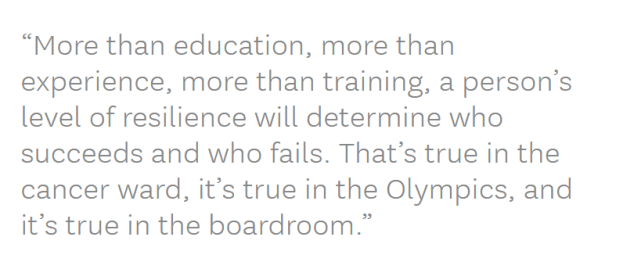
The article cites three things required for resilience. 1. Facing down reality (basically not being overly optimistic). 2. The search for meaning (seeing life as part of a bigger picture). 3. Ritualised ingenuity (the ability to make-do with what’s around you to solve problems).
I’m pretty good at one and three, but two is a problem. I highlighted this quote:
“[M]eaning making is, most researchers agree, the way resilient people build bridges from present-day hardships to a fuller, better constructed future. Those bridges make the present manageable, for lack of a better word, removing the sense that the present is overwhelming.
The present is overwhelming. Yes, that’s it. I see no future without depression, no future where I’m not battling every day to find a reason to keep fighting, and so every day is overwhelming.
I then found a more recent article by the Harvard Business Review on Resilience, from 2016, (I told you it was the key term for business) called, Resilience is About how you recharge, not how you endure. It starts by explaining that resilience shouldn’t be about how long we fight, but how quickly we recover.
We often take a militaristic, “tough” approach to resilience and grit. We imagine a Marine slogging through the mud, a boxer going one more round, or a football player picking himself up off the turf for one more play. We believe that the longer we tough it out, the tougher we are, and therefore the more successful we will be.
The reason I left both my ‘proper’ jobs, the reason they broke me, was because they were relentless. Long days, high stress, lack of support, and an expectation that you were never ill. Leaving at 5pm was called a ‘half-day’. That was a decade ago, and I know (apparently) things are better now. But it’s still frightening. I once had a boss tell me to take a couple of days ‘to get a better attitude’ after I’d lost it at him. Turns out, he was on the money. I went hiking in the Lakes and came back rejuvenated. But the ‘get a better attitude’ part has stuck with me ever since. It was my lack, my failing, that was the problem, my inability to stand the pace.
The key to resilience is trying really hard, then stopping, recovering, and then trying again.
We are beginning to understand this. It used to be called a duvet day, which sounds terribly indulgent. Now it’s called self-care. It amounts to the same thing. Switching off. Literally. Turning off the phone, crawling into whatever space makes you feel safe, and disconnecting.
The danger for a depressive, however, is that’s the space where the voices hide. Lying in bed because you can’t function as a normal human being isn’t always restorative. So another kicker for resilience.
There are two memes on Facebook that I love at the moment:
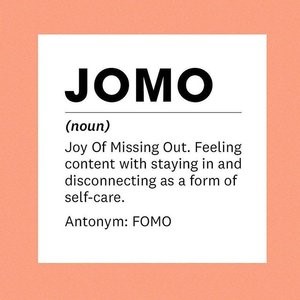
I did this last night. Although joy is the wrong word. But I stayed in as a form of self-care. I had FOMO (Fear of Missing Out) too, because I’d been looking forward to dinner with my friends. But I turned off my phone, so I wouldn’t see all the WhatsApp messages, and I looked after myself.
The other one is key, though:
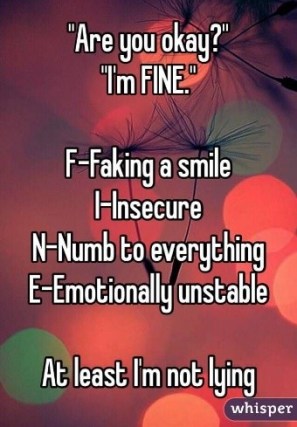
My son asks me every five minutes if I’m ‘okay’ especially when I’m clearly not. I say, ‘I’m fine’ to reassure him. Yesterday I had to say, ‘I’m not fine, but I’ll be okay, please can you stop asking.’ Thankfully he’s the most emotionally mature eight-year-old and he understood.
Sometimes ‘Fine’ is the best answer I have. Because people don’t want to hear the truth or they’ve heard the truth so many times it gets tedious, or they feel helpless because they know they can’t make it better. People like to fix things. People like to fix people. It isn’t always possible.
When I explained to my friends last night, they were the perfect friends. “Tough” one response said, “You’ll be missed”. As in, we know it’s tough but we understand, and we won’t stop asking you to come but we won’t pressure you either. Perfect. It’s taken a long time to find friends like those, because anxiety doesn’t leave much room for friends.
Anyway, today is a new day. I am resilient. I bounce back. Thanks to those friends I have a plan, a future I can prepare for, that will help with the overwhelming now. I battle on.
But the next time you hear someone say a suicide is ‘the easy way out’ or ‘selfish’ or ‘cowardly’, send them my way, and I’ll give them some context.
 It’s been a while since my last post. It feels like forty years. Given the nature of Invisible Illness, I thought I’d better check in and say I’m still here, just about.
 I’ve spent the last six weeks reading everything I can and replaying my life through this new filter. Exhausting but incredibly enlightening. All the parts of me, of my life, that I thought were broken were actually a result of me being ‘neuro-divergent’. The phrase ‘normal, not normal’ springs to mind. Mostly, for the first time in forever I don’t feel alone. (Go on, who now has a Frozen song playing in their head)
 September didn’t get much better. I don’t know if it was exhaustion or a change in meds supplier but I was (am) fragile as a poppy. Any attempt to process more than one thing and I crash like a crappy computer.
 So it isn’t completely crazy for this ditsy arts student slash author to try and learn something as methodical as programming. But the brain is soooooo slow at 42 (even if it is the answer to life, the universe and everything!) I’m doing an online course from Harvard and have already nodded off during a lecture.
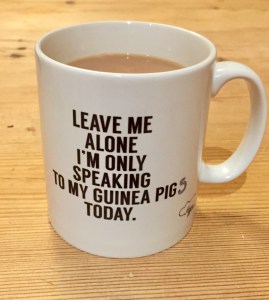
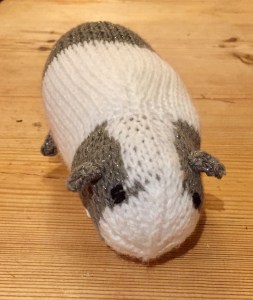 And even my therapigs are being pickles. I keep trying to combine them into a herd but I have one that’s a bit of a bully. In my advice emails from the lovely people at Wood Green, they said that some gps are just like that and “it’s great that she has a companion already.” Ha! She’s basically me: impossible to live with and lucky she has a life partner who will put up with her. What it does mean is they stay in separate cages, so two lots of mucking out and laundry. Perhaps I need to stick to the guinea pig Mum gave me for my birthday.
 I’ve submitted Dani and the Djinni for the Mslexia Children’s Novel Award and, if that goes nowhere, it will be the next in line to be illustrated. I’m doing a book signing at my local library next month so I need to keep plodding on with the writer bit of writermummy.
 Back in November 2016 I was working for a friend of a friend, typing up audio files, and she asked if I would help one of her dream writers with a final edit of their autobiography. My first response was to say no: I didn’t feel qualified to edit someone else’s work, especially when I pay someone to do a final edit on my own novels. In fact, I recommended that the author speak to my editor, and assumed that would be the end of it.
 Can you hear them? All the blog posts I have written in my head over the past few months. Mostly at 2am, when my terrible sleep pattern has me wide awake, brain working, body dead. Unfortunately, by the time I’m up at 5.30am, the body is awake and the mind is numb.

 These days we’re never far from home. My daughter just texted me a love heart she drew and I could video call if I wanted. I don’t know if it’s good or bad. As a parent it’s comforting – I don’t know how my parents coped when I travelled around New Zealand, with only the occasional text message or sporadic email from a grotty internet cafe to let them know where I was and if I was okay.
 At the same time there is a sense of never being free, of never getting lost (I used Google Maps to find the B&B), of always being tethered. Of being reachable, connected. Being able to receive messages from my son that are full of poop emojis!
 I took the dog on a different walk last week, and it was exciting to meander without timetable or anyone knowing where I was. It shows you don’t actually have to travel to feel free, or always feel free when you travel.


 I don’t really want to talk any more about the EU Referendum, but I’m going to anyway, because I can’t think of anything else.
 All of us. Not just those who voted to leave, but those who voted in a Tory government, those who didn’t fight harder for an opposition to be proud of, those who thought only of their own and didn’t worry about anyone else. Those who let the poor get poorer and the rich get richer.
