Blog Post Revisited: Using Life’s What Ifs

My Three Darlings

My Three Darlings

I finally sent a complete draft of Class Act to my fabulous Beta Reader yesterday, and found myself at a loose end. I know it needs more work but, quite frankly, I’m sick of the sight of it and am starting to doubt whether it even works as a story. Time for a change.

I want to start something new, rather than working on one of the three or four half-finished manuscripts I have on my laptop, courtesy of years of NaNoWriMo. But I’m a bit all chick-litted out, after Two-Hundred Steps Home and working on Class Act. So I got to thinking about other ideas I’ve had, and I remembered the Middle Grade Novel idea I had nearly a year ago. This is a bit on how it started.

A few days after writing that post, I wrote the one below. A little insight into where some of my writing ideas come from.

-––––––———

Writing out some of the background for my new novel today I realised I was inadvertently writing a ‘what if’ about my own life, or one tiny aspect of my life. I think sometimes that’s what writers do. They use their words, their imaginations, to explore different lives they might have lived. Mine is a little thing that might have been huge.
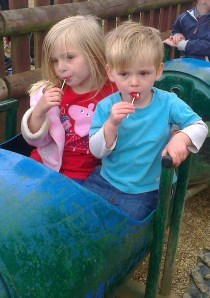
Close Siblings

Close Siblings

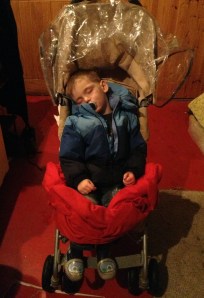
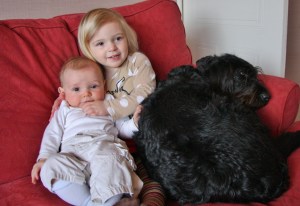
I was late for my period this month: second month in a row. Now, we’re careful. We have two beautiful children and I’m in my late thirties. My first child was born at 37 weeks, the second at 35 weeks. My pediatrician friend said that a trend to premature babies could easily continue.

So, even if we wanted more children (which we don’t – only when I get occasionally broody) the risks are far too high. And I KNEW I wasn’t pregnant. I’m more likely to be menopausal, as early menopause runs in the family. But, still, you start putting two and two together and making five. I was tired, grumpy, teary and, above all, late.

The protagonist in Baby Blues & Wedding Shoes gets pregnant against the odds. These things happen. I worried. I read up about menopause at 2am on my phone. And, being me, I re-planned my future with a third child in it. I needed to be prepared, just in case. I worked out the age gap, when the third would start school. I decided it would be nice for my son to have a play mate when my daughter starts school in September. I tried to decide whether I’d prefer a boy or a girl. I’m a writer: I wove stories.

Drove hubbie nuts.

Then I decided I ought to actually get a test and part of me was actually a bit excited (damn you, breeding hormones). I didn’t need the test, as it turned out. As if just buying it was enough, I knew before I got home that it was no longer required. In a tiny way I felt as if I’d lost a baby, even though no baby existed. Because I had made the scary future so plausible.

I wasn’t going to talk about it on the blog – it seems to come under the ‘too much information’ category. Until I started writing out my character list for the new book this morning:

George: 11. Two siblings, Ben (14) and Susie (16). George suspects he wasn’t planned. His sister tells him their mother used to say ‘I’ve only got two hands’ or ‘one of each, job done’. George feels unwanted and an outsider. Susie is academic, Ben is musical. They’re close. George likes football and computer games and being lazy.

My Little Bean

My Little Bean

I realised, half way through writing it, that George is my imaginary third child. The things I worried about at 2am were all there: that any other children born into our family would feel left out because my two are so close in age; that my eldest would remember me saying ‘one of each, job done’; that a third child would feel alienated, like my Uncle and my Mum – both the last of three kids.

The loss of my imaginary child, that hurt for a day, doesn’t hurt so much now. When I see the kids needing another play mate I do wish I had started my family earlier, so more children was a possibility. But now I can write them in to existence instead.

So much cheaper and no need for cots, bottles, stretch marks, swollen ankles and endless dirty nappies. Hurrah.


Reading is Working, Honest

A Doorstop of a Book

A Doorstop of a Book

I had a bit of a hiccup this morning; the first biggy since starting on the tablets a week ago. I had hoped the tablets would help reduce my insomnia, but they seem to have made it worse instead. I’m waking at 2am and 5am every night, unable to close my eyes. In retaliation I’m back to napping as soon as the kids are asleep which only exacerbates the issue.

I woke up fretful and panicked, with palpitations and a strong desire not to have to face the school run. I made it through the chattering and the tears and the “Mummy I’m going to miss you” but by the time I got home I was shattered and most definitely unfit for work.

Add to lack of sleep the presence of hubbie at home on a rare day off and writing just wasn’t going to happen. I find it extremely hard to write with someone else in the house, almost as if I feel guilty that I’m not doing something more productive with my time, like laundry or housework. It stems from childhood and it drives hubbie potty, not least because a lazy day on my part without guilt makes it much easier for him to do the same (not that writing is a lazy day).

Anyway, for a whole host of reasons I decided it was a day for reading. I’m ploughing my way through a doorstop of a fantasy book I found in my old bedroom at my mother’s house – The Curse of the Mistwraith by Janny Wurts. If I’ve read it before I blocked the painful experience from my memory. I’m not sure why it’s gripped me now because it’s a fiendishly difficult read. As opaque in language as The Raven Boys, but lacking Maggie’s poetry and passion, it’s dense and unfathomable but clearly with enough story to maintain my interest. I’ve given up on much easier reads.

The book sprung to mind when I read Rinelle Grey’s recent post on world building in Sci Fi and Fantasy (Is Simple Ever Better? My answer is yes!). The world building in this book is elusive and complicated, but promises unicorns and dragons so appeals to the fairy princess in my soul. And as I curled up in bed reading I suddenly found myself opening my laptop and tapping out 500 difficult words to get me to the next place in Class Act. Clearly just the act of reading can free up words in a muddled mind, connect those pesky twenty-six characters into something with vague meaning.

So, there you go, reading is working if you’re a writer. I have proof. I never need feel guilty again. (Though of course I will. Who wouldn’t feel guilty reading and calling it working for a living?) Next time though I might just choose something easier to read. Like War and Peace.

What’s Your Character’s Love Language?

Do you know your characters' love languages?

Do you know your characters’ love languages?

It’s no secret, here on the blog, that I was strongly affected by reading The Five Love Languages by Gary Chapman, and coming to understand mine and my husband’s particular languages. It has strengthened our relationship and helped us communicate. I’m also now looking at the children and trying to understand how they feel love.

But, being me, I never miss an opportunity to put my life lessons to work on my writing.

Today, at the end of walking the dog – it taking that long for my drugged brain to start working – I turned my mind to the dilemma of my current writer’s block. I’m trying to pen an emotional scene in Class Act, to get my protagonist Rebecca past a difficult experience in her life, without having any direct knowledge of the issue.

I don’t want to belabour the point. Like the postnatal depression in Baby Blues & Wedding Shoes (which I do have experience of), the issues in Rebecca’s past are important for the effect they have on her character and relationships, but I don’t want them forming the be all and end all of the novel. I’m writing genre fiction not literary fiction and aiming for a happy ever after, albeit a plausible one that survives challenges.

So I wondered how I could help Rebecca get through the difficulty most quickly, and whether that could be done genuinely with the right man without it all seeming too convenient and unrealistic. It made me ponder what her Love Language might be and I realised that – for her – the love language has to be Words of Affirmation. Therefore Alex, the love interest, needs to talk to her, reassure her, convince her of his sincerity. I’m not sure what his Love Language is yet. I think his might be Quality Time. That’s the thing lacking from his childhood and the thing he yearned for in his failed relationship at the start of the novel.

I feel as empowered in my writing as I did in my marriage by looking at things this way. I have also realised that I know my characters better than I might give myself credit for. I think I’ll use the five love languages again when considering my romantic protagonists. It’s a new, interesting and simple way to ensure coherent, three-dimensional characters, particularly in the Romance genre.

Just goes to show, you can learn from the strangest of sources. As a friend of mine used to say, “Every day’s a school day.”

Eking Out The Words

Sometimes you have to get down to graft

Sometimes you have to get down to graft

I finally got back to work on Class Act this week but, my goodness, it’s like pulling teeth. I’m unfortunately at a juncture in the novel where the protagonist is tackling something from her past as her relationship with the male lead hots up.

I didn’t write these scenes the first time through – not deliberately, it just didn’t come out in the first draft. I don’t do sex and I don’t do conflict, and these scenes have both. Only, writing them in my current frame of mind, I feel like I’m trying to make a porcelain tea set using a hammer and chisel.

It’s tempting to delete everything I’ve painfully written this morning – all three hundred measly words – but sometimes you just need something on the page to edit, and move on.

Occasionally you look back and it isn’t as awful as you remember. Mostly, you look back and get out a big fat red pen and fix it. All I know is I’ll never have a manuscript to get to Beta Readers if I don’t push on through. As lovely as it is that I sold 30 copies of Baby Blues and got a new five star review (and it is lovely!) it’s only going to work if I keep writing.

Sometimes the 300 words, eked out one cup of tea at a time, are as important and precious as the three thousand rattled off in good order. They’re all steps up the mountain.

Celebrating Success and Searching for Motivation

Achieving great rankings

Achieving great rankings

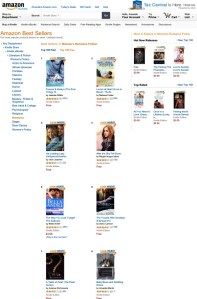
My Baby Blues and Wedding Shoes promotion ended this morning and it couldn’t have gone better. I had around 2,500 downloads and reached some great numbers in terms of ranking:

#8 in the Romance category on Amazon.com

#10 in Contemporary Women’s Fiction on Amazon.com

#39 on overall free downloads for Amazon.co.uk

#15 in Contemporary Romance on Amazon.co.uk

Now I know these numbers don’t mean a great deal. The majority of people who downloaded the book won’t read it, even fewer will leave a review. However to get that many downloads in two days, when the book only has one review in the US and none anywhere else (and virtually no promotion other than a few tweets and status updates) gives a little ray of hope that at least my blurb and front cover are okay (Though hubbie tells me the title makes people think the book is depressing.)

I see free promotions as more of a banner advert, getting my name in front of people who wouldn’t otherwise discover me and my writing, than a way to get new readers. I know myself that I download dozens of books I’ll never read. Time will tell whether it works as a strategy, but if nothing else it’s a nice feeling to see yourself on the first page of the bestsellers! 🙂

Making it on the first page!

Making it on the first page!

It also makes me see the benefit in loading a book up for preorders via Smashwords. If I could sell enough copies in the weeks prior to release, then that splurge of sales on day one of release would do wonders for initial rankings. Of course, I have to finish my next book for that to happen and, boy oh boy, am I struggling. I’m still tired and scattered from the medication, and I just can’t seem to pin myself down to the hard graft of revisions. I know if I’m not careful weeks will turn into months and, like the box of kids’ things waiting for me to sell on ebay, it will become an insurmountable task to get back to work.

I wanted to get my first draft to the editor by Easter, so I could take the two weeks off to clear my mind, ready to work on the revisions when they came back, and give the children my attention during the school holidays. Ho hum, that gives me five weeks to add thirty thousand words and fill all the plot holes AND get it to Beta Readers. Hmmm some mountains are too high. I think it might be that which is freezing my mind. Needing to work around the school holidays is adding a new dynamic to my already-fragile motivation! Oh well, every mountain is climbed one step at a time. I just need to write ten words today and it will be twenty tomorrow.

But first I might walk the dog!

Filling the Gaps: Where’s the sex?

"Romance" covers show what readers want

“Romance” covers show what readers want

I’ve been working on Class Act today, hurrah! After too many days lost to sickness (me and the children) it was nice to get back to it, even if I didn’t make as much progress as I’d hoped. I had a pretty rough day yesterday and it is hard to write, for me, when I’m emotionally drained.

So I spent the time I had looking through my current draft of the novel to spot areas that needed expanding. As I’ve mentioned before, I tend to write the highlights in my first rough draft, and then have to go back and fill in the gaps during revision.

One thing I’ve noticed that I leave out a lot is the sex. My books are fairly chaste, particularly by modern standards. There isn’t much nookie, even though Baby Blues starts with a sex scene (which was originally more detailed than the final edit). I find it’s not something that gets added in unless I think of it. Maybe it’s because I grew up reading (and loving) Georgette Heyer novels. (Class Act definitely has elements of a Heyer story). Maybe it’s because I’m a mother of two small children, generally too exhausted to give much thought to nookie in my own life (sorry hubbie!)

It’s certainly unusual. Most of the chick lit books I grew up reading (aside from Heyer) have at least one or two sex scenes, from the sweet, to the implied, to the steamy. I enjoyed reading them in my teens and twenties, although I’m not a fan of erotica or books that have sex as the main focus. But it is generally a natural part of relationships and therefore plays a role in the character and plot development, so why do I leave it out?

My Latest Read - lots of kissing!

My Latest Read – lots of kissing!

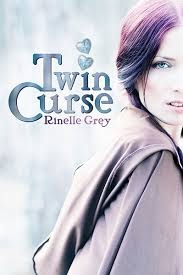
I am noticing, as I read Twin Curse, that there’s lots of kissing and physical contact (and I’m sure eventually sex). And I wondered, is that why my books don’t sell well and don’t get reviews? In the days of Fifty Shades of Grey, am I not fulfilling the need for a bit of action? Certainly if you search ‘romance’ books on Amazon, the covers suggest that bedroom action is a key selling point. When I write my novels, my aim is usually to explore characters at life-changing points in their lives: change of career, change of priorities, change of heart. They fall in love, but that’s only part of the story. The demons they battle are in their minds and in their past. But, to make the relationships genuine, there has to be some physical attraction.

I remember watching an episode of Bones once (a TV show about a forensic anthropologist who is also an author). The lead protagonist is proud of her books, particularly the scientific aspects of them, but her fans buy and read them for the sex. She actually has a friend of hers help her with that aspect of the stories and eventually gives her friend a percentage of the book royalties because she realises it is the sex that is selling the books.

I suppose the phrase “sex sells” didn’t come about by accident. But it feels awkward for me to go through the story and inject sex scenes where there are none. Particularly in Class Act, where the physicality of the relationship is a core part of the story. I was shocked to discover I’d got to the climax scene in the first draft without the couple ever ending up in the bedroom – even though it was a core part of the story! (The same happened in Baby Blues but at least she had the excuse of being pregnant / a new mother!)

And then of course there is the issue of how steamy to be. I prefer implied action, because what is a turn on for one maybe a complete turn off for someone else. I remember reading Mills & Boon as a teenager and giggling over the “throbbing member” type descriptions. Focusing on the sensations and the emotions is probably more my style. But there is a danger that it all gets too introspective and unrealistic: people don’t typically have internal dialogue when they’re in the clinch of passion.

Anyway, I don’t really have the answers, but I was intrigued when I realised how unromantic and chaste my romance novel is in its early drafts. Maybe I should stick with writing YA or move into MG fiction. I’m obviously more interested in plot points than pants! But, for now, I need to fill the gaps. I’m sure hubbie will be happy if I do some research and inject some sex back into things! 😉

Revisions and The Raven Boys

My new workstation - the kids' homework desk!

My new workstation – the kids’ homework desk!

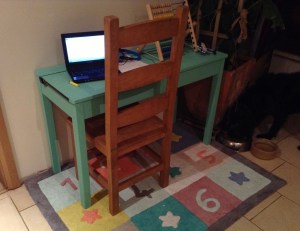
I finally managed to get back to some work today, having packed my almost-better children off to school and nursery. I felt guilty about it, because they probably should have been at home, but I needed the space and silence and absence of sick to start feeling human again.

It felt good to work on my manuscript for the first time in ten days, even though I failed at the numbers game. That’s the thing with revision: you write and write and cut and edit and, at the end of several hours, you have 200 words fewer than you started with.

It’s disheartening.

I’m editing and expanding with this novel, so there are still thousands of words to write to fill the gaps. It’s not uncommon for me. When I write my first drafts I tend to write the highlights; something like an extended synopsis. I write for the romantic ending, the big scenes, the turning points. Then, fifty thousand words later, I look through what I have written and think what?! How did I get from there to there? How did she go from hating to loving him? Why have I given all the secrets away in the first chapter? How much backstory? Then I have to go through and unpick the mess. Fill in the motivations, flesh out the hundred-word paragraphs that really should be two-thousand word chapters. It’s tiresome work, because I write to discover the ending. Once I’ve reached the end, I’m not that interested in filling in the spaces.

I read that way, too. I usually have to read a book twice because, the first time through, (if the book’s any good at story pace or suspense) I skim-read whole chapters to get to the essence, the plot point, the drama. I miss all the great language, the unfolding of characters and personalities, the subplots, the themes. I devour the book, barely tasting it, and then have to go back through and vacuum up the crumbs.

Revision leaves me feeling like this

Revision leaves me feeling like this

I’m reading the sequel to The Raven Boys – The Dream Thieves – at the moment (despite my rant about the abrupt and unsatisfying ending of the first one) and I’m utterly hooked. Now that I know it’s a four-parter, I’m not worrying too much about story resolution (although I’m still skimming ahead for the drama, of which there is plenty). I feel that I’m reading the book in a language other than my native tongue, as if it’s in Old English or something, because the writing is dense and complex and poetically beautiful, but for some reason that’s okay.

But it hasn’t helped my revision. Because, when I put the book down and reluctantly get back to work, I read through my oh-so-obvious story line, with my two-dimensional, unintriguing characters, and I want to chuck the lot in the bin. My Alex and Rebecca are pale imitations (not imitations, because I wrote them before I read Maggie Stiefvater, but you know what I mean), pale shadows of Gansey and Ronan, Adam and Blue. And I want them to shine and live, like Maggie’s characters do. It’s exhausting.

No one says writing a novel is easy. Actually, writing it is the easy part. Making it make sense, making it shine: that’s the impossible task. Reading the words of a master is at once both inspiring and crushing. Never mind. I shall slog on, ignoring the expert sprinting past to the finish, and climb my own climb, one step at a time. It’s worked before. I have faith. I’ll see you at the summit!

A Curious Novel

My latest read

My latest read

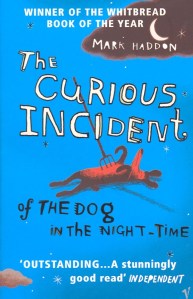
I finished reading The curious incident of the dog in the night-time by Mark Haddon last night and I really want to capture my thoughts on this interesting novel. I began reading it with no expectations. I’d heard of it, that’s all, when I saw it in the library. I had no notion of what it was about, or the author, or anything (including the fact that the title comes from a Sherlock Holmes quotation.) I merely selected it as part of my aim, this year, to read more and select a wider range of books.

I’m glad I did. It is a strange novel, about a fifteen-year-old boy with Aspergers Syndrome. I feel privileged to have read it. Yes, that’s my overwhelming impression. It wasn’t a rip-roaring read, a heart-warming romance, or an unputdownable thriller, but still it dragged me through to the end with little effort (which is a big ask of a book these days because I’m very quick to give up on something that doesn’t keep me awake!)

It is funny, quirky and endearing, but mostly it’s a clever book. Written in the first person, from inside the mind of an autistic teenager, it presents the world in a new way. It also gave me a new respect and understanding for autistic children and their parents. But not in a way that demanded sympathy or forced ideas on me.

Instead, through an evolving set of anecdotes and an unravelling mystery story, it revealed immense detail about the character, his family, his life and his interpretation of the world. Some of the apparently peripheral discussions, for example about God, or time, or the universe, were both enlightening and profound.

As a writer, the book is a master class in RUE (resist the urge to explain). The reader is left to put the pieces of the jigsaw together in a way that the main character often isn’t able to. And, despite it being written in the first person, an entire world is unveiled surrounding the main character. I can’t begin to explain how so much was revealed with so little being said (certainly not without giving away spoliers.)

I think the enjoyment came from this, though. The reason the novel kept me awake was because I was actively involved in constructing the text, fleshing out the story, connecting the dots. The same was true of The Raven Boys, now I come to think about it. I’m starting to think of it as the art of secrets. Not glaringly obvious secrets, of the kind I might clumsily put in a novel – like Josh’s big secret in Two-Hundred Steps Home, or why Claire broke up with Michael. But more a subtle revelation of the bigger picture, like panning out in a movie and seeing the full context.

It is a goal I intend to aim for in my own novels, although I know I’ve got years of practice ahead of me before I get there. I don’t think it’s something that can be taught, but something that has to be learned through hard effort. I suspect it will also require me to become more a planner than a pantser. My natural writing style is to reveal everything as soon as it occurs to me (I’d make a rotten poker player). Instead I need to play it more like chess. Think fifteen moves ahead, prepared to change my plans if necessary, but keeping the moves secret for the reader to discover at the best moment.

I feel like my daughter; only just learning to read but wanting to be able to read adult books. I’m only just learning to write and I want to be able to write like that. Now! Now! Now! *Pouts*. Time to read a few craft books, consume a stack of fantastic novels, dip into a load more blogs and, more importantly, practice, practice, practice. I can feel (another) rewrite of Class Act coming. Bring it on.

Research and The Raven Boys

What Alex's London flat might look like

What Alex’s London flat might look like

I miss Claire. There, I’ve said it. I miss writing an installment of her journey each day, with a reasonable idea of where she was in the world, at least, and where her story was going. I miss guaranteed word count.

I’m in redrafting hell at present, trying to rescue two characters I love from a badly plotted and planned novel awash with backstory. The problem with loading a first draft with backstory is that changing one thing has a rippling effect across the entire manuscript, especially if you’re trying to rewrite two lines of throwaway history into a whole chapter or even two.

My lead man Alex has a friend called Philip who is essential to the story. Starting In Media Res I didn’t have to worry too much about their relationship before; where they first met, how they met, considering they’re so different. Now, though, we first see them catching up down the pub, setting up the rest of the story’s action, and I have to understand all these things. How do people from different backgrounds meet? How do their different careers and incomes affect their friendship? What’s the age difference? I managed 700 words of stilted dialogue today and gave up in disgust.

I’m also trying not to be overly influenced by the book I’m reading – The Raven Boys by Maggie Stiefvater – as her novel contains a character that could be, or at least have known, Alex as a public school boy. Maggie Stiefvater’s character is so convincing I’m finding parts of him creeping into my prose: except Raven Boys is set in America, whereas Alex would have gone to an English boarding school (which I know very little about, another fact that wasn’t especially important before.)

As each of these random strands of research crop up, I keep losing the flow of writing because I need to research the role of a stage hand or investigate pubs in North London or apartments in Chelsea. I might even have to watch an episode of Made in Chelsea – *shudder* – to try and understand Alex’s present girlfriend Paige more, as again she has moved from a paragraph of explanation to a speaking part.

I swear this is the last time I rescue an old manuscript by moving the timeline back a few months. Next time it starts where it starts and that’s that!

A Pantser Plans

Using Beat Sheets to plan my revisions

Using Beat Sheets to plan my revisions

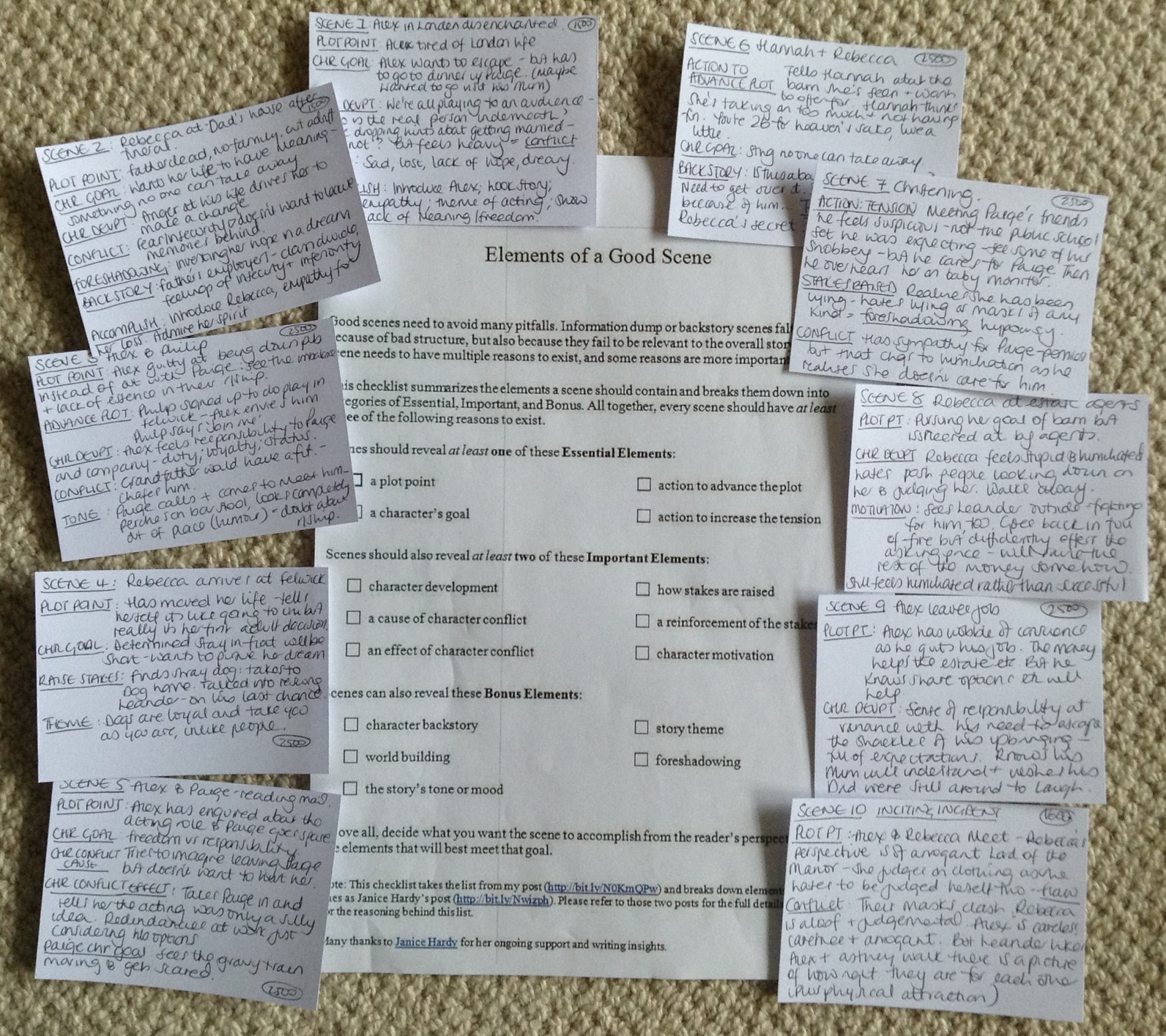
The unthinkable happened today. I did planning. With beat sheets and notecards and everything. I’m a Pantser to the core: analysing a scene down to the tiny details paralyses me. Especially if I do it before I write, as I have done for the extra third of a novel I’m putting at the front of Class Act. But actually, do you know what, it wasn’t so bad.

I’m still working on some of the terminology, for example pinch points and black moments, although instinctively I have a shrewd idea what they are. I have done it before, actually, for all my seat-of-the-pants writing preference, and I’m always relieved at how much of the necessary detail I already have. Sometimes it just needs writing down to reassure myself I do know something (although a VERY VERY long way from everything) about this novel writing lark.

I had gathered much of the required information during my last craft session (the sporadic times when I read through a load of blogs and books to refresh or learn elements of writing craft.). My favourite resource is Jami Gold: as a Pantser and a romance writer, I feel she understands my pain. In fact her Beat Sheet for Romance Writers formed a large part of my morning’s work. She explains that if, like me, you can’t pkan in detail for fear of frightening off the Muse, you can use beats – points in the story – to make sure things are developing as they should.

I also used her posts based on a Michael Hauge workshop she attended to put more thought into my characters’ development, flaws and ultimate romance. The key ones I used were Are These Characters the Perfect Match and An Antidote to “Love at First Sight”. Both of these look at two elements of characterisation – a character’s Mask (the role they play, based on their longings, fears, wounds and beliefs: their emotional armour) and a character’s Essence (who they are inside, behind the masks, or who they have the potential to be). In a good romance, attraction will be based on Essence rather than Mask.

Planning Elements of a Scene

Planning Elements of a Scene

So, in Baby Blues, Helen was attracted to Daniel because his businessman forceful character Mask played to her career orientated Mask. But Marcio was her right love interest, because they both had the same essence underneath: a love of creativity and interpreting the world through their art, and a desire for home and family.

The concept really helps when a character moves from one relationship to another (as mine often do.) You don’t want the protagonist to look like an idiot because the previous relationship was flawed, and also you don’t want the previous partner to be a stereotype or a villain (although Daniel, in Baby Blues, is a bit of both!)

The other thing I’ve been trying to use is an Elements of a Good Scene checklist, which I also found on Jami’s Blog, the idea for which came from Janice Hardy’s blog. I feel exposed, using something like this, as I feel I don’t know the difference between “Plot point” and “action to advance the plot” or “how the stakes are raised” versus “reinforcement of the stakes”. I suspect that might be why I find it hard to write tense page turners! In my head, though, I’ve summarised it as “plot development”, “character development”, “conflict” and “backstory/theme/tone/foreshadowing”. As long as the scene has some of those that’s good. Well, it’s a start!

Of course, I was right – at the beginning when I said planning paralyses me. I need to start writing, before I spend so long on planning I’m fed up with the story or too scared to start. But it was a useful day’s work and hopefully, when I sit at my desk on Monday, I’ll be able to write some of the additional 45,000 words the story needs to get to a full length novel!

Anyway, hopefully now I have a plan this will be the last of the ‘I’ve forgotten how to do manuscript revision’ posts and I’ll get on to writing something more interesting for the non-writers who follow my blog! Thank you for your patience.