Renewing my love affair with dragons (and editing)

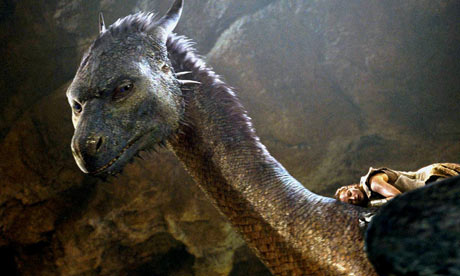
Still from Stefen Fangmeier’s 2006 film Eragon.
Photograph: 20th Century Fox/Allstar

I find myself in the unprecedented position that I am itching to start editing my work in progress, Dragon Wraiths.

Usually I only enjoy the writing part and approach revision and editing much as I would a trip to the dentist. This time, though, I am having to force myself to finish the four or five chapters in the final section before I start taking it all apart. Thankfully I decided on a structure of nine 3,000-word-ish chapters per section (although I have added a whole extra section in my usual scope-creep), otherwise I would take the easy way out and decide the first draft is done already.

For most of my novels I am aware that I have underplayed the climax because I ran out of steam, or ideas, or a new book lured me away. So I am determined to battle through my battle scenes before I let myself review the whole and start drawing out the themes.

This time I think my last-chapters-lethargy is caused by things other than exhaustion or boredom (although with an average word count of 10,000 a day on the two days a week I get to write, exhaustion of ideas is definitely a factor. Hence no blog posts for a couple of weeks – all out of words!)

Firstly I’ve already closed out the love story and written the final scene. A mistake, but an unavoidable one. The final scene presented itself while I was walking the dog (see next post) and I never look gift words in the mouth. As a result I have written the bit of the story I’m interested in and skimmed over the same parts I often skim-read, namely the battle scenes.

The other problems are more positive. I am nervous, elated and excited about this book. It feels good. I have ideas about themes, character development, setting and so on that I want to build on during revision. All the wonderful blogs I read have clearly had an influence and I am eager to put them into practice.

I have also been reading some excellent and varied middle grade and young adult books about dragons, including Eragon by Christopher Paolini (written when he was fifteen!) and The Dragon’s Eye by Dugald A. Steer. These were complemented by an interesting blog post from 2009 that I discovered when searching for an image for this post: Dragons in Literature by Imogen Russell Williams, adding yet another great blog writer to my growing list.

As well as my eagerness to get going on revision I am also conscious of my deadlines. I am writing this book to enter in two Children’s Novel competitions, with deadlines of 10th September and end October. Clearly there is not enough time to revise properly so I need to get started as soon as I can or face a difficult decision: Whether to forget the competitions and focus on finishing the novel to the best of my ability or do a rush job (including reducing word count from 110k to 80k) and hope for the best.

What are your views on dragons in literature?

Have you ever had to rush revision to hit a deadline? All advice gratefully received. 

This interview with Christopher Paolini contains some great advice for writers.

Quick Post: Latest from Kristen Lamb: “More than Magic and Gadgets”

Lion Dragon Shinto Shrine by Sara F Fujimura

Kristen Lamb’s Blog is fast becoming my favourite place to get writing tips.

Kristen’s latest post is essential reading for anyone contemplating writing a sci-fi/fantasy/YA Paranormal novel.

Or any novel for that matter.

There is no point me re-hashing her post as it is all relevant. You can read her great advice here:

http://warriorwriters.wordpress.com/2012/08/13/more-than-magic-gadgets-taking-science-fiction-and-fantasy-to-another-level/

I’m off to revise Dragon Wraiths right now…

Planning and pesky characters


Artwork by Amber Martin

I don’t write plot plans or outlines and this blog explains why.

If you follow regularly you’ll know I’m rubbish at planning what I write, preferring instead to let the story develop as the words (hopefully) flow from subconscious to computer screen.

However after writing my post about the Chicken House / Times children’s book competition, I decided to write a plot plan for my young adult novel, Dragon Wraiths. I had an idea where the story was going, haven written half of it, so it seemed a safe, logical thing to do, particularly as I haven’t got long to draft and redraft before submission in September / October. I hoped that a plan would help me get all the continuity right first time and save some long-term pain. All good.

Except the pesky characters won’t do what they’re told.

I’m two chapters into my ‘plan’ and already I’ve added a whole new section to the novel, extending it from 3 parts to 4. I’ve changed a good character into a barrier and rewritten the whole ending. Twice.

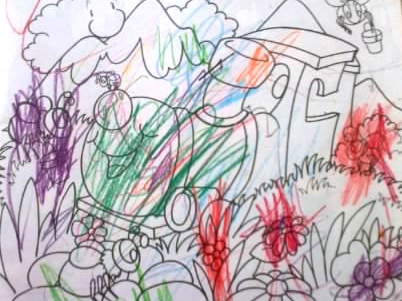
So far my adherence to the plan resembles my children’s colouring: The lines are there only to be scribbled over. As a parent I have tried to let my kids colour how they like, seeing it as too controlling to tell them to colour inside the lines. Am I giving a free-rein to my own creativity by scribbling all over my own plot plan, or am I just scatty?

I have also discovered that, while I find it almost impossible to summarise a chapter into one line, it is easy for one line of planned plot to become two or three chapters.

I have written 7,000 words today and covered only two lines of plot plan.

They find the missing girl and she agrees to help takes no account of how hard it turned out to be to find the girl or the fact that she was rude and uncooperative when they did find her. My whole story depends on the girl being helpful: I didn’t expect her to have a mind of her own. In twenty words of dialogue, written while walking the dog, she has destroyed my whole plot outline with her rudeness. Grrr.

So I am ploughing ahead without worrying too much about the plan. It is still useful as a guide for key plot developments, particularly for the sciency bits that are not my strong point. As for the rest, even I don’t know if the darn woman will help out in the end, or finish up being written out of the book entirely.

That’ll show her.

To be the best we can be

Cropped transparent version of Image:Olympic f...

Listening to the radio today I heard a former Olympic Athlete say that being an Olympian in training is much easier than living a normal life. Unfortunately I don’t know the exact quote or even who said it, because both kids were yelling at the time. His point though was not to belittle the effort put in by the athletes but to say that a life consumed by training is straightforward compared to what the rest of us have to deal with. You get up, you train, you compete. You have a goal, targets, schedules.

It got me thinking.

Firstly, we shouldn’t underestimate how much effort we put into our own lives, even if we aren’t winning medals. Spending 14 hours a day reasoning with toddlers may be just as gruelling in its own way as spending that time on a bike, but without the ultimate recognition, (or a cool uniform or sponsorship freebies!)

The second thing I decided was actually we do have it easier, because our life doesn’t come down to tiny moments. Kristian Thomas missed a bronze medal because he made a tiny mistake on the vault. Four years of effort came down to four minutes of brilliance and a heartbreak of a tumble. How many of us, faced  with that, would bring out our best?

As a result of my musings I decided that two things are essential:

We should strive, every day, to be the best we can be at that moment. Not the best there is, but the best we can be at that time, on that day. When I’m about ready to put both kids in nursery and go back to work full time just to be able to pee on my own, I try to find something to make it better. Choosing to giggle instead of shout. It doesn’t always happen, but if there is one more laugh and one less bellow in a day that’s a success I should be proud of.

The other thing I think, to do with writing, is that targets are important. Whether it’s Nanowrimo, the WFMAD (Write Fifteen Minutes a Day) challenge or a self-imposed publishing deadline. The human race often performs its best under extreme pressure. You don’t have to be a sixteen-year-old Chinese girl to find that out.

I watch the Olympics and I know I could never train that hard or be that good at rowing or swimming or gymnastics. But if I strive each day to inspire and be inspired in my own areas of influence, then maybe I, too, can be a champion.

“Treat your book like your child”

Parenting or Writing, which is harder?

Over on the NaNoWriMo blog, the Office of Letters and Light, they recently interviewed author Karen M. Cox, whose second novel Find Wonder in All Things was written during a NaNoWriMo. Her novel was awarded an Independent Publishers Book Award, which just shows how great NaNoWriMo can be for unlocking the novel in you.

As part of the interview, Karen gives her top writing, revision, and publishing tips for other NaNoWriMo participants.

These are summarised below:

  • Write every day during NaNoWriMo. The days that I started out ‘behind’ were tough days.    
  • When you stop for the day, know where you’re going tomorrow. It helps eliminate the ‘staring at a blank screen or paper’ syndrome. 
  • Resist the urge to edit until you’ve got the thing out of your brain and onto the stone tablet, paper, or screen. 
  • Find people you trust to give you feedback: [people with] no agenda besides reading good material.
  • Throughout the writing process, treat your book like your child. What I mean is love it, treasure it, brag about it, but be objective and open-minded enough to discipline it—through accepting constructive criticism, editing, rewriting—without losing your long-term vision for when it’s ‘all grown up.’ This is harder than it sounds—you have to weigh others’ opinions without pride and prejudice, yet still stay true to what you want for your ‘child’ in the end.

It was the final point that really stuck in my mind as the most comprehensive piece of advice, but the hardest (for me) to follow. On a bad day the advice would mean me yelling at my book over something stupid and then sobbing in the corner for being a terrible writer, destined to go to Writer Hell in a handcart.

As you can tell, I haven’t sussed parenting yet, particularly the discipline part. I find it hard not to take toddler-defiance personally and I’m often more prone to childish tantrums than they are (I like to think I’m the highly strung artistic sort but that’s probably rubbish!)

I know all the theories of good discipline and on a good day, with lots of sleep, I can be that parent, calmly instigating time-outs and positive rewards. Much as I know the theory of what constitutes good writing and on a good day I can be that writer too, editing with consistency and a clear mind. On a normal day, however, I have as haphazard an approach to editing as I do to parenting: I do what I can do, get frustrated that I’m not doing it better, and constantly fight the urge to throw in the towel.

Maybe I need to write all my first drafts now, play with them and enjoy them, and get to the task of revision and redrafting when I’ve worked out how to be a proper grown-up parent person.

Oh dear, I might never finish a novel.

Quick post about Milestones

I reached 60,000 words on Dragon Wraiths, my WIP, today.

Looking for other significant numbers I realised I have exceeded 30 blog posts here since I started. Many more than I thought I would manage. I even have 20 followers.

It might seem like tiny steps to other people, but I didn’t expect any of it and at last I feel like the hard work is slowly paying off.

All I need to do now is suss out Twitter, where I currently have one follower (my husband) and Facebook where my WriterMummy page has 7 likes and my Amanda Martin page has 6. Onwards ever onwards.

Books and Songs

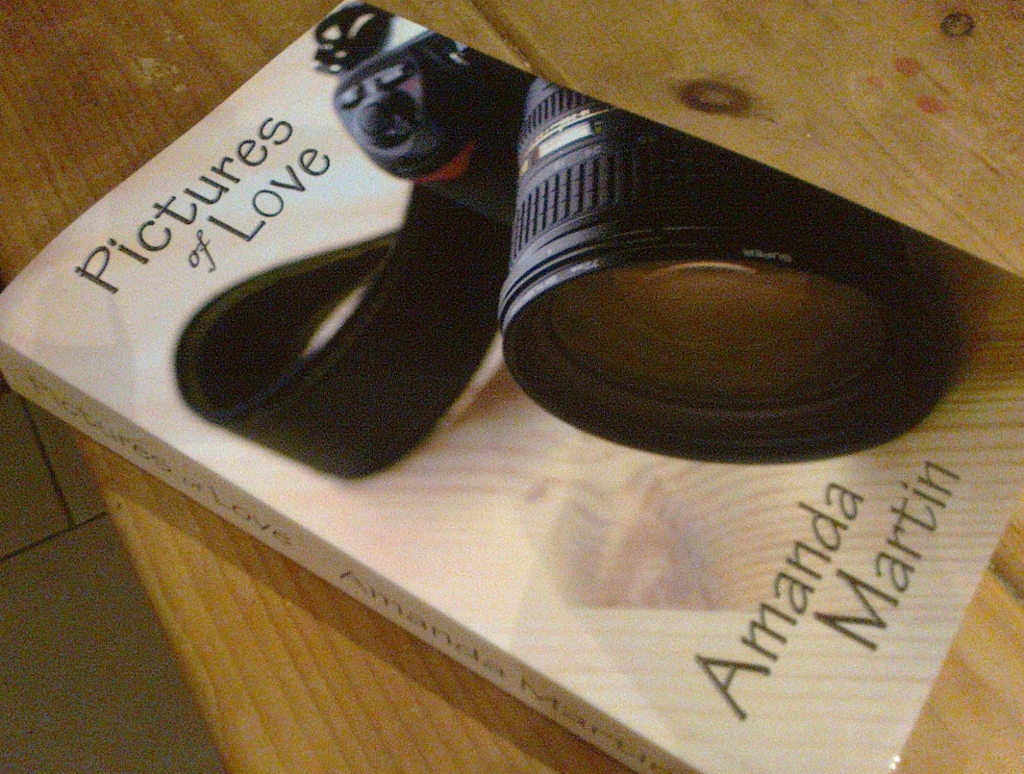
Front cover

It seems appropriate, given that the fabulous Olympic Opening Ceremony spent a lot of time on literature and music, that I rediscovered two truisms this week; Reading makes you a better writer and music can be powerfully motivating.

Both activities – reading my own choice of novels and listening to my own choice of music – have become rare events since the children were born.

There are many reasons for this.

  • I tend to zone out the world entirely when I’m reading a good book; something that, until recently, hasn’t been vaguely possible. My son especially requires constant vigilance to ensure his continued good health (not because he suffers from any kind of illness, but because he likes to throw himself off high things).
  • Kids (and husbands) have an in-built sensor that alerts them when you’ve got to a good bit. Husbands you can just about tell to feck off, but it’s only on really bad days that I say that to the children.
  • Even after they’ve gone to bed, assuming I can keep my eyes open to read, the little one wakes every couple of hours, and on the rare occasion I’ve read past midnight, he’s guaranteed to be up and screaming from 1am until 5am. I had one awful night during my consumption of Hunger Games when I didn’t actually get any sleep. Not the best way to get through the following day without going to Mummy Hell in a handcart.
  • Then there has been what to read. My book club kept choosing self-help nonfiction type books, which I duly struggled through but didn’t often enjoy. I read far too many Mills & Boon in my attempt to mirror the style for The Real Gentleman, with no success. I re-read all my favourite romances when editing Pictures of Love. But I found that I had moved on, my priorities are no longer about meeting the man of my dreams, but closer to getting a good night’s sleep and maybe the chance to pee by myself. So I sought out novels about parenting but reading them was a bit of a busman’s holiday and I knew I didn’t have the skill to write anything so funny.  
  • I was also paranoid that reading books of the same genre as the one I was writing might lead to me inadvertently copying a character or piece of plot. I even read a book that had almost the same beginning as mine, which terrified me.

So I stopped reading anything but blogs and my life was poorer for it.

With music it’s the same thing. When I worked as an artist I had Classic FM on all day as background burble and when the adverts became too annoying, I switched to Radio 2, where I’ve stayed, (except between 12 and 2 as I can’t stand Jeremy Vine.)

The novelty of Radio 2 has long since worn off but I only had a radio in my old car and, besides, the kids don’t like me singing unless it’s Wheels on the Bus or Old McDonald had a farm.

Anyway, this week that all changed.

I re-read Philip Pulman’s His Dark Materials to try and banish my writer’s block on my young adult novel Dragon Wraiths. The quality of the writing is such that it automatically raised my game. Reading nothing but books for very young children, (think Gruffalo and The Hungry Caterpillar), combined with permanent sleep deprivation, has resulted in my vocabulary shrinking to that of a five-year-old. Not something Philip Pulman can be accused of.  When I finally found some time to write on Thursday I found myself using words that wouldn’t have occurred to me the week before.

I also got a new car this week, with cd player AND iPod jack. Even better, I had the chance to listen to my music in the car, on the two hour trip back from the beach yesterday (kids were asleep – we had children’s songs all the way there). Not only were some of the big numbers stirring, motivating, uplifting, I also found the same vocabulary-enhancing effect happening.

Some amazing one-liners leapt out and smothered me with goosebumps and envy.

Lines like, “On winter trees the fruit of rain is hanging trembling in the branches like a thousand diamond buds,” or “Regrets and mistakes. They are memories made,”

Mini stories in a few words, the ultimate flash fiction.

I used to use Country Music songs as examples of story arc when I was teaching Creative Writing. There’s a great Garth Brooks song, Papa Loved Mama, which is another well-executed example of flash fiction, including my favourite example of showing rather than telling rage:

“The picture in the paper showed the scene real well
Papa’s rig was buried in the local motel
The desk clerk said he saw it all real clear
He never hit the brakes and he was shifting gears.”

 It doesn’t have to be literary to be effective.

What songs and books stand out in your mind as excellent inspiration or great examples of flash fiction?

The dangers of self-publishing: Introducing “Them.”

It turns out you can make your work-in-progress look too like a real book too easily. The image of seeing your WIP in kindle format (or even print) is seductive, but probably not a great idea for the proof copy. Aside from the hassle of getting the right format to everyone, when pretty much all e-readers can open the traditional pdf, I’ve discovered the existence of “them”.

After my mother gave her damning verdict on Pictures of Love, “I preferred your first book,” (the one I wrote in a few weeks, barely edited at all, and had rejected by Mills and Boon,) she said something that dumfounded me:

“Did they not edit or proof-read your book before formatting it for kindle?”

My response, when I stopped laughing, was to say, “Mum, there’s no They. I wrote it, revised it, edited it, proof-read it, designed the cover, wrestled with kindle formatting, added the copyright, the dedication, the publisher’s logo. All of it. You’re my beta reader, so in fact you’re They. You’re meant to help me find the typos.”

“Oh,” she said, “I wondered why there were so many. They do come a bit thick and fast at the end.” Not what I wanted to hear but unsurprising as every time I started proof-reading I began at the beginning but didn’t always make it to the end.  I get distracted so easily.

As a result I have a thudding fear that the second half of the novel, the half only my mother has read apart from me, is a bit rubbish. Seems I’m probably right, at least as far as editing goes. And if I missed a heap of typos, I probably didn’t spend enough time revising the latter half of the book in terms of language, character, plot.

And yet there it is, my Lulu print version, sitting in paperback glory on my kitchen table, looking for all the world like a ‘proper’ book.

So I think when the naysayers who don’t like self-publishing bemoan the fact that something can look like a traditionally published book and still be awful, they may occasionally have a point.

Another scary thought is how easily the formatted-for-kindle version is being passed around without my knowledge. I used to password protect my pdfs. I don’t even know if you can do that for kindle. What if my proof makes it into the outside world? (My sister-in-law has already sent it to my father-in-law, and another beta reader has given a copy to his parents.)

What if everyone thinks like my mother and wonders why They haven’t done a better job finding errors? Or me for that matter. I don’t mind if the book is deemed a failure because the characters are underdeveloped or the plot is thin, but being damned for typos when it isn’t even the final edit gives me the shivers.  In future I think I’ll splash Beta Reader Copy or Proof over every page and be less vain about trying to make it look like a proper novel.

Or maybe it is time to go back to that Agent list after all.

The Five Mistakes Killing Self-Published Authors by Kristen Lamb

Spending more time on mummy than writer: As it should be when they’re this cute!

I was made aware of Kristen Lamb through findingmycreature, who kindly left a comment on my last post. She suggested I read Kristen’s best-selling books We Are Not Alone–The Writer’s Guide to Social Media and Are You There, Blog? It’s Me, Writer , after I discussed my confusion about where to start when it comes to social media.

The books look brilliant and when I have the pennies I shall buy them, but there is also lots of very helpful advice on Kristen’s blog (have a look if you haven’t been there before). I was particularly interested in her recent post The Five Mistakes Killing Self-Published Authors. As someone who is keen to self-publish soon, I obviously read this closely. As a result, I may well delay self-publishing Pictures of Love until the new year, when I have had a chance to let the novel sit for a bit longer, re-read some craft books and then spent some more time on revision. (As an aside, every post of Kristen’s I read made me want to hit Delete on Pictures of Love and to rewrite it from scratch, only better.)

This is a summary of the five mistakes Kristen discusses, although I recommend visiting her blog to read the whole article.

Mistake #1 Publishing Before We Are Ready

The problem with the ease of self-publishing is that it is, well, too easy. When we are new, frankly, most of us are too dumb to know what we don’t know. Just because we made As in English, does not automatically qualify us to write a work spanning 60-100,000 words. […]

Additionally, too many new writers I meet do not properly understand the antagonist. They don’t grasp three-act structure, and most don’t have any idea what I mean when I mention POV, Jungian archetypes, or the phrase, “scene and sequel.”

At this point I decided I probably shouldn’t self-publish just yet. I have no idea what a Jungian archetype is or what the phrase ‘scene and sequel’ means. It was a humbling thought. At least my book has a three-act structure and I know what POV is!

[…] Self-publishing is suffering a stigma from too many writers publishing before they are ready. If you really want to self-publish, I am here to support you and cheer you all the way, but remember, we have to write better than the traditional authors.

This last point really hit home: yes I’ve read published novels that were badly written – but they were usually by already-established authors who were clearly trying to hit a deadline. They were forgiven. I will not be forgiven if my first novel is slated on Amazon.

Mistake #2 Jumping in Before Understanding the Business Side to the Business

I see a lot of writers rushing into self-publishing without properly preparing to be a small business, yet that is exactly what we are. When we self-publish, we take on new roles and we need to understand them. We need to be willing to fork out money for proper editing, cover design and formatting. […]  We can be told a million times to not judge a book by its cover, yet that is exactly what readers do

At least I feel reasonably happy with my book cover, but it won’t help if someone buys my book then doesn’t get past the first chapter.

Mistake #3 Believing that, “If We Write it They Will Come”

There are a lot of writers who mistakenly believe that self-publishing is an easier and faster way to fame and success. Yeah, um no. And those magic beans are really just beans. Sorry.

Self-publishing is A LOT of work, especially if we are starting out this way.  […] Not only do we need to write good books, but we need to write prolifically. We also need to work our tails off on social media.  […] This is one of the reasons self-publishing isn’t for everyone. We need to look at how badly we want the dream, and then ask how many hours are we willing to work? What are we willing to sacrifice?

This is my biggest problem – I am finding it hard to get the balance right between writing and all the other roles I have to fulfil. The mummy in writermummy is pretty demanding at the moment. Not to mention that, financially, I should probably be getting a job to earn money, rather than spending more money on a dream.

Mistake #4 Misusing FREE!

There are a lot of problems with giving books away for FREE! We shouldn’t be giving away our work unless it serves some kind of a strategic advantage. There are ways to effectively harness the power of FREE! but too few writers understand how to do this and they just end up giving away their art for no tangible gain. […]

I have read arguments for and against ‘free’ and it is helpful to have those arguments presented in the same place by the same person.

Mistake #5 Shopping One Book to DEATH

[…] One of the BIGGEST problems I see with self-published writers is that they publish one book and then they focus every bit of energy on selling THAT book. […] Here’s the thing. Self-publishing, in many ways, just allows us to accelerate the career path of the author. Even in traditional publishing, it usually takes about three books to gain traction. In traditional publishing, this takes three years because we are dealing with a publisher’s schedule.

[…] This is why it is critical to keep writing. Not only will writing more books make you a better writer, but once people discover they love your writing, they have a number of titles to purchase. Being able to offer multiple titles is how we make  money at self-publishing.  […]

This is one of the reasons I want to publish Pictures of Love – so I can move on to the next (hopefully better) book. I’m caught between the terror of abject humiliation and the need to move forwards.

Remember Why We Do This

[…] We are striving to be better writers, to be better entrepreneurs, to get better at organization and time-management and to write more books and better books. If we can learn from these mistakes and grow, then the future is ours for the taking.

Wise words. You can find Kristen’s blog here: http://warriorwriters.wordpress.com/

Marketing Time-line for Self-Publishing

Image representing Lulu as depicted in CrunchBaseWhile I wait (im)patiently for feedback from my beta readers I have been worrying about Marketing.

[As an aside, I have had one comment so far, from my mum, and her feedback was – it’s not as good as your last book (the one that was rejected from Mills & Boon). That’s filled me with confidence.]

I find the marketing of my book far more daunting than anything else I’ve done so far. I’ve talked before about how rubbish I am at selling myself and this includes trying to engage on social media. I am self-conscious even writing on other people’s blogs or twitter feeds (twitter still baffles me) and when I browse around people’s sites, whether on Facebook or Pinterest, I get distracted and forget why I am there.

I have searched around on the internet for advice, but it has been difficult to find a cohesive plan for things you can and should do to help market your book. Until I recently found this great post on the Lulu blog, with a timeline of things to do before you publish.

It starts 12 weeks before launch, so I’m way behind if I want to do all these things before publishing Pictures of Love in August. That said, as I haven’t had any beta reader feedback yet, I don’t know if August is still feasible. If I have a complete re-write to do, on top of finishing Dragon Wraiths by September, it is likely I will have to push back the release date.

I was going to summarise the Lulu post and include the best bits here, but as it is all very useful, I have posted the complete text below. I’m off to work out what I can do in the couple of hours a week I find time to do marketing!

Please let me know how you get on and any other ideas you have to get your book noticed.

The Post:

On Lulu’s blog there’s been a lot of talk about the “how” of marketing (Pinterest, Blogging, Twitter, writing a press release, video chat, etc.) but little focus on the “when,” which is an equally important component of a successful book marketing campaign.

Here are some general guidelines you can follow compiled in a simple marketing timeline to help you plan:

10–12 weeks out: Do your research. Find appropriate blogs and media outlets that might want to review your book and compile a list of media contacts. Come up with a list of friends who can help spread the announcement of your publication and ask each one personally for support. When you reach out to contacts, offer them a free copy of your book and ask for pre-publication quotes to be used in your book’s detail page at various online retailers.

*Expert tip: Make the first chapter of your book available for free for anyone who might want to review your book or include it in a news article. You can do this by creating a free eBook on Lulu.com that includes just the first chapter of your book as well as contact details for press inquiries.

8–10 weeks out: Draft your press release and any announcement emails you’re planning on sending out. Make sure to re-read them numerous times and get friends or family to proof them for you. Ensure that if you’ve not already done so, your Facebook page, Twitter and Pinterest account, and blog include up-to-date info on your upcoming book. Be sure that every update, post, announcement and release includes a direct link to where readers can pre-order your book. (You can use a URL shortener like bit.ly if you like). Now’s a great time to do a cover reveal on social media — unless, that is, you’re planning to work with a blogger for an exclusive reveal on someone else’s site.

6–8 weeks out: Send your press release and start pitching bloggers. This is also a good time to formally announce the release of your book online. When doing so, consider including a question on Twitter and Facebook to encourage engagement and make sure to provide a link where readers can pre-order your book. We know you already know, but double-check that landing page to make sure that your cover image, title, description and reviews are all up-to-date and grammatically correct.

4–6 weeks out: Start thinking about adding “flair” to your social media. Launch week-by-week book giveaways and poll your fans or create extra content (a book playlist, an author interview, etc.) to generate excitement. If you’ve created a video trailer, announce its premiere date on your blog and then post it about four weeks out. As the one-month mark approaches, follow-up with bloggers and other media outlets if you’ve not yet heard back from them.

2–4 weeks out: Post a teaser chapter to your blog — either all at once or split it up to tease out future buyers even longer. Announce winners of any giveaways or contests you’ve run and launch a final giveaway extravaganza (a book plus swag that relates to your book) to coincide with your book’s release date. Continue to make sure that that any good reviews and/or awards you receive are featured on your Lulu, Amazon, BN.com, etc. pages.

0–2 weeks out: You’re in the homestretch! Be prepared, if you’ve done your research right, to be doing blog interviews, updating social media frequently about not only the book, but your excitement, and featuring content and giveaways to celebrate! However, on the day your book goes on sale, give yourself a break. Leave the computer behind and enjoy a breakfast/lunch/dinner out. You deserve it.

Remember, just because your book is out doesn’t mean your marketing efforts end. Continue to look for larger news opportunities to tie your book to, update your social media outlets and blog on a regular basis so your community grows, and keep on top of awards you can submit your book for. More than anything, be creative, take risks, and, later on, hopefully reap the rewards.