Finding Sense in Stories

Horrible headlines

Horrible headlines

Sat here on a Saturday morning, trying to think of something to write for my blog post, my mind was blank. After a night of The Raven Boys type dreams (always the danger of reading a powerful book at bedtime) I couldn’t pull together a story. I started flicking through my Reader, catching up on my favourite bloggers, like Miss Fanny P, looking for inspiration.

And then I came across a post that stopped me like a punch to the stomach. On Wednesday this week, over the border in Scotland, a three year old boy went missing from his first-floor flat, some time between bedtime and morning. The kind of story that twists inside you as a parent and makes you rush to hug your child.

I’ve been following the story with latent hope, as the people of Edinburgh poured out in their hundred to search for the missing boy. As is usual in such circumstances, we discussed whether our children could leave the house by themselves (they could) and whether there was more to the story than a boy running away from home (it seems there possibly was).

So, when I saw in my Reader this post by a resident of Scotland, whose children were involved in the search for the missing boy, I felt physically sick. We all want a story to have a happy ending. As an author (an author who lives for the HEA) I can’t bear a story that doesn’t end as I think it should. One that involves the death of a small child is the worst there is.

The Facebook appeal

The Facebook appeal

It’s not the only story that has wrenched at me this week. There’s the case of a child who died within hours of their first day at nursery, or Jordon, the autistic boy who locked his mother in the house and disappeared on 9th January.

The latter story, like the story of the missing three-year old boy in Edinburgh, was one I discovered first on Facebook. I always share missing people or pets messages because Social Media ought to be good for something. In the case of Jordon, the story had a happy ending, with the boy being found alive and well. But during my internet search to see if he was okay, I discovered another dozen stories of missing children found dead.

They haunt me, these stories. Not just as a parent, imagining something happening to one of my children (which I can’t imagine, or I’d never let them leave the house again). I think of the families blown apart. The scars that won’t heal. The blame, the recriminations, the guilt. Of all the people touched, all the people searching with hope in their hearts. The policeman holding back tears as he breaks the terrible news. The assumptions that will be made, as the authorities search for the truth.

Mostly I think about the mother (who is often the first one questioned). I no longer judge mothers. No matter what we see from the outside, we have no idea and we must not judge. I am sure there are evil people in the world, but there are just as many desperate, overwhelmed, frightened people and we cannot know the truth of their lives.

As a writer, I live these stories with full emotion. It isn’t just a news story, it’s life in all its messy detail. There aren’t heroes and villains, winners and losers. Just the complicated horrible terrible beauty and tragedy of life. And it’s why I write love stories, women’s fiction, journeys of self discovery. The world needs hope and Happily Ever After. It needs to make sense of life and wrap up the loose ends, to have themes and symbolism and resolution.

Because life doesn’t. Life has sadness and questions and fear. It has grieving families and worried parents. We’ll all hug our little ones just a bit tighter today, and maybe we’ll look for escape in a book. I know I will.

Research and The Raven Boys

What Alex's London flat might look like

What Alex’s London flat might look like

I miss Claire. There, I’ve said it. I miss writing an installment of her journey each day, with a reasonable idea of where she was in the world, at least, and where her story was going. I miss guaranteed word count.

I’m in redrafting hell at present, trying to rescue two characters I love from a badly plotted and planned novel awash with backstory. The problem with loading a first draft with backstory is that changing one thing has a rippling effect across the entire manuscript, especially if you’re trying to rewrite two lines of throwaway history into a whole chapter or even two.

My lead man Alex has a friend called Philip who is essential to the story. Starting In Media Res I didn’t have to worry too much about their relationship before; where they first met, how they met, considering they’re so different. Now, though, we first see them catching up down the pub, setting up the rest of the story’s action, and I have to understand all these things. How do people from different backgrounds meet? How do their different careers and incomes affect their friendship? What’s the age difference? I managed 700 words of stilted dialogue today and gave up in disgust.

I’m also trying not to be overly influenced by the book I’m reading – The Raven Boys by Maggie Stiefvater – as her novel contains a character that could be, or at least have known, Alex as a public school boy. Maggie Stiefvater’s character is so convincing I’m finding parts of him creeping into my prose: except Raven Boys is set in America, whereas Alex would have gone to an English boarding school (which I know very little about, another fact that wasn’t especially important before.)

As each of these random strands of research crop up, I keep losing the flow of writing because I need to research the role of a stage hand or investigate pubs in North London or apartments in Chelsea. I might even have to watch an episode of Made in Chelsea – *shudder* – to try and understand Alex’s present girlfriend Paige more, as again she has moved from a paragraph of explanation to a speaking part.

I swear this is the last time I rescue an old manuscript by moving the timeline back a few months. Next time it starts where it starts and that’s that!

Bridport and Baby Blues

My Goodreads Giveaway

My Goodreads Giveaway

I wrote a long rambling post for the blog today about parenting, love and life, following on from a spectacularly low point on the school run this morning, that started with yelling in the traffic jam and ended up with daughter and I both in tears. But, if I’m tired of thinking about my failings as a parent then I’m sure you’re tired of reading about them. So I’m going to talk writing instead.

I finally listed a Giveaway on Goodreads this week to win a paper copy of Baby Blues and Wedding Shoes. It’s open to all the countries I can ship to easily from Amazon, so if you fancy reading it, or just like a chance at a freebie, do pop over to Goodreads and sign up, and tell your friends! 🙂

Continuing on a writing theme, I spotted a couple of my Baby Blues bookmarks in a stand at the library today in what turned out to be a rack of leaflets on the Bridport Prize. For those who don’t know, the Bridport Prize is one of the most well-known short story (plus flash fiction and poetry) competitions in the UK, with a first prize of £5000. I think about entering every year, but I haven’t written anything shorter than 100,000 words in years. If you have, and fancy your chances, the closing date is 31st May 2014. (I can’t put any more details at present because the website doesn’t seem to be working, but this is the link).

Brittle Star Competition

Brittle Star Competition

Next to the Bridport flyer was another writing competition with a March 2014 closing date, again for short stories and poetry. This is the Brittle Star inaugural poetry and short fiction competition closing on 12th March 2014. The prizes are much more modest (£250 per genre) but all winners will be published in Brittle Star and invited to a launch and prize giving event in London (a great chance for networking!)

Incidentally, if you want to keep up to date with UK writing competitions, I recommend visiting (and following) the Sally Jenkins – Writer blog. Sally Jenkins’ frequently lists details of writing competitions both big and small as well as lots of hints and tips and great resources. I learned about the Mslexia Children’s Novel Competition from her and, if I hadn’t, I might never have finished Dragon Wraiths. I’m very grateful!

Getting Ready in the Morning: Mummy vs Daddy

Breakfast Chaos

Breakfast Chaos

This is an average morning in the Martin household:

Mummy

6.15am – daughter comes in and asks if she can read (she has one star left on her Groclock)

6.20am – daughter starts singing loudly in her room

6.25am – daughter turns on bathroom light and I wait for the shout of “Mummy, I’m finished!”

6.30am – daughter calls for a bum wipe

6.45am – husband’s alarm goes off – he rolls over and silences it then goes back to sleep

6.45am – daughter runs in asking if it’s time to go downstairs because Daddy’s alarm has gone off

7.00am – tire of waiting for Daddy to get up or daughter to read quietly in her room. Get up (even though kids’ ‘sun’ doesn’t come up until 7.15am)

7.05am – let dog out

7.10am – put porridge in the microwave and boil kettle, unstack dishwasher and tidy kitchen

7.15am – put breakfast on table for first child, turn off radio and put Cbeebies on the iPad for an easy life, after getting distracted checking email and messages for five minutes. Dispense biscuits for dog

7.20am – son comes downstairs, crying about something, saying his nappy has leaked, or standing in middle of kitchen, half naked, demanding pants. Pour him cereal and put him in front of iPad

7.21am – realise haven’t heard shower. Yell up to see if husband is awake

7.22am – son needs a wee. Take him to the bathroom

7.25am – remember dog (who has been bouncing at the window for twenty minutes to come in). Let her in and wipe her paws

7.27am – remember porridge in microwave and put on for extra three minutes

7.30am – take breakfast and coffee up to husband in attempt to get him out of bed and into the shower

7.38am – send children up to get dressed, try to eat breakfast, run up to turn on bedroom lights and sort out clothing dispute

7.41am – get dressed into yesterday’s crumpled clothes, open blinds in daughter’s room, open blinds in son’s room, make beds, turn off lights, pick up pyjamas, sort out dirty clothes left in a heap the night before, lay out pants and socks for husband who is now running late

7.45am – cajole children into getting dressed instead of playing. Remind husband not to spend all day in the shower

7.46am – eat cold porridge and drink cold tea

Brushing Teeth on the Run

Brushing Teeth on the Run

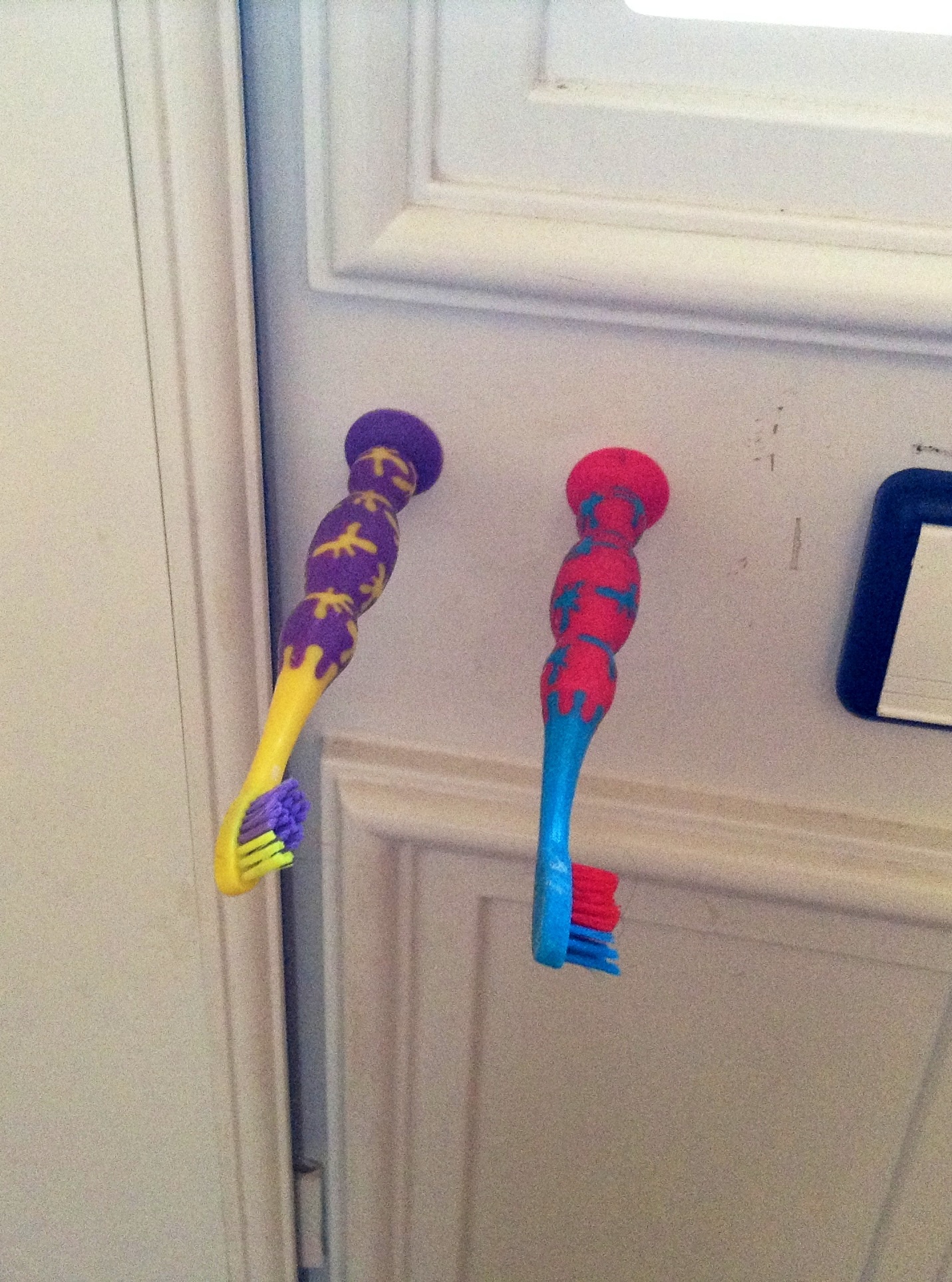
7.50am – brush teeth and get toothbrushes for kids

7.55am – realise son can’t get dressed because there are no clean clothes in his drawers. Locate laundry pile, take upstairs, sort and put away

8am – kiss husband goodbye

8.05am – make sure kids have eaten breakfast and are dressed

8.10am – brush daughter’s hair and endure screams, get frustrated at trying to plait it, put it in a pony tail on the third attempt

8.15am – remember haven’t made packed lunch for son, quickly make a cheese sandwich

8.20am – fill up school water bottles, yell at kids for not putting their shoes on, run round saying “we’re late, we’re late”

8.25am – get children in car with promises of program on the iPad. Remember haven’t brushed teeth, run back in house for toothbrushes. Brush teeth in the car

8.28am – realise car windscreen is frozen, run back in house for warm water, curse when throw water all over car seat by accident. Wipe car seat, sit in wet patch

8.30am – finally leave the house. Drive for ten minutes listening to Octonauts for the fifteenth time

8.40am – get to town and look for parking space

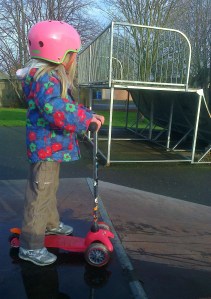
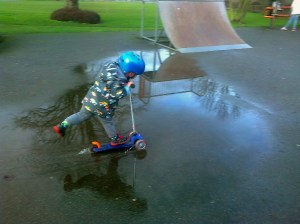
8.45am – park and get scooters out, wrestle children into hats, coats and gloves, grab school bags, trot after scooting children to school saying “we’re late, we’re late”, pick up at least one child with grazed knee and wet clothes. Promise plasters

8.50am – remove daughter’s coat, deposit water bottle, show and tell item, signed forms, homework diary, make sure daughter has signed the register, write encouraging ‘star’ for daughter’s board, leave her with teaching assistant, usher son out of the building past all the other parents and children, shoulder spare scooter

8.55am – get son scooting back to car, while saying “we’re late, we’re late”

9.05am – drive son to preschool, park on the mud, step in dog poo, forget lunch box, run back to car

9.10am – get son in slippers, take off coat, find a spare peg for his bag, find his name on the register table, put packed lunch in kitchen, find his mimi, give son to keyworker, crying and saying he’ll miss me, run round to make silly faces at the window

9.12am – stride back to car, drive to end of road to turn car around, navigate out past the twenty other cars. Turn radio on. Breathe.

9.15am – get home, put dishwasher on, turn off rest of the lights, put on laundry, put wet towels on the radiator, turn on tumble dryer, tell the dog we’ll go out later, make cup of tea

9.30am – start work

Daddy

6.45am – alarm goes off. Silence it. Go back to sleep

7.20am – wife calls up the stairs to see if I’m up. Say yes. Go back to sleep.

7.30am – wife brings porridge and coffee. Eat porridge and coffee.

7.40am – get in shower. Stand under hot water for ten minutes. Shave. Brush teeth.

7.50am – get dressed in clothes laid out on bed. Put on ironed shirt. Go downstairs. Kiss everyone goodbye

8.00am – leave house. Sit in running car while the windscreen defrosts.

8.05am – drive to work listening to the radio

8.30am – start work

Lessons In How To Be A Bad Parent

In McDonalds

In McDonalds

I just spent a wonderful evening catching up with a good friend (who, thankfully, sees parenting as challenging as I do and isn’t afraid to admit it) while our kids played beautifully together upstairs. If only all evenings could be spent thus.

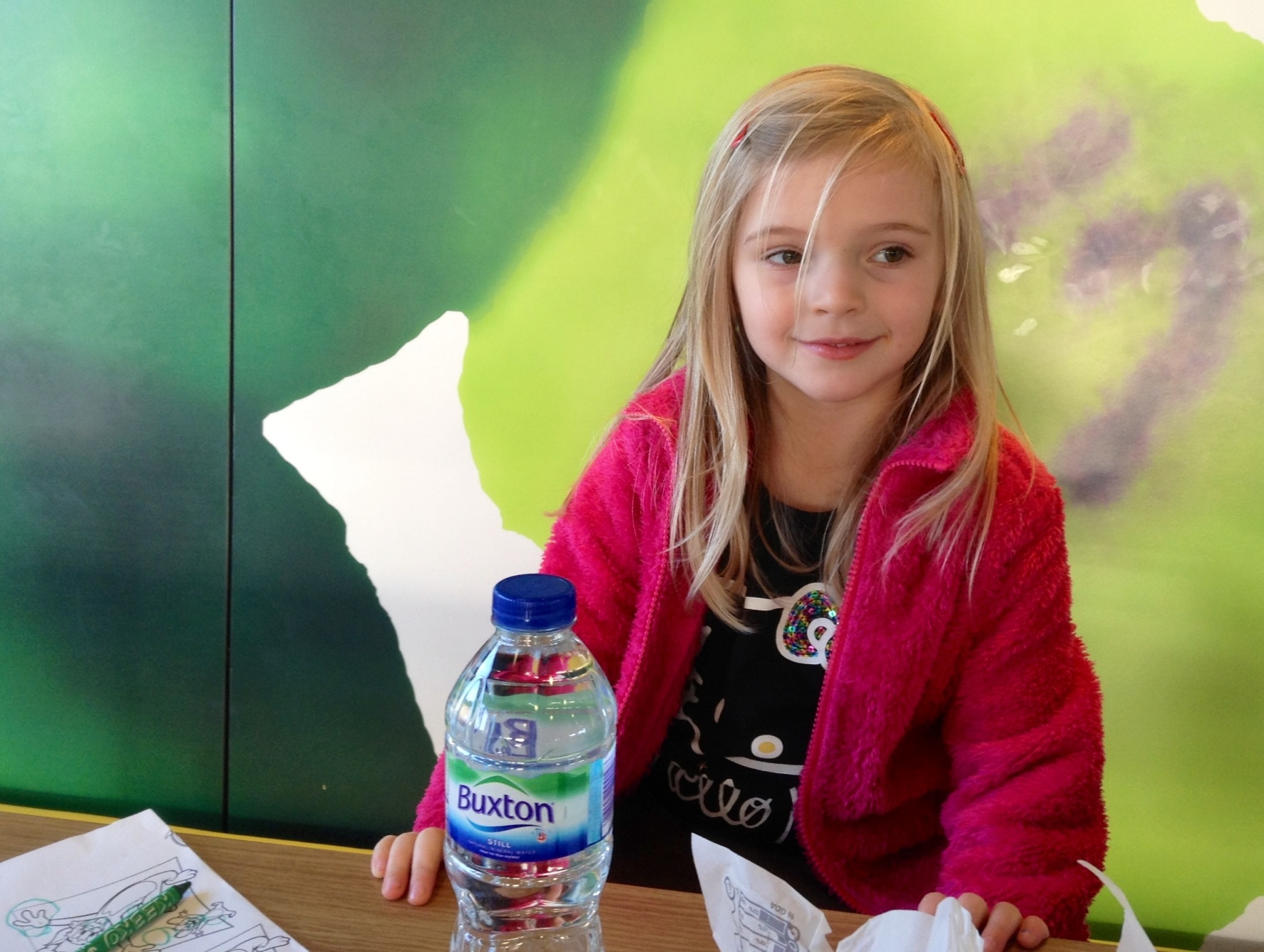
I was telling her of my new low this week, when I bribed my child to eat some fish finger in McDonalds (he refuses to eat anything but chips and beans, certainly no meat or fish) and it made me think of all the things I never thought I’d find myself saying as a parent (and that have probably secured a special ring of parenting hell just for me).

These are a few I can remember:

  • To my child in McDonalds: “Just eat one piece of fish finger and then you can have your chips”
  • Too frequently, and in the hearing of other parents: “Please just finish your chips and beans, and then you can have your cookie”
  • “Please, can you just watch TV, I’m too tired to take you outside”
  • “Yes you can watch another programme, but it’ll mean no bedtime stories”
  • “Can we watch Ben & Holly? I’m bored of Octonauts”
  • In response to a scream: “Unless you’re bleeding I’m not interested”
  • After daughter practised counting to 100, out loud, ALL DAY: “Can you stop counting now and play Candy Crush instead?”
  • To a chatterbox child: “Would you like your mimi?” (Dummy/Pacifier)
  • To an overly affectionate child: “I don’t want a cuddle right now but I’m sure Kara (the dog) does”
  • “I don’t think a third satsuma/yoghurt/fruit pot is a good idea, would you like a cookie?”
  • “I’m too tired to go to the park and it’s cold, would you like to go shopping?”
  • “Why don’t you watch TV on the iPad; we’ll do your homework tomorrow”

I’m sure there are hundreds of others, and that doesn’t include all the things I swore I’d never ever say, no matter how tired and cranky I got (shut up / go away / serves you right / FFS / don’t you dare / you’re doing my head in and so on.)

Sigh. At least I can make other people feel better about their parenting! Don’t you just love being a mum?

Sunday Ramble

Designing Party Invites

Designing Party Invites

It’s been a long, long weekend. Both my daughter’s teachers came out on Friday to say she’d been subdued during class (even though I told them when I dropped her off that she has a cold. They’re hot on attendance and so have to take the consequences!) and my son’s nursery key worker said he burst into tears fifteen minutes after I dropped him off (which isn’t like him).

We’ve all got this head cold that seems to have tiredness and grumpiness as by-products. I feel like I’ve done nothing but nag at the children and tell them off all weekend, which in turn leads to endless Mummy guilt and feelings of general despair that I’m scarring them for life with my constant snapping and snarling.

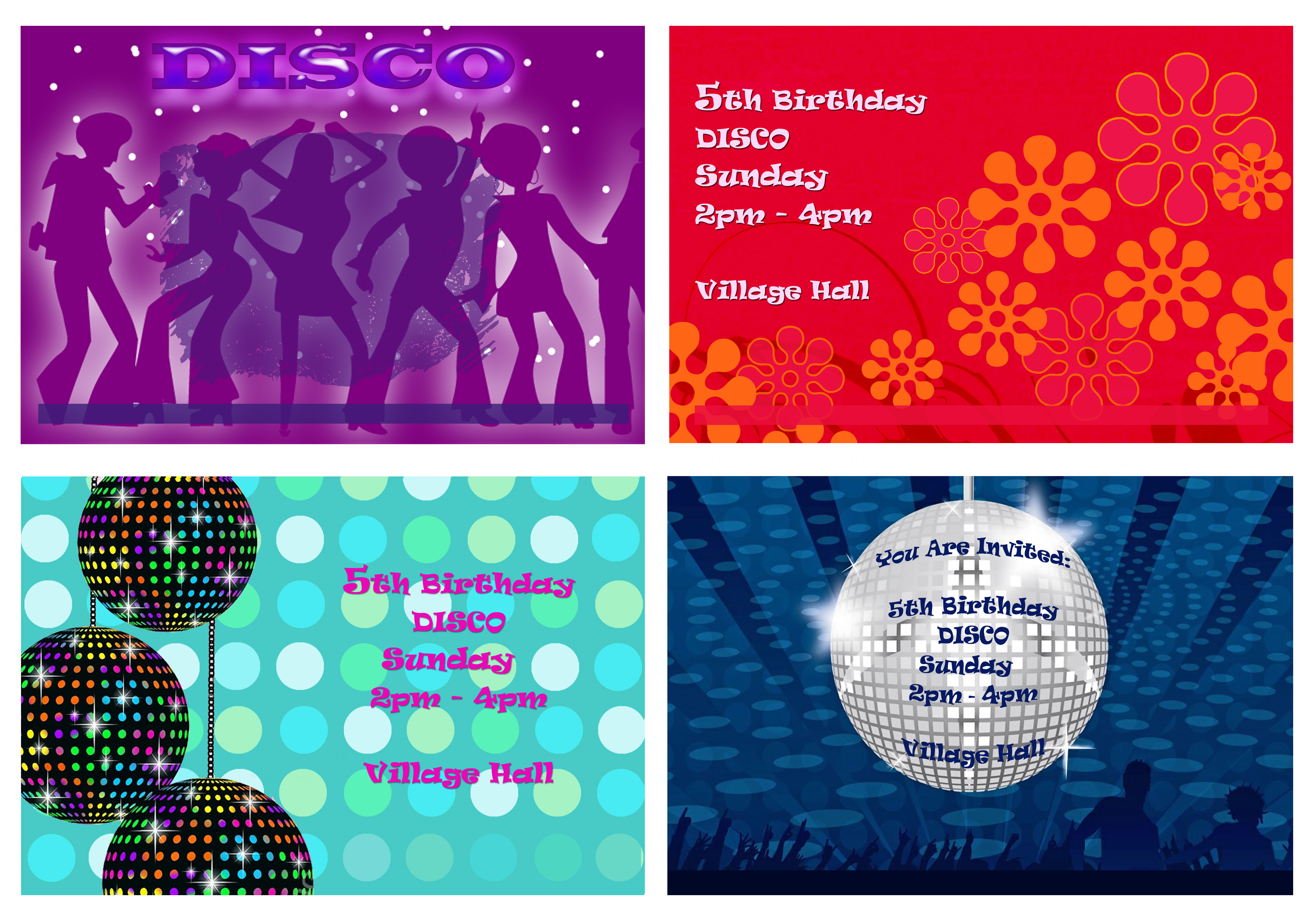
It certainly hasn’t been the weekend for trying to organise a child’s birthday party (I feel sorry for the other mum I’m planning the party with!) Still, I managed to get the invitations printed (although not written as I ran out of envelopes), the disco booked and we agreed on a village hall and booked it. Baby steps, little milestones. I have to say, I hate organising children’s parties. The child in question gets so hyped up and excited, “is it tomorrow, is it tomorrow?” and there are so many details to manage. Not to mention the idea of having 40 kids in a hall. That’s why the disco: trying to entertain eight children in our house last year showed us that we are not children’s entertainers! 🙂

My answer to everything this evening

My answer to everything this evening

I’m trying to think what else we did this weekend but it’s a bit of a blur. We went to see my father-in-law, who has just come back from a trip to New Zealand. He brought a newspaper back from the town I lived in while I was there – Dunedin – and it made me homesick. Even though I had the ups and downs of a turbulent romance during my months there, they still figure as some of the happiest moments of my life. There was a real sense of community amongst the ex-pats and I was happy to be included in it. I haven’t often felt part of a community, and it’s a lovely feeling.

Today was a bit about survival. It was too cold to contemplate going for our usual swim, and the kids ended up fending for themselves. Or fighting, mostly. The adults aren’t the only ones cranky with this cold. The children seemed to spend the day yelling, “It’s Mine!” and “I’m Telling!” until I wanted to run out into the street and scream. (The neighbours wouldn’t blink if I did – I quite often lock myself in the utility room and scream myself hoarse. Should I admit that?)

My daughter also keeps getting stabbing pains in her head, which we hope are just the headaches we’re also getting from the virus, but it does add to the general worry. I’m afraid I’m the kind of parent that will either ignore something completely or over-react and want to rush the child to A&E. Poor hubbie has to try and figure out the right response between the two.

All in all I’m glad it’s Sunday and we’re all back to school / work / nursery tomorrow. How do you survive a weekend with tired, ill, cranky kids? I’ve decided a large glass of wine is the answer…

What Sharknado Taught Me About Characters

Because of course a chainsaw is weapon of choice against a great white

Because of course a chainsaw is weapon of choice against a great white

Hubbie and I finally watched Sharknado the other night. I’d read about it on Kristen Lamb’s blog and it sounded  right up hubbie’s street: low budget B Movie with awful special effects that’s a bit tongue in cheek and doesn’t take itself too seriously.

I don’t share in his enjoyment and fully intended to go to bed. But the movie was just so darn awful I couldn’t tear myself away. Not being as used to such movies I kept saying “but what about..?” and “that wouldn’t happen..” Then realised I was talking about a movie where sharks were sucked up into a tornado and didn’t suffocate, where sharks could swim through storm drains and jump twenty feet into the air.

However it was all about different levels of suspended disbelief. I could accept all the things to do with the sharks – it was a science fiction movie after all. I could just about accept that you could blow a hurricane apart with a MacGyver home-made bomb (although I’m sure there are plenty of people living in tornado paths that wish it was true.) The bit I struggled with most, however, was character motivation.

Safe on the stairs? I don't think so!

Safe on the stairs? I don’t think so!

People are people, whether there are sharks falling from the sky or spinning round in a waterspout or not.

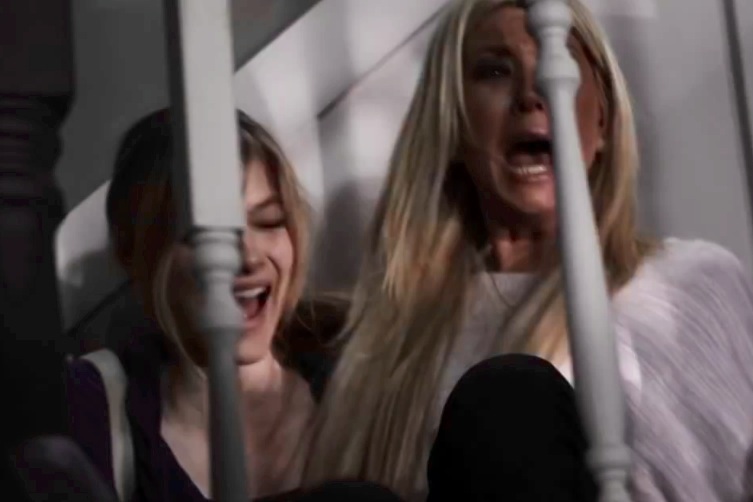
So, if a mother was sat on the stairs with her daughter watching her husband being eaten alive by a giant shark, wouldn’t she at least climb a bit higher up the stairs away from the bloody water and body parts? And if a man drove halfway across town to rescue said daughter, would he stop in the path of sharks to rescue a stranger?

Aside from the dire acting and the awful script, the actions of the characters just weren’t believable. I could accept the sharks and the bombs and all that, but I didn’t give two hoots about the characters.

What I took away from the movie (apart from a vivid nightmare about genetically altered wolves which made me wish Horror was my genre of choice) was that you can get people to believe anything if you write it with conviction, but you have to get the character motivation right. With authentic characters, who have clear goals and believable motivation, you can sell anything. Even flying sharks.

A Pantser Plans

Using Beat Sheets to plan my revisions

Using Beat Sheets to plan my revisions

The unthinkable happened today. I did planning. With beat sheets and notecards and everything. I’m a Pantser to the core: analysing a scene down to the tiny details paralyses me. Especially if I do it before I write, as I have done for the extra third of a novel I’m putting at the front of Class Act. But actually, do you know what, it wasn’t so bad.

I’m still working on some of the terminology, for example pinch points and black moments, although instinctively I have a shrewd idea what they are. I have done it before, actually, for all my seat-of-the-pants writing preference, and I’m always relieved at how much of the necessary detail I already have. Sometimes it just needs writing down to reassure myself I do know something (although a VERY VERY long way from everything) about this novel writing lark.

I had gathered much of the required information during my last craft session (the sporadic times when I read through a load of blogs and books to refresh or learn elements of writing craft.). My favourite resource is Jami Gold: as a Pantser and a romance writer, I feel she understands my pain. In fact her Beat Sheet for Romance Writers formed a large part of my morning’s work. She explains that if, like me, you can’t pkan in detail for fear of frightening off the Muse, you can use beats – points in the story – to make sure things are developing as they should.

I also used her posts based on a Michael Hauge workshop she attended to put more thought into my characters’ development, flaws and ultimate romance. The key ones I used were Are These Characters the Perfect Match and An Antidote to “Love at First Sight”. Both of these look at two elements of characterisation – a character’s Mask (the role they play, based on their longings, fears, wounds and beliefs: their emotional armour) and a character’s Essence (who they are inside, behind the masks, or who they have the potential to be). In a good romance, attraction will be based on Essence rather than Mask.

Planning Elements of a Scene

Planning Elements of a Scene

So, in Baby Blues, Helen was attracted to Daniel because his businessman forceful character Mask played to her career orientated Mask. But Marcio was her right love interest, because they both had the same essence underneath: a love of creativity and interpreting the world through their art, and a desire for home and family.

The concept really helps when a character moves from one relationship to another (as mine often do.) You don’t want the protagonist to look like an idiot because the previous relationship was flawed, and also you don’t want the previous partner to be a stereotype or a villain (although Daniel, in Baby Blues, is a bit of both!)

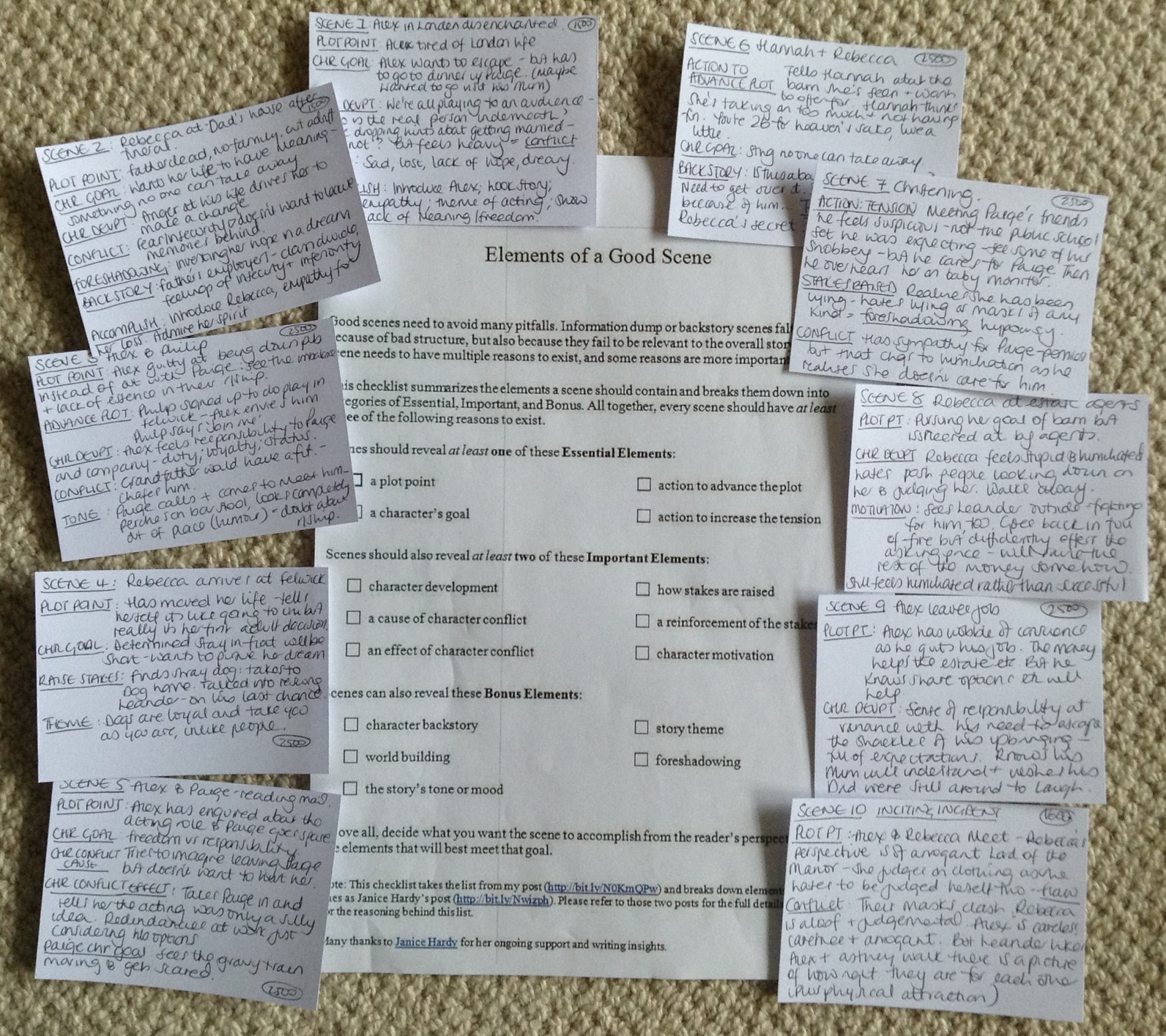
The other thing I’ve been trying to use is an Elements of a Good Scene checklist, which I also found on Jami’s Blog, the idea for which came from Janice Hardy’s blog. I feel exposed, using something like this, as I feel I don’t know the difference between “Plot point” and “action to advance the plot” or “how the stakes are raised” versus “reinforcement of the stakes”. I suspect that might be why I find it hard to write tense page turners! In my head, though, I’ve summarised it as “plot development”, “character development”, “conflict” and “backstory/theme/tone/foreshadowing”. As long as the scene has some of those that’s good. Well, it’s a start!

Of course, I was right – at the beginning when I said planning paralyses me. I need to start writing, before I spend so long on planning I’m fed up with the story or too scared to start. But it was a useful day’s work and hopefully, when I sit at my desk on Monday, I’ll be able to write some of the additional 45,000 words the story needs to get to a full length novel!

Anyway, hopefully now I have a plan this will be the last of the ‘I’ve forgotten how to do manuscript revision’ posts and I’ll get on to writing something more interesting for the non-writers who follow my blog! Thank you for your patience.

The Tricky Question of Backstory

Challenging my views of writing!

Challenging my views of writing!

Following on from yesterday’s request for advice and opinion, I need to ask about back-story. It’s the bane of my life, and Class Act is littered with it. Baby Blues & Wedding Shoes was, too, in the early drafts, and I solved the problem by starting the novel six months earlier.

That will work to some extent for Class Act, (lovely – another massive re-write! 🙂 ) but there are two incidents in the female protagonist Rebecca’s early life that impact on her current personality, and I don’t know how to integrate them. At present they’re written as flashbacks. Shudder. Unfortunately I actually like how they’re written so it’s easy to become attached to the scenes rather than put them in the bin where they should be.

The problem is I get defensive of my characters and want to explain why they have the flaws they do. But how much detail is necessary or desirable, and when should it be revealed? In The Radleys, by Matt Haig, the back story is cleverly integrated and is also overlaid with the character’s perception, so you start out with a half truth that colours your view of a character’s actions, and that view evolves and changes towards the climax of the novel. Masterful stuff. I’m pretty certain I’m not skilled enough just yet to pull it off without getting in a muddle.

The other problem is defining the novel’s inciting incident. Really, both bits of backstory are. Or the moment where the lead protagonists meet, which is where the novel currently opens. Baby Blues originally started with when the love interests meet, too, and after the rewrite that scene ended up a third of the way through the book. I like it, because you get to know the characters first, but then it blows wide open what the first turning point should be. We make decisions every day which, with hindsight, turn out to be inciting incidents. The job we take,   or the bus we catch that breaks down or gets blown up.

Incidentally, Jami Gold has a great post on the importance of getting these elements or ‘beats’ right in a novel and how defining them isn’t always straightforward! See Why Story Structure Matters. Unfortunately, even with her helpful Beat Sheets, getting the right elements into a story at the right time is (for me) the hardest part of writing.

So, right now my options are revelation through phone conversations with a friend (tricky), adding a prologue (generally advised against), or vague hints that might be missed or misunderstood. It was much easier with Claire in Two-Hundred Steps Home, as she didn’t really have a back story that mattered!

What are your views? Any great examples of how inciting incidents in childhood or early adulthood have been successfully integrated into a story? How much do you need/like to relive past experiences that have influenced a character? When do you need to know the details? Do you need to already care about a character, or do they help you care? Sometimes it feels like I’ve forgotten how to write a novel!