At one of the many many meetings I’ve had with school over the last half a dozen years, the teacher I was seeing said, “we both agree, don’t we, that the best place for a child is in school.” I was able to respond, “No, the best place for a child is in education.”
It sounds like splitting hairs, but as an English teacher he understood the importance of the distinction. He met my comment with a raised eyebrow and a wry smile. As a part of the school’s senior leadership team, he couldn’t be seen to agree that my child might get a better education away from the school building, but he couldn’t deny the truth.
The confidence and knowledge that allowed me to make that statement, to win that skirmish in a really long fight that shouldn’t be a war, came in a large part from following Clinical Psychologist Dr Naomi Fisher, and other professionals like her, on social media.
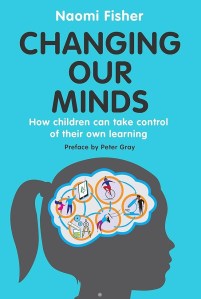
This evening I took advantage of a 99p kindle offer to get Dr Fisher’s book, which has been on my reading list for a while: “Changing Our Minds: How children can take control of their own learning”.
I don’t normally willingly read non-fiction and when I do it takes time and concentration. Not this one. I got 10% through in an hour of straight hyperfocus, even with reading on my phone.
It helps that the book mentions Sudbury Valley in the US, a democratic school where my nephew and niece go, and one that I would love to have sent my children to. But, more than that, it articulates everything I’ve come to learn about school vs education.
Schools were designed for obedience, not critical thinking. They are out dated and no longer fit for purpose, not just for SEND kids like mine, but for the future of our society.
Standardised testing, where a percentage are always going to fail due to bell curve marking, is no way to prepare children for a happy or productive life. Kids aren’t robots. And the more AI enters our world, the more we need humans to be human, in all its imaginative, creative, diverse brilliance.
I wish I could follow the advice of this book, for my SEND daughter who is currently facing Year 11 with no school willing to educate her in a way she can manage. We did try home education, as regulars will know. It was sadly too late for us, for a myriad of reasons, but the knowledge and the choice are still important. For her, as much as for me. She knows that she hasn’t failed at school, school failed her.
I have also witnessed her self-directed learning. I can see for myself how it can work, how even the small opportunity she has had to experience it has given her so much hope for the future. Still, the shortest escape route for us at this point is to get her the GCSEs she needs for college in the least painful way. Which is to fight for school to see her as more than a waste of resources.
Seriously, don’t ask. 🤐
However, for any parent who just knows their child isn’t thriving in school, who has the time and energy to embrace a different way, or even just wants to learn a new perspective to the Department of Education’s indoctrination that school attendance is essential, I encourage you to read this book.
Even reading the preface and first chapter is worth 99p.
Honestly. If I could have read this four years ago, when it was written, our lives would perhaps have been far less traumatic and my daughter wouldn’t feel utterly rejected by the very place society keeps telling her she has to be to have a successful life.
But I didn’t.
So, we’ll don armour for the next battle. And share our story so maybe others won’t have to.
 writermummy
That definitely looks like a book I should add to my list. I would have never dreamed that getting my children through school would be such an ordeal. I want them to learn to think, and so often this simply is not a goal of conventional education. I have one entering 11th grade, and another going in to 10th. Mine have gone to a.variety of schools, and every year I question whether I’m doing the right thing. So many meetings, so many decisions. It’s an exhausting place to be for a parent.
Sending hugs. It is exhausting.
I have been a classroom teacher in several UK state schools, in international schools and in a private school in the UK. I’ve also home-schooled my autistic children and known many people who home-schooled. My children have also learned under state, private and international education systems along the way.
I can tell you that home-school is BY FAR the better way to educate children – any children really, but especially those on the spectrum. Few teachers realise this but that stats really show home-schooled kids do much, much better and are certainly happier and more in love with learning than their peers. School education is the WORST way to do it but alas most parents can’t afford or don’t have the skills to educate their children at home. School education is quantity solution rather than a quality.
Thanks for this. I’ve downloaded the book. As a member of an extremely neuro-diverse family this struck a chord.